
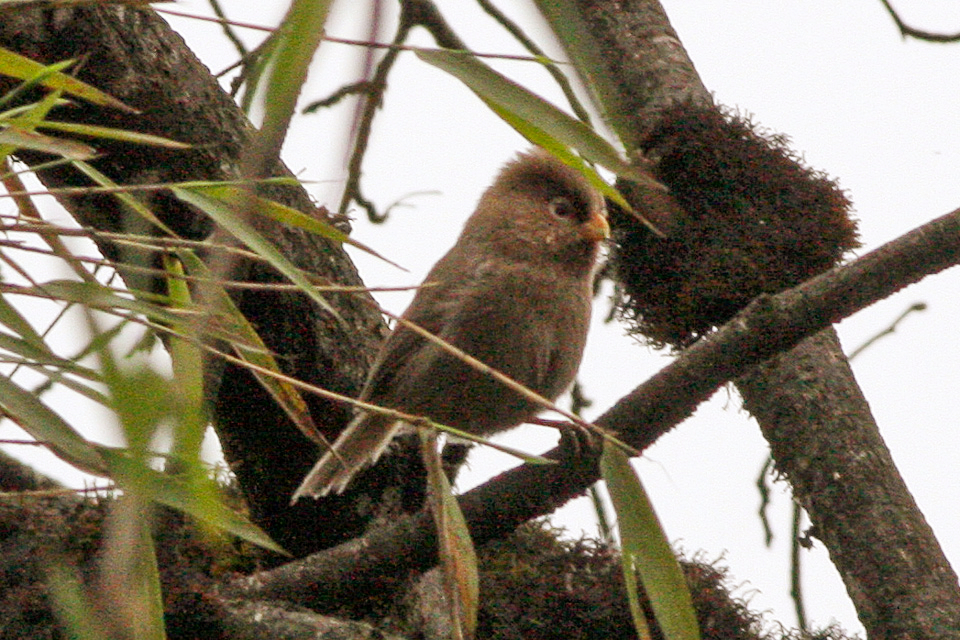
Rufous-tailed Babbler
Moupinia poecilotis
Order: Passeriformes / Family: Sylviidae

Wikimedia Commons
About the Rufous-tailed Babbler
The Rufous-tailed Babbler, scientifically known as Moupinia poecilotis, is a small, elusive songbird belonging to the family Sylviidae. This species is primarily found in the dense thickets and forest undergrowth of central and southern China, particularly in provinces such as Sichuan, Yunnan, and Guizhou. The bird's significance extends beyond its striking appearance; it plays a vital role in the ecosystem by controlling insect populations and contributing to the seed dispersal processes within its habitat. The Rufous-tailed Babbler thrives in subtropical and temperate forest environments, where its adaptability allows it to exploit various ecological niches. One of the most fascinating aspects of the Rufous-tailed Babbler is its seasonal behavior patterns. During the breeding season, which occurs from April to August, these birds become more vocal and territorial, often seen in pairs or small family groups. Outside the breeding season, they exhibit a more gregarious nature, forming loose flocks with other babblers. This seasonal shift in behavior not only enhances their survival during the winter months but also facilitates the sharing of information about food sources and predator threats. The ecological role of the Rufous-tailed Babbler cannot be overstated. As an insectivore, it helps regulate the populations of various insect species, thereby maintaining a balanced ecosystem. Its preference for dense, tangled vegetation allows it to efficiently forage for insects while also contributing to the aeration and turnover of leaf litter, which is critical for soil health. Furthermore, the Rufous-tailed Babbler's role in seed dispersal is facilitated by its consumption of small fruits, making it an integral part of forest regeneration processes. The Rufous-tailed Babbler's presence in these ecosystems underscores the importance of conserving its habitat, as these regions face increasing threats from deforestation and habitat fragmentation.
The Rufous-tailed Babbler belongs to the family Sylviidae, within the order Passeriformes. These birds typically live average 4 years, max recorded 6 years.
How to Identify a Rufous-tailed Babbler
The Rufous-tailed Babbler is easily identified by its medium size, measuring approximately 14 cm in length. Its most distinctive feature is the vivid rufous coloration of its tail, which contrasts sharply with its otherwise olive-brown plumage. The bird's underparts are a paler brown, providing subtle camouflage in the forest undergrowth. Adult Rufous-tailed Babblers exhibit a uniform plumage, while juveniles can be distinguished by their slightly duller coloration and less pronounced rufous tail features. Both male and female Rufous-tailed Babblers share similar plumage characteristics, making visual sex differentiation challenging in the field. However, males may exhibit slightly more vibrant coloration during the breeding season, a trait linked to mating displays. In terms of flight, the Rufous-tailed Babbler presents a rounded silhouette with a distinctive tail shape that aids in identification. When perched, the bird often holds its tail slightly cocked, a posture that highlights the rich rufous hue. Confusion with similar species, such as the Fulvetta, can occur due to overlapping habitats, but the Rufous-tailed Babbler's unique tail coloration and size differences serve as reliable distinguishing features.
Having trouble telling birds apart? Upload a photo to our bird identification tool for an instant species match.
Rufous-tailed Babbler Habitat and Range
Preferred Habitat
The Rufous-tailed Babbler primarily inhabits dense thickets and forest undergrowth in subtropical and temperate regions. It thrives in elevations ranging from 500 to 3000 meters, with a preference for areas that offer abundant cover and food resources. These birds are most commonly found in the mountainous regions of central and southern China, such as the Hengduan Mountains and the eastern Himalayas. While typically associated with forest environments, the Rufous-tailed Babbler can occasionally be observed in secondary growth and scrubby areas, especially during the non-breeding season when it expands its foraging range. Unlike some of its relatives, the Rufous-tailed Babbler tends to avoid urban environments, preferring the tranquility and cover provided by rural and semi-natural landscapes. Seasonal habitat shifts are minimal, as the bird's year-round presence in its core range reflects its adaptability to local climatic conditions.
Geographic Range
The Rufous-tailed Babbler is predominantly found in the central and southern regions of China, with its range encompassing provinces such as Sichuan, Yunnan, Guizhou, and Guangxi. It is a resident species, meaning it does not undertake long-distance migrations. Instead, the bird exhibits local movements driven by food availability and breeding needs. Within its range, the Rufous-tailed Babbler is most abundant in the forested landscapes of the Hengduan Mountains and adjacent areas. While its distribution is relatively limited to these regions, the bird is locally common in suitable habitats. Population density hotspots are primarily located in areas where dense undergrowth and thicket habitats are well-preserved. Despite its restricted range, the Rufous-tailed Babbler's adaptability to various forest types has allowed it to maintain stable populations within its preferred geographic confines.
Want to know which birds visit your area? Browse our backyard birds by location guides for region-specific species lists.
What Does the Rufous-tailed Babbler Eat?
The diet of the Rufous-tailed Babbler consists primarily of insects and other small invertebrates, which it expertly forages for within the dense undergrowth of its forest habitat. Its feeding technique involves a combination of gleaning and probing, using its sharp bill to extract prey from leaf litter and vegetation. Common prey items include beetles, caterpillars, and spiders, with a preference for soft-bodied insects that provide essential nutrients. Seasonal variations in diet are evident as the bird adjusts its feeding habits according to prey availability. During the spring and summer months, the Rufous-tailed Babbler may supplement its diet with small fruits and berries, contributing to its role in seed dispersal. The bird typically forages alone or in pairs during the breeding season, but can join mixed-species flocks in the non-breeding season to exploit richer food sources. Feeding activity peaks during the early morning and late afternoon, when cooler temperatures and reduced predation risk provide optimal foraging conditions.
Rufous-tailed Babbler Behavior and Social Structure
The Rufous-tailed Babbler exhibits a complex social structure that varies seasonally. During the breeding season, these birds are territorial, with pairs establishing and defending territories against intruders. Courtship displays often involve vocalizations and tail fanning, showcasing the bird's distinctive rufous tail. Once the breeding season concludes, the Rufous-tailed Babbler adopts a more sociable demeanor, joining small flocks that can include other babbler species. These flocks facilitate cooperative foraging and enhance predator detection. The Rufous-tailed Babbler responds to predators with a combination of alarm calls and evasive maneuvers, taking advantage of its agility to navigate dense vegetation quickly. Daily activity patterns are characterized by bursts of activity interspersed with periods of rest, particularly during the hottest parts of the day. This behavior reflects the bird's adaptability to its environment and its capacity for energy conservation.
Rufous-tailed Babbler Nesting and Reproduction
The nesting habits of the Rufous-tailed Babbler involve constructing a dome-shaped nest made primarily of twigs, leaves, and grasses, often lined with softer materials such as feathers or moss. These nests are typically situated close to the ground in dense shrubbery or thickets, providing both camouflage and protection from predators. The typical clutch size ranges from 2 to 4 eggs, with both parents sharing incubation duties over a period of approximately 13 to 15 days. After hatching, the fledglings remain in the nest for about 12 to 14 days before venturing out. Parental care continues post-fledging, with both parents involved in feeding and protecting the young. The Rufous-tailed Babbler generally produces one to two broods per year, depending on environmental conditions and food availability. This reproductive strategy ensures the continuation of their population in suitable habitats.
Rufous-tailed Babbler Sounds and Vocalizations
The Rufous-tailed Babbler's primary song is a melodic series of chirps and whistles, with a rhythm that is both lively and variable. The pitch tends to be high and clear, often echoing through the dense undergrowth where the bird resides. Call notes are softer and include a variety of trills and chatters used for communication between mates and within flocks. Alarm calls are sharper and more insistent, serving as a warning to other birds about potential threats. During the dawn chorus, the Rufous-tailed Babbler's song contributes to the vibrant soundscape of its forest habitat, competing with the calls of other forest-dwelling species.
Interesting Facts About the Rufous-tailed Babbler
- 1The Rufous-tailed Babbler is capable of mimicking the calls of other bird species, a skill that aids in social interactions.
- 2Despite its small size, the Rufous-tailed Babbler can produce a surprisingly loud and complex song that echoes through the forest.
- 3This bird is a highly effective insectivore, consuming up to 80% of its body weight in insects per day.
- 4Rufous-tailed Babblers are known to join mixed-species flocks, which enhances their foraging efficiency and predator awareness.
- 5The Rufous-tailed Babbler uses its tail for balance and communication, especially during courtship displays.
- 6These birds exhibit a strong territorial instinct, often engaging in vocal duels with rivals to defend their breeding areas.
- 7The dense, tangled vegetation of its habitat provides the Rufous-tailed Babbler with both food and protection from predators.
Rufous-tailed Babbler Conservation Status
The Rufous-tailed Babbler is currently listed as Least Concern by the IUCN, with its population considered stable across its range. However, ongoing habitat loss due to deforestation and agricultural expansion poses a potential threat to its continued well-being. Local conservation efforts in China focus on preserving forest habitats and promoting sustainable land use practices. Historically, the Rufous-tailed Babbler's populations have remained relatively stable due to its adaptability to different forest types. Continued monitoring and habitat protection are essential to ensure that this species does not face more severe threats in the future.
Other Sylviidae Species



Birds Similar to the Rufous-tailed Babbler
These species are often confused with the Rufous-tailed Babbler due to similar appearance or overlapping range.
