Spiny Babbler
Turdoides nipalensis
Order: Passeriformes / Family: Leiothrichidae

Wikimedia Commons
About the Spiny Babbler
The Spiny Babbler, Turdoides nipalensis, holds the unique distinction of being the only bird species endemic to Nepal, a country renowned for its rich biodiversity and dramatic landscapes. This medium-sized bird, belonging to the Leiothrichidae family, inhabits the lush subtropical and temperate forests of the mid-hills of Nepal. The Spiny Babbler’s presence in the forests around the Kathmandu Valley, as well as in Chitwan and Pokhara, highlights its adaptability to various woodland environments. These birds contribute significantly to the ecological balance within their habitats by participating in seed dispersion and insect population control. With their gregarious nature, Spiny Babblers often forage in groups, moving through the underbrush and low trees in search of food. Their social structure and communal behavior play a crucial role in the ecosystem, as they help maintain the health of their forested habitats by controlling insect populations and assisting in seed dispersal. The Spiny Babbler's role as an insectivore means it helps regulate the numbers of various insect species, including pests, thereby contributing to the health of the forest. These birds also engage in complex vocalizations, which include a mix of melodious songs and harsh calls that echo through the forest, serving both as a means of communication and as a territorial signal. During the breeding season, which typically runs from April to July, the Spiny Babbler becomes even more vocal and active. The males perform a series of displays and songs to attract mates and establish their territory. This period is critical for the species, as they build nests and raise their young in the dense foliage that provides both food and protection. In essence, the Spiny Babbler is a vital component of its ecosystem, showcasing the interconnectedness of species within the complex web of life in Nepal's forests.
The Spiny Babbler belongs to the family Leiothrichidae, within the order Passeriformes. These birds typically live typically around 5-7 years in the wild..
How to Identify a Spiny Babbler
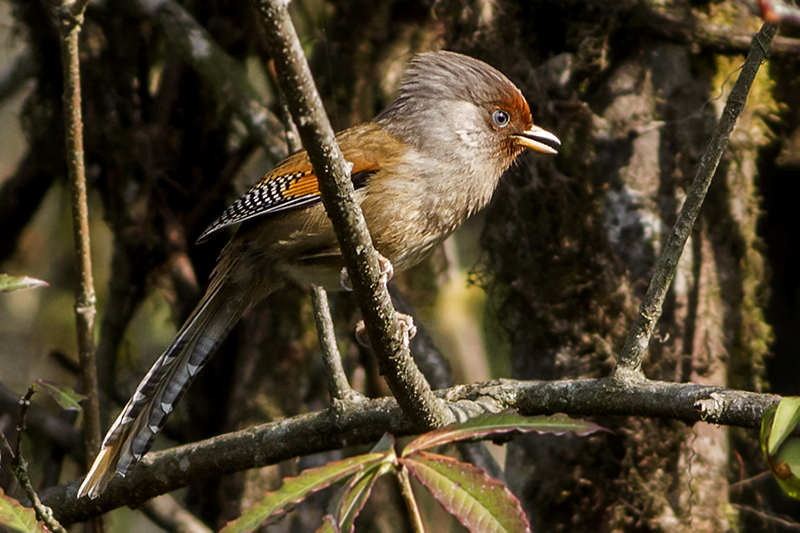
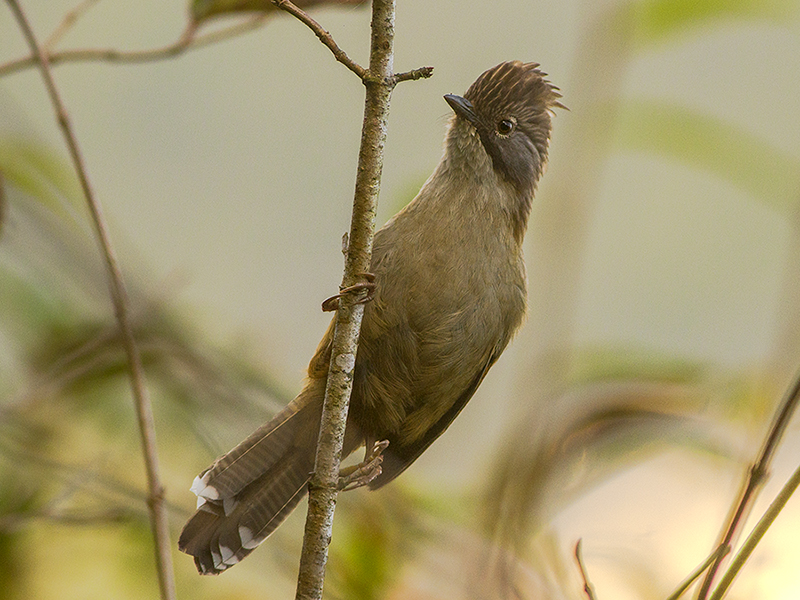
The Spiny Babbler is characterized by its distinctive spiny plumage, which gives it a somewhat scruffy appearance. Adult Spiny Babblers have a predominantly brown body with hints of gray on the head and throat, and lighter underparts. Their plumage is notable for the stiff, spiny feathers that appear to stand on end, particularly on the upperparts, giving the bird its common name. Juveniles resemble adults but tend to have a slightly duller coloration. Males and females are similar in appearance, making it difficult to distinguish between the sexes in the field. However, males may appear slightly larger during the breeding season due to their more active display behaviors. In terms of silhouette, the Spiny Babbler exhibits a typical babbler profile with a long tail and a somewhat chunky body. Its perching posture is often horizontal, with a slight tilt of the head as it actively scans its surroundings. While there are other babbler species in the region, the Spiny Babbler's unique plumage and endemic status make it relatively easy to identify once its distinctive features are known.
Having trouble telling birds apart? Upload a photo to our bird identification tool for an instant species match.
Spiny Babbler Habitat and Range
Preferred Habitat
The Spiny Babbler thrives in the subtropical and temperate forests of Nepal, favoring areas that provide dense underbrush and ample tree cover. It is commonly found in forested regions around the Kathmandu Valley, as well as in the mid-hill regions such as Chitwan and Pokhara. While it is primarily a forest-dwelling species, the Spiny Babbler can occasionally be spotted in scrublands and secondary growth areas, particularly where human activity has led to forest fragmentation. The bird typically resides at elevations ranging from 500 to 2,500 meters, although it may move to lower elevations during the winter months in search of food. Despite occasional sightings near rural settlements, the Spiny Babbler generally avoids urban areas, preferring the secluded and thickly vegetated habitats that provide safety and food resources.
Geographic Range
The Spiny Babbler is endemic to Nepal, meaning it is found nowhere else in the world. Its range is confined to the central and eastern regions of the country, where it inhabits the mid-hill forests. The Kathmandu Valley, Chitwan, and Pokhara are notable areas where the Spiny Babbler is commonly observed. Unlike many other bird species, the Spiny Babbler does not undertake long migrations. Instead, it exhibits some altitudinal movement, shifting to lower elevations during the colder months. This movement allows it to access food resources that may be scarce at higher elevations during winter. Within its range, the Spiny Babbler’s population density tends to be higher in areas that offer abundant undergrowth and minimal human disturbance. However, habitat fragmentation and deforestation in some regions pose challenges to maintaining stable population densities.
Want to know which birds visit your area? Browse our backyard birds by location guides for region-specific species lists.
What Does the Spiny Babbler Eat?
The Spiny Babbler primarily feeds on insects and other small invertebrates, playing a crucial role in controlling pest populations within its habitat. Its diet includes beetles, ants, caterpillars, and spiders, which it gleans from leaves, branches, and the forest floor. During the breeding season, the demand for food increases as adults need to feed their growing young. This leads to more intensive foraging and occasional dietary shifts to include more plant material such as seeds and berries. The Spiny Babbler employs a foraging technique characterized by active searching and probing within leaf litter and vegetation. It often hunts in small groups, which allows it to cover larger areas and increases its chances of locating prey. The bird’s feeding schedule is mostly diurnal, with peak activity occurring in the early morning and late afternoon when insect activity is also high.
Spiny Babbler Behavior and Social Structure
The Spiny Babbler exhibits a highly social and cooperative behavior, often seen in small groups as it forages through the underbrush. This social structure aids in predator detection and increases foraging efficiency. During the breeding season, males engage in song displays and aggressive territorial behavior to attract mates and deter rivals. Courtship involves a series of vocalizations and physical displays, with both sexes participating in nest building and chick rearing. The Spiny Babbler is generally non-migratory but may move locally in response to seasonal food availability. Its response to predators includes loud alarm calls and a tendency to dive into dense cover. Daily activity patterns show peak feeding times in the early morning and late afternoon, with periods of rest during the hottest parts of the day.
Spiny Babbler Nesting and Reproduction
The Spiny Babbler constructs its nest in dense shrubbery or low trees, using twigs, leaves, and other plant materials to form a cup-shaped structure. Nest location is typically chosen for its concealment and proximity to food sources, providing safety for the eggs and chicks. The clutch usually consists of 2-4 eggs, with an incubation period lasting roughly 12-14 days. Both parents share incubation duties and later participate in feeding and caring for the chicks. Fledging occurs about 14-16 days after hatching, although the young remain dependent on the parents for several weeks post-fledging. The Spiny Babbler typically raises one or two broods per year, depending on environmental conditions and food availability.
Spiny Babbler Sounds and Vocalizations
The Spiny Babbler’s vocalizations are a distinctive feature of its behavior, comprising a variety of songs and calls. Its primary song is a melodious series of whistles and trills, delivered with a rhythmic pattern that rises and falls in pitch. These songs are often heard at dawn, as males proclaim their territory and attract mates. Aside from its song, the Spiny Babbler produces harsh alarm calls when disturbed or threatened, which serve to alert other group members to potential danger. Compared to other babblers, its calls are relatively loud and carry well through forested areas, making the Spiny Babbler a conspicuous auditory presence in its habitat.
Interesting Facts About the Spiny Babbler
- 1The Spiny Babbler is the only bird species endemic to Nepal, making it a unique symbol of the country's natural heritage.
- 2Despite its limited range, the Spiny Babbler has adapted well to various forest types, from subtropical to temperate zones.
- 3The name 'Spiny Babbler' comes from the stiff, spiny feathers on its back, which are unique among babblers.
- 4The Spiny Babbler's song is a complex combination of whistles and trills, often heard during the breeding season.
- 5Although primarily insectivorous, the Spiny Babbler's diet may include seeds and berries, especially during food shortages.
- 6The Spiny Babbler’s social structure includes living and foraging in small groups, which aids in predator detection.
- 7Its presence is often detected by its distinctive vocalizations before the bird itself is seen, due to its secretive nature.
Spiny Babbler Conservation Status
The Spiny Babbler currently holds a status of Least Concern on the IUCN Red List due to its stable population and restricted range limited to Nepal. However, the species faces threats from habitat loss due to deforestation, agricultural expansion, and human encroachment. Conservation efforts in Nepal, such as the establishment of protected areas and community forest initiatives, help mitigate these threats by preserving critical habitats. While historical population changes are not well-documented, continued monitoring is essential to ensure the Spiny Babbler remains a thriving component of Nepal’s avian diversity.