
Striated Antbird
Drymophila devillei
Order: Passeriformes / Family: Thamnophilidae

Wikimedia Commons
About the Striated Antbird
The Striated Antbird (Drymophila devillei) is a captivating species within the Thamnophilidae family, primarily inhabiting the subtropical and tropical forests of South America. This bird is known for its remarkable adaptation to the dense undergrowth, where it plays a crucial ecological role as an insect predator. The Striated Antbird is particularly significant for its contribution to pest control, maintaining a balance within its ecosystem by feeding on a variety of invertebrates. Found across regions such as the Amazon Basin, it thrives in countries like Brazil, Peru, and Bolivia. In these dense forests, the Striated Antbird is an integral part of the avian community, often observed foraging in pairs or small groups. Seasonal behaviors of the Striated Antbird include slight altitudinal migrations within its range, moving to different elevations depending on food availability. During the breeding season, these birds become more vocal, asserting their presence with loud calls. The species is also known to participate in mixed-species flocks, which enhances its foraging efficiency by reducing predation risks. The Striated Antbird's ecological role extends beyond pest control. It also aids in seed dispersion through its insectivorous diet, indirectly supporting plant reproduction. Despite its elusive nature, the Striated Antbird serves as an important bioindicator for forest health, with its presence often signifying a well-balanced ecosystem. As forests face increasing threats from deforestation and habitat fragmentation, the conservation of species like the Striated Antbird is essential for maintaining biodiversity and ecosystem function.
The Striated Antbird belongs to the family Thamnophilidae, within the order Passeriformes. These birds typically live average 5 years with a maximum recorded of 8 years..
How to Identify a Striated Antbird
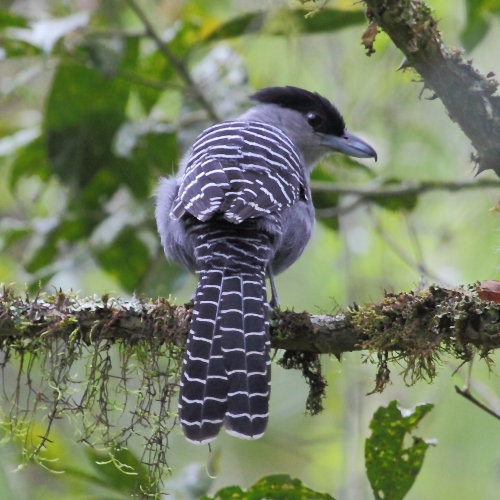
Identifying the Striated Antbird involves noting its distinct plumage and behavior. Adults exhibit a striking pattern of black and white streaks across their plumage, with the underparts being predominantly white. The back and wings show a combination of brown and black, providing excellent camouflage in the forest understory. Males and females are similar in appearance, though females may exhibit slightly duller tones. Juvenile Striated Antbirds typically have a more muted coloration, lacking the pronounced streaking seen in adults, which gradually develops as they mature. When comparing to similar species, the Striated Antbird can be distinguished by its consistent streaked pattern and smaller size. In flight, it displays a rapid, fluttering movement often close to the ground, which is characteristic of many antbird species. Perching posture is typically upright, with the birds often seen clinging to vertical branches or vines. The Striated Antbird's unique field marks make it a distinctive member of the antbird family, aiding ornithologists and birdwatchers in its identification.
Having trouble telling birds apart? Upload a photo to our bird identification tool for an instant species match.
Striated Antbird Habitat and Range
Preferred Habitat
The Striated Antbird predominantly inhabits dense, humid forests, particularly favoring subtropical and tropical lowland rainforests. It thrives in areas with abundant undergrowth, such as the Amazon Basin, where the forest structure provides ample cover and foraging opportunities. The species is typically found at elevations up to 1,200 meters, though it may occasionally venture higher in search of food or during certain seasons. Seasonal habitat shifts are generally minor, involving movements within its altitudinal range rather than long-distance migrations. Unlike some forest-dwelling birds, the Striated Antbird is rarely found in urban environments, preferring the secluded and complex layers of primary and secondary forests. Its reliance on dense vegetation underscores the importance of forest conservation for its continued survival.
Geographic Range
The Striated Antbird's range is concentrated in the northern and central parts of South America. It is predominantly found in the Amazon Basin, extending into parts of Brazil, Peru, and Bolivia. This bird's breeding range aligns closely with its overall distribution, as it remains in the same regions year-round. Unlike many migratory species, the Striated Antbird does not engage in extensive migrations, instead exhibiting localized movements following the availability of food resources. Population density hotspots are primarily within the dense, humid forests of the Amazon, where the species is more commonly observed. This bird's presence in a particular area often indicates a healthy forest ecosystem, as it requires specific habitat conditions to thrive.
Want to know which birds visit your area? Browse our backyard birds by location guides for region-specific species lists.
What Does the Striated Antbird Eat?
The diet of the Striated Antbird consists primarily of insects and other small invertebrates. It shows a marked preference for ants, beetles, and spiders, which it gleans from foliage and the forest floor. Seasonal changes in diet are minimal, as this bird's primary food sources remain relatively consistent throughout the year. Foraging techniques include gleaning and sallying, where the bird actively searches leaves and branches for prey. The Striated Antbird is adept at capturing small prey, usually less than 1 cm in size, using its sharp bill. Feeding typically occurs during the early morning and late afternoon, coinciding with peak insect activity. This bird's role as an insectivore highlights its importance in controlling insect populations within its habitat.
Striated Antbird Behavior and Social Structure
Striated Antbirds exhibit a variety of intriguing behaviors that make them a fascinating subject for study. Socially, these birds often form pairs or small family groups, with a strong emphasis on monogamous pair bonds. Territorial behavior includes vocal displays and occasional physical confrontations to defend feeding territories. During courtship, males perform elaborate displays, showcasing their plumage and vocal abilities to attract females. Flocking patterns include participation in mixed-species foraging flocks, which increases food acquisition efficiency and reduces the risk of predation. In response to predators, the Striated Antbird relies on its cryptic coloration and agility to escape detection. Daily activity patterns involve periods of intense foraging followed by rest, with peak activity occurring during cooler parts of the day. The Striated Antbird's behaviors reflect its adaptation to a dynamic and competitive forest environment.
Striated Antbird Nesting and Reproduction
The nesting habits of the Striated Antbird are adapted to its forest habitat. Nests are typically built low to the ground, often in dense underbrush or small saplings, providing concealment from predators. Nest construction involves the use of leaves, twigs, and other plant materials, forming a cup-shaped structure that is both secure and camouflaged. Clutch size generally consists of two to three eggs, which are incubated by both parents over a period of approximately 14 to 16 days. After hatching, the chicks remain in the nest for around 12 to 14 days before fledging. Parental roles are shared, with both male and female contributing to feeding and protection of the young. The Striated Antbird typically raises one to two broods per year, depending on food availability and environmental conditions. This reproductive strategy ensures the survival of offspring in a challenging forest ecosystem.
Striated Antbird Sounds and Vocalizations
The Striated Antbird's vocal repertoire is varied and serves multiple purposes. Its primary song consists of a series of clear, melodious whistles that rise and fall in pitch, often used to establish territory and attract mates. Call notes are sharp and staccato, functioning as communication between pair members or signaling alarm. When disturbed, Striated Antbirds emit a rapid chattering sound that serves as an alarm call to alert others. During the dawn chorus, these birds contribute to the symphony of forest sounds, with their distinctive whistles standing out among other avian calls. The Striated Antbird's vocalizations play a crucial role in its social interactions and territorial maintenance.
Interesting Facts About the Striated Antbird
- 1The Striated Antbird is known for its ability to follow army ant swarms, capturing insects that flee from the ants.
- 2Despite its name, the Striated Antbird does not eat ants but rather targets other insects disturbed by them.
- 3This species is often found in mixed-species flocks, benefiting from the presence of other birds to reduce predation risk.
- 4The Striated Antbird's streaked plumage provides excellent camouflage, helping it blend into the undergrowth.
- 5Unlike many birds, the Striated Antbird remains largely sedentary, with only minor local movements in search of food.
- 6The bird's song can travel over long distances in the dense forest, which aids in territory establishment.
- 7Striated Antbirds are important indicators of forest health, as they require specific habitat conditions to thrive.
Striated Antbird Conservation Status
The Striated Antbird is currently classified as Least Concern by the IUCN, with a stable population trend. However, it faces significant threats from habitat destruction due to deforestation and land conversion for agriculture. These activities reduce the extent and quality of the forest habitat necessary for the species' survival. Conservation efforts focus on preserving large tracts of intact forest and promoting sustainable land-use practices. Historically, the Striated Antbird's population has remained relatively stable, but ongoing habitat loss poses a potential risk. Protecting the forest ecosystems that this species depends on is essential for its continued existence and the overall health of the region's biodiversity.
Other Thamnophilidae Species



Birds Similar to the Striated Antbird
These species are often confused with the Striated Antbird due to similar appearance or overlapping range.

