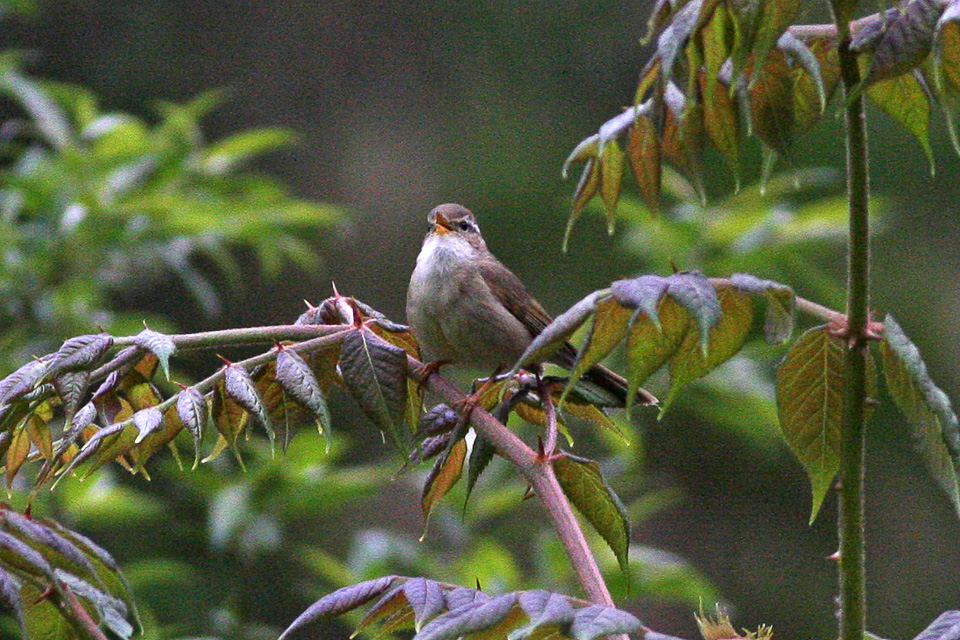
Sunda Warbler
Seicercus grammiceps
Order: Passeriformes / Family: Phylloscopidae

Wikimedia Commons
About the Sunda Warbler
The Sunda Warbler, scientifically known as Seicercus grammiceps, is a small passerine bird belonging to the family Phylloscopidae. It inhabits the tropical regions of Southeast Asia, with a particular affinity for the lush forests of Borneo, Sumatra, and Java. This warbler plays a crucial role in its ecosystem as an insectivore, helping to control insect populations. Its presence in dense forest canopies contributes to the rich biodiversity of these regions, where it is often observed foraging tirelessly. During the breeding season, which typically occurs from March to June, the Sunda Warbler displays increased vocal activity, filling the forest with its melodious song. Outside the breeding season, its behavior becomes more subdued, though it remains an active forager throughout the year. The significance of the Sunda Warbler extends beyond its ecological role; it is a vital indicator of the health of its forest habitats. Changes in its population can signal shifts in the ecosystem, making it an important species for conservationists monitoring the impact of deforestation and habitat loss in Southeast Asia. The warbler's adaptability to different altitudinal ranges, from lowland forests to montane regions, demonstrates its ecological versatility. While preferring primary forests, it can also be found in secondary growth areas, though these populations are often less stable. This adaptability, however, is not limitless, as the species still faces threats from extensive logging and land conversion. Despite these challenges, the Sunda Warbler remains a resilient species, continuing to thrive in many parts of its range. Observations of the Sunda Warbler provide valuable insights into the complex interactions within tropical forest ecosystems. As forest degradation continues, understanding the dynamics of species like the Sunda Warbler becomes increasingly important for developing effective conservation strategies.
The Sunda Warbler belongs to the family Phylloscopidae, within the order Passeriformes. These birds typically live average 3-5 years with a maximum recorded of 7 years..
How to Identify a Sunda Warbler
The Sunda Warbler is a small bird, measuring about 10 to 12 centimeters in length. Its plumage is characterized by olive-green upperparts and bright yellow underparts, a combination that provides excellent camouflage among the forest foliage. The crown is typically grayish, and a distinct white eye-ring encircles its dark eye, giving it a striking appearance. Males and females exhibit similar plumage, making sex identification in the field challenging. Juveniles resemble adults but have a slightly duller yellow on the underparts. In flight, the Sunda Warbler displays a rapid, fluttering wingbeat that is typical of many small warblers. Its perching posture is upright, often observed clinging to branches as it actively forages for insects. The Sunda Warbler can be confused with the mountain warbler, although the latter tends to inhabit higher elevations and has a different song pattern. Careful observation of plumage details and vocalizations is essential to correctly identify the Sunda Warbler in the field.
Having trouble telling birds apart? Upload a photo to our bird identification tool for an instant species match.
Sunda Warbler Habitat and Range
Preferred Habitat
The Sunda Warbler thrives in tropical and subtropical forests, favoring dense, humid environments with abundant foliage. It is commonly found at elevations ranging from sea level up to 2,000 meters, though it prefers primary and mature secondary forests. In lowland areas, it inhabits dipterocarp forests, while in montane regions, it is associated with mossy forests. During non-breeding seasons, the Sunda Warbler may venture into slightly disturbed habitats, but it remains predominantly within forested areas. Unlike some other warblers, it is rarely found in urban environments, preferring the seclusion of forested habitats.
Geographic Range
The Sunda Warbler's range is confined to the Sunda Islands in Southeast Asia, including Borneo, Sumatra, and Java. It is a resident species, meaning it does not undertake long-distance migrations, though it exhibits some altitudinal movements depending on the season. During the breeding season, it is most commonly found in mid to upper elevation forests, while in the non-breeding season, it may descend to lower elevations. The population density of the Sunda Warbler is highest in regions with minimal human disturbance, where primary forest habitat is intact. Its presence is sparse in heavily logged or converted areas.
Want to know which birds visit your area? Browse our backyard birds by location guides for region-specific species lists.
What Does the Sunda Warbler Eat?
The Sunda Warbler primarily feeds on insects, with a diet composed largely of caterpillars, beetles, and other small arthropods. It forages actively among the foliage, often seen gleaning insects from leaves and branches. Its foraging technique involves quick, darting movements, and it occasionally hovers to snatch prey from the undersides of leaves. During the breeding season, its diet may expand to include spiders, which provide additional nutrients for the growing young. The warbler's feeding activity peaks during the early morning and late afternoon, aligning with periods of increased insect activity.
Sunda Warbler Behavior and Social Structure
The Sunda Warbler exhibits a solitary or paired social structure, especially during the breeding season. It is territorial, with males establishing and defending territories through song. Courtship displays involve males singing persistently to attract females, often accompanied by wing-fluttering and tail-spreading. Outside the breeding season, the Sunda Warbler may form loose mixed-species flocks, foraging alongside other insectivorous birds. Its response to predators involves a series of alarm calls and evasive maneuvers, taking advantage of its small size and agility. The warbler is diurnal, with peak activity during the early morning and late afternoon.
Sunda Warbler Nesting and Reproduction
Sunda Warblers construct cup-shaped nests, typically placed in the fork of a branch or hidden among dense foliage. Nests are constructed from fine plant materials, such as grasses and leaves, bound together with spider silk. The typical clutch size ranges from two to four eggs. Both parents participate in incubation, which lasts approximately 12 to 14 days. After hatching, the chicks are altricial, requiring significant parental care. Fledging occurs about two weeks post-hatching, with the young remaining dependent on parents for several additional weeks. The Sunda Warbler may produce one to two broods per year, depending on environmental conditions.
Sunda Warbler Sounds and Vocalizations
The primary song of the Sunda Warbler is a melodious sequence of high-pitched notes, often described as a rapid 'tit-ti-tit-tit.' These notes have a clear, flute-like quality, making the song easy to recognize in the forest. The warbler also produces soft call notes and harsher alarm calls when threatened. During the dawn chorus, its song is among the first to be heard, contributing to the rich acoustic tapestry of the tropical forest. The song serves both as a territorial marker and a courtship display.
Interesting Facts About the Sunda Warbler
- 1The Sunda Warbler can be found at elevations up to 2,000 meters, making it adaptable to diverse forest environments.
- 2Despite its small size, the Sunda Warbler plays a crucial role in controlling insect populations in its habitat.
- 3The vibrant yellow underparts of the Sunda Warbler serve as an excellent camouflage in the dappled sunlight of the forest canopy.
- 4Sunda Warblers are known for their agility, often seen darting among branches in search of insects.
- 5The species exhibits altitudinal migration, moving to lower elevations during the non-breeding season.
- 6Sunda Warblers contribute to the dawn chorus in their habitats, with their song being one of the first heard at daybreak.
- 7Their nests are expertly camouflaged, often constructed with various plant materials and bound with spider silk.
Sunda Warbler Conservation Status
The Sunda Warbler is currently listed as Least Concern by the IUCN, reflecting its relatively stable population across much of its range. However, ongoing threats from deforestation, habitat degradation, and land conversion pose significant risks. Conservation efforts focus on protecting primary forest habitats and mitigating the impacts of logging and agricultural expansion. Monitoring population trends is crucial, as these birds are sensitive indicators of forest health. Historical data show fluctuations in population density correlating with habitat changes, underscoring the importance of habitat preservation.