
Timor Leaf Warbler
Phylloscopus presbytes
Order: Passeriformes / Family: Phylloscopidae
Wikimedia Commons
About the Timor Leaf Warbler
The Timor Leaf Warbler, Phylloscopus presbytes, is a small passerine bird that belongs to the family Phylloscopidae. It is endemic to the island of Timor, which lies in the Lesser Sunda Archipelago in Southeast Asia. This bird plays a crucial role in the local ecosystem, contributing to insect population control through its feeding habits. Its presence indicates a healthy forest environment, as it thrives in primary and secondary growth forests, showing a preference for montane and lowland regions.
The Timor Leaf Warbler is an agile and active forager, often seen hopping through the mid-canopy and understory in search of insects. It is a quintessential example of the warbler family, demonstrating a suite of adaptations that make it an efficient insectivore. Its role in the ecosystem extends beyond just being an insect predator-it also helps in pollination, albeit incidentally, as it moves from branch to branch.
Seasonal behaviors of the Timor Leaf Warbler include changes in foraging patterns, as certain insects become more or less available. During wetter months, when insect populations surge, the warbler takes advantage of this abundance, while in drier periods, it may have to expand its territorial range slightly to find adequate food resources. Despite these fluctuations, the Timor Leaf Warbler remains a relatively sedentary species, not engaging in long-distance migrations.
The Timor Leaf Warbler belongs to the family Phylloscopidae, within the order Passeriformes. These birds typically live around 3-6 years in the wild..
How to Identify a Timor Leaf Warbler
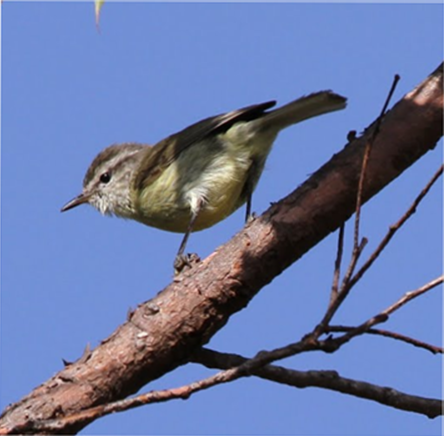
The Timor Leaf Warbler is a small bird, measuring approximately 10 to 11 centimeters in length, with a wingspan of about 16 centimeters. It exhibits predominantly green plumage on its upperparts, which provides excellent camouflage within its leafy habitat. The underparts are paler, often showing a yellowish or whitish tint, particularly on the belly and flanks, which becomes more pronounced during the breeding season.
Adults of both sexes are similar in appearance, making them difficult to differentiate in the field. Juvenile Timor Leaf Warblers, however, can be identified by their slightly duller plumage and less pronounced facial markings. One key feature for identification is the presence of a distinct eye stripe, which is more vivid in adults. While observing in the field, note the bird's active movements and its characteristic tail-flicking behavior.
The warbler's flight silhouette is characterized by rapid, fluttery wingbeats, typical of the Phylloscopus genus. When perched, it often adopts an upright posture, maintaining a constant watch for insects. It can easily be confused with other leaf warblers in its range, but its specific combination of size, coloring, and behavior provides reliable identification points.
Having trouble telling birds apart? Upload a photo to our bird identification tool for an instant species match.
Timor Leaf Warbler Habitat and Range
Preferred Habitat
The Timor Leaf Warbler inhabits a variety of forested environments on the island of Timor. It shows a marked preference for primary and secondary tropical forests, as well as montane regions. These birds are typically found at elevations ranging from sea level up to 2000 meters, with a higher density in montane forests where they find ample food resources and suitable nesting sites.
Within these habitats, the Timor Leaf Warbler occupies the mid-canopy and understory layers, where it can forage effectively. While primarily a forest-dwelling species, it can occasionally be found in more open woodland areas, particularly if these are adjacent to denser forest tracts. Unlike some other warblers, the Timor Leaf Warbler does not readily adapt to urban environments, as it relies heavily on the insect-rich habitats provided by intact forests.
Geographic Range
The Timor Leaf Warbler is endemic to the island of Timor, which is politically divided between the sovereign state of East Timor and the Indonesian province of East Nusa Tenggara. Its range is restricted to this island, where it occupies various elevations and forest types. The highest densities of this species are typically found in the montane forests that offer rich foraging opportunities and suitable nesting sites.
Unlike many other warblers, the Timor Leaf Warbler does not undertake long-distance migrations. It is largely sedentary, with any movement being local and typically related to resource availability. Within its limited range, the bird maintains stable populations, provided that forest habitats remain intact and are not subject to extensive logging or land conversion.
Want to know which birds visit your area? Browse our backyard birds by location guides for region-specific species lists.
What Does the Timor Leaf Warbler Eat?
The diet of the Timor Leaf Warbler consists primarily of insects and other small invertebrates. It favors caterpillars, beetles, and spiders, which it gleans from leaves and branches in the mid-canopy and understory. During the wet season, when insect populations peak, the warbler's diet expands to include a broader variety of prey, taking advantage of the increased availability.
This bird employs an active foraging strategy, characterized by rapid movements and keen observational skills. It often hangs upside down from branches, much like a tit, to access prey hidden beneath leaves. While it primarily feeds during daylight hours, the exact timing of its foraging can shift depending on prey activity and environmental conditions.
Timor Leaf Warbler Behavior and Social Structure
The Timor Leaf Warbler is known for its social, yet territorial, behavior. It often forms small flocks, particularly outside the breeding season, which aids in predator detection and increases foraging efficiency. During the breeding season, however, pairs become territorial, defending their chosen nesting sites vigorously against intruders.
Courtship involves a series of vocalizations and displays, where the male flutters his wings and sings to attract a mate. Once paired, the birds maintain a strong bond throughout the breeding season. They are diurnal, engaging in most of their activities during daylight, with peak activity occurring in the early morning and late afternoon.
In response to predators, the Timor Leaf Warbler employs a combination of vocal alarms and evasive flight. It may also use mobbing tactics, joining forces with other small birds to drive away potential threats. This behavior underscores its adaptability and the importance of social structures in its survival strategies.
Timor Leaf Warbler Nesting and Reproduction
The nesting habits of the Timor Leaf Warbler are typical of many Phylloscopidae species. Nests are generally cup-shaped and constructed with fine grasses, leaves, and cobwebs, providing both camouflage and structural integrity. These nests are frequently situated in the fork of a tree or among dense foliage, typically at a height of several meters above ground to deter ground-based predators.
Clutch size ranges from two to four eggs, with both parents sharing incubation duties over a period of about 12 to 14 days. The fledging period lasts approximately 10 to 12 days post-hatching, during which time both parents continue to feed and protect the young intensively. The Timor Leaf Warbler typically raises one brood per year, although in years with favorable conditions, a second brood may be attempted.
Timor Leaf Warbler Sounds and Vocalizations
The song of the Timor Leaf Warbler is a series of high-pitched, rapid trills and whistles, which serves to establish territory and attract mates during the breeding season. Its vocalizations are generally a mix of short, repeated notes that vary in pitch and tempo, making them distinctive among the forest's soundscape.
In addition to its song, the warbler uses a range of call notes, including sharp 'chip' sounds, which function as contact calls within flocks or to signal alarm. During the dawn chorus, this bird becomes particularly vocal, contributing to the rich acoustic tapestry of the forest. Comparing its calls to the sound of a distant, fast-paced typewriter can help identify it by ear.
Interesting Facts About the Timor Leaf Warbler
- 1The Timor Leaf Warbler's eye stripe is not only a visual feature for identification but also aids in reducing glare from sunlight while foraging.
- 2Despite its small size, the Timor Leaf Warbler can consume up to half its body weight in insects daily, showcasing its role as a voracious insectivore.
- 3This species' nesting strategy involves using cobwebs, which provide elasticity and strength to the nest structure, a clever use of natural materials.
- 4The Timor Leaf Warbler's song, though simple, has subtle variations that can signal different intentions, from mating calls to territorial warnings.
- 5The bird's tail-flicking behavior is not merely a characteristic movement but a strategic action to flush out insects from their hiding spots.
- 6The species' preference for montane forests has kept it insulated from some of the development pressures faced by lowland species on Timor.
- 7The Timor Leaf Warbler's sedentary nature contrasts with many other warblers, which are renowned for their long-distance migrations.
Timor Leaf Warbler Conservation Status
Currently, the Timor Leaf Warbler is listed as Least Concern by the IUCN, indicating a stable population. However, its restricted range on the island of Timor makes it vulnerable to habitat destruction and fragmentation due to logging and agricultural expansion. Conservation efforts focus on preserving forest habitats and maintaining ecosystem integrity. Historical population levels have likely fluctuated with changes in forest cover and climate conditions. Continued monitoring and habitat protection are essential to ensure the warbler's long-term survival, as any significant alterations in its habitat could have profound effects on its population dynamics.
Other Phylloscopidae Species



Birds Similar to the Timor Leaf Warbler
These species are often confused with the Timor Leaf Warbler due to similar appearance or overlapping range.

