Whistler's Warbler
Seicercus whistleri
Order: Passeriformes / Family: Phylloscopidae

Wikimedia Commons
About the Whistler's Warbler
The Whistler's Warbler, Seicercus whistleri, is a small passerine bird known for its vivid plumage and melodic whistling call, which resonates throughout the montane forests of Asia. Occupying a significant ecological niche, this species thrives in the subtropical and temperate forests, particularly within the Himalayan region, extending across northern India, Nepal, Bhutan, and parts of China. The warbler plays an essential role in these ecosystems, primarily as an insectivore, controlling populations of small arthropods and contributing to pest management. During the breeding season, these warblers are highly active in the dense understories of mixed forests, often found flitting among the foliage in search of food. Their presence indicates a healthy, biodiverse environment. In their breeding habitats, Whistler's Warblers are integral to the ecological balance, as their foraging habits aid in the spread of seeds and pollination of certain plant species. The bird's seasonal behaviors are marked by altitudinal migrations; during the colder months, they descend to lower elevations, sometimes venturing into more open woodlands and secondary growth areas. This seasonal movement is crucial for their survival, allowing them to exploit different food resources as availability shifts with the seasons. The Whistler's Warbler's role extends beyond mere ecological contribution; it also serves as an indicator species for environmental changes, given its sensitivity to habitat disturbances and climate variability. Conservationists often monitor their populations to assess the health of the forest ecosystems they inhabit. As such, the Whistler's Warbler is not only a symbol of the vibrant biodiversity of its native regions but also a critical species for conservation efforts focused on protecting montane forest habitats.
The Whistler's Warbler belongs to the family Phylloscopidae, within the order Passeriformes. These birds typically live average 4-6 years, max recorded 10 years.
How to Identify a Whistler's Warbler
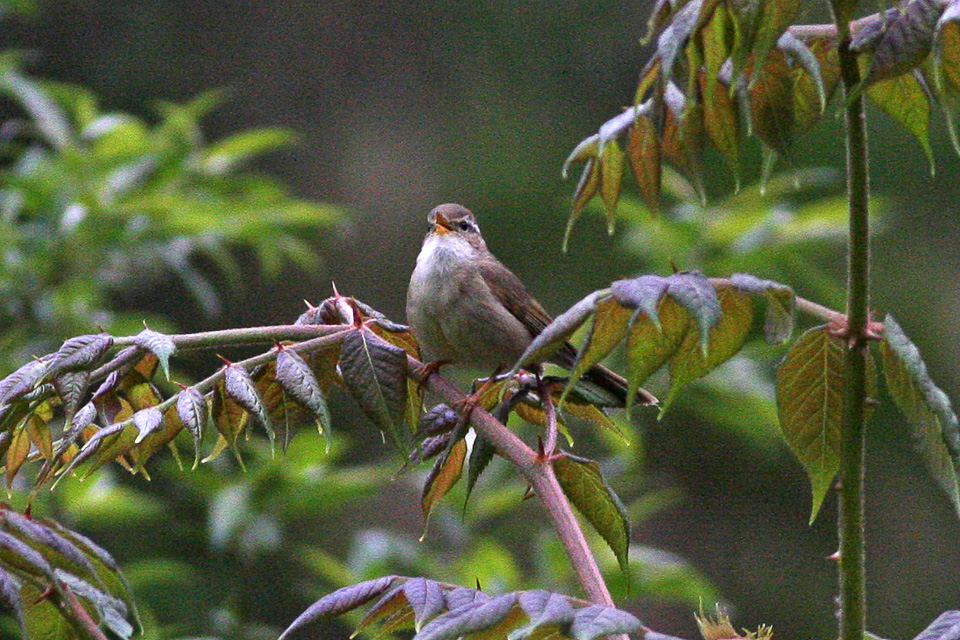
The Whistler's Warbler is characterized by its bright yellow underparts, which contrast sharply with its olive-green upperparts and grayish head. Adults display a distinctive white eye-ring, which aids in identification, while the wings and tail are a muted brown with subtle edging. Juveniles resemble adults but exhibit duller plumage, lacking the vividness of the mature birds. Males and females are similar in appearance, although males may show slightly brighter coloring during the breeding season. In flight, the Whistler's Warbler appears agile and rapid, often seen darting through the canopy in a flurry of color. The silhouette of the bird in flight is slim, with a slightly forked tail that aids in its acrobatic aerial maneuvers. While perched, the warbler typically adopts an upright posture, often flicking its tail and wings. The species can be confused with the Gray-hooded Warbler, especially given their overlapping ranges. However, the Whistler's Warbler's more pronounced yellow underparts and distinctive song help differentiate it. Observers should note the bird's active movements and characteristic foraging behavior, which often involves gleaning insects from leaves and twigs.
Having trouble telling birds apart? Upload a photo to our bird identification tool for an instant species match.
Whistler's Warbler Habitat and Range
Preferred Habitat
Whistler's Warblers inhabit montane forests, thriving in both subtropical and temperate zones. They prefer dense, mixed deciduous and coniferous forests, especially those with a rich understory. Typically found at elevations ranging from 1,500 to 3,500 meters, these warblers are well adapted to high-altitude environments. During the breeding season, they are most commonly associated with undisturbed forest habitats, but they can also be found in secondary growth and scrublands during migration. Seasonal habitat shifts occur as they move to lower elevations in winter, where they might be seen in less dense woodlands or even gardens and parks on occasion. While they are more prevalent in rural and natural settings, their adaptability allows them to occasionally venture into urban fringes, although they are not typically found in heavily urbanized areas.
Geographic Range
The Whistler's Warbler breeds across the Himalayan range, with populations recorded from northern India through Nepal and Bhutan, extending into southeastern Tibet and parts of western China. Their breeding range is confined to montane forests where they find optimal conditions for nesting and foraging. As the seasons change, these warblers undertake altitudinal migrations, descending to lower elevations in the foothills of the Himalayas, as well as moving southward into the plains of northern India and Bangladesh during the winter months. Their migration corridors are primarily along the wooded valleys and riverine forests that provide suitable stopover habitats. Within these regions, population densities can vary, with higher concentrations often found in areas offering abundant food resources and optimal breeding conditions. While they are not considered globally threatened, local populations may fluctuate based on habitat quality and availability.
Want to know which birds visit your area? Browse our backyard birds by location guides for region-specific species lists.
What Does the Whistler's Warbler Eat?
Whistler's Warblers are primarily insectivorous, feeding on a wide variety of small arthropods. Their diet consists mainly of caterpillars, beetles, spiders, and other soft-bodied insects, which they actively glean from the foliage. During the breeding season, their food intake increases to support the demands of their growing young. In winter, when insects become scarce, they may supplement their diet with seeds and small fruits. The warbler employs an energetic foraging technique, flitting from branch to branch and occasionally hovering to pick prey from the undersides of leaves. This active foraging style not only helps them find food but also aids in the control of insect populations within their habitats. Prey size typically ranges from small to medium, with the warbler showing a preference for easily manageable arthropods. Their feeding schedule is primarily diurnal, with peak activity occurring in the early morning and late afternoon when insect activity is highest.
Whistler's Warbler Behavior and Social Structure
Whistler's Warblers are generally solitary or found in pairs during the breeding season, exhibiting strong territorial behavior. Males establish and defend territories through song, often engaging in vocal duels with neighboring males. Courtship displays include fluttering flights and singing from prominent perches to attract females. Outside the breeding season, they may join mixed-species foraging flocks, benefiting from increased vigilance against predators. The warbler's response to threats involves swift, erratic flight and seeking cover in dense foliage. Daily activity patterns are marked by periods of intense foraging interspersed with bouts of singing and preening. Whistler's Warblers are most active during the cooler parts of the day, retreating to shaded areas during midday heat. Their social structure is relatively simple, with interactions primarily focused on mating and territory defense.
Whistler's Warbler Nesting and Reproduction
The nesting behavior of the Whistler's Warbler involves constructing a cup-shaped nest made of moss, leaves, and fine grasses, often lined with feathers or animal hair for insulation. These nests are typically placed in low shrubs or small trees, concealed within dense foliage to protect against predators. The female lays a clutch of 3 to 5 eggs, which she incubates for approximately 12 to 14 days. During this period, the male provides food and defends the territory. Once hatched, the chicks are altricial, requiring constant care and feeding by both parents. The fledging period lasts about 10 to 12 days, after which the young leave the nest but remain dependent on the parents for several more weeks. Whistler's Warblers usually raise one brood per year, although in favorable conditions, they may attempt a second.
Whistler's Warbler Sounds and Vocalizations
The primary song of the Whistler's Warbler is a series of clear, whistling notes that rise and fall in pitch, creating a melodious phrase often described as 'whee-tee-whee-tee-chirr'. This song serves both territorial and mate attraction purposes. Additionally, the warbler produces a variety of call notes, including sharp 'chip' sounds and softer 'tsip' calls used for communication among pairs. Alarm calls are harsher and more rapid, alerting others to potential danger. During the dawn chorus, the Whistler's Warbler's song is particularly prominent, cutting through the ambient noise with its distinctive cadence. This vocalization is reminiscent of a musical whistle, both in quality and rhythmic delivery, making it a memorable sound within its habitat.
Interesting Facts About the Whistler's Warbler
- 1Whistler's Warblers can adjust their foraging strategies depending on the availability of prey, showcasing remarkable adaptability.
- 2The species is named after British ornithologist Hugh Whistler, who contributed significantly to the study of Asian birds.
- 3During migration, Whistler's Warblers can travel over 500 kilometers to reach suitable wintering grounds.
- 4These warblers are adept at mimicking other bird calls, a skill that aids in territory defense and mate attraction.
- 5The Whistler's Warbler's melodious song can carry over considerable distances, a key adaptation for communication in dense forests.
- 6Despite their small size, Whistler's Warblers play a crucial role in controlling insect populations in their native habitats.
- 7Their bright yellow plumage provides excellent camouflage among the yellowing leaves of their forest homes.
Whistler's Warbler Conservation Status
The Whistler's Warbler is currently classified as Least Concern by the IUCN, with populations considered stable across much of its range. However, localized threats such as habitat destruction and deforestation pose significant challenges to their long-term conservation. Efforts to protect montane forest habitats, particularly within the Himalayan region, are crucial to maintaining healthy populations. Conservation initiatives should focus on sustaining forest cover and mitigating the impacts of climate change, which could alter the availability of suitable habitats. Historical population trends indicate that while the warbler has maintained stable numbers, ongoing habitat pressures necessitate continued monitoring to prevent potential declines.