
White-bibbed Antbird
Myrmeciza loricata
Order: Passeriformes / Family: Thamnophilidae
Wikimedia Commons
About the White-bibbed Antbird
The White-bibbed Antbird, scientifically known as Myrmeciza loricata, is a captivating avian species within the family Thamnophilidae. This bird inhabits the Atlantic Forest of southeast Brazil, a biodiversity hotspot renowned for its rich array of flora and fauna. The White-bibbed Antbird plays an integral role in the ecosystem as an insectivore, contributing to the control of insect populations. This species thrives in the dense underbrush of tropical lowland and montane forests, relying on its agility and cryptic coloration to navigate and forage in its lush environment.
The significance of the White-bibbed Antbird extends beyond its ecological role. As a representative of the Atlantic Forest, it serves as an indicator of forest health. The bird's reliance on well-preserved forest habitats makes it vulnerable to habitat fragmentation and deforestation, ongoing threats that imperil the biome. The persistence of the White-bibbed Antbird underscores the value of conserving these critical habitats, which are crucial for the survival of numerous endemic and threatened species.
Ecologically, the White-bibbed Antbird engages in mutualistic relationships with army ants, a behavior common among its family members. As army ants traverse the forest floor in search of prey, they disturb insects that the antbirds then capture. This intriguing foraging strategy underscores the bird's adaptability and role in the intricate web of life within the Atlantic Forest. The White-bibbed Antbird exhibits seasonal behaviors linked to the breeding cycle, with increased vocalizations and territorial displays occurring during the breeding season to attract mates and defend nesting sites. Maintaining a stable population of White-bibbed Antbirds requires focused conservation efforts addressing habitat preservation, which is pivotal to the sustainability of the rich biodiversity of the Atlantic Forest.
The White-bibbed Antbird belongs to the family Thamnophilidae, within the order Passeriformes. These birds typically live average 5-7 years with a maximum recorded of 11 years..
How to Identify a White-bibbed Antbird
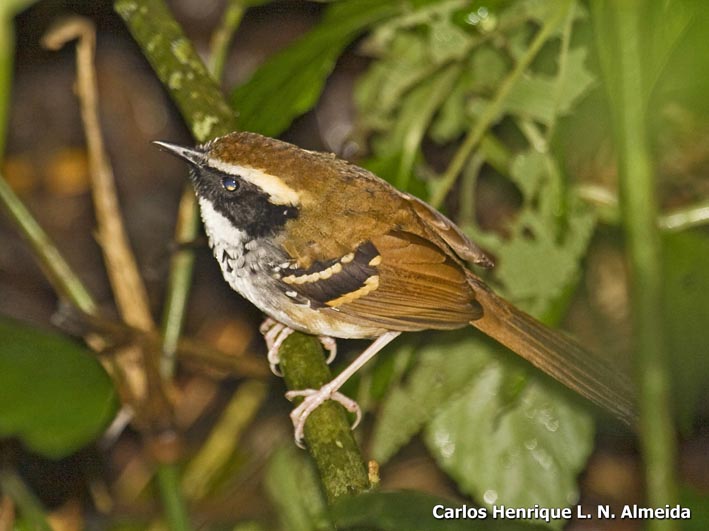
The White-bibbed Antbird is a medium-sized passerine with distinctive field marks that facilitate its identification. Adult males feature a prominent white throat and upper breast, which contrast sharply with their black head, back, and wings. This striking white bib serves as a key field mark and is the origin of the bird's common name. The rest of the body is predominantly dark slate-gray, with a slight gloss on the wings. Females, while similar in size, display a slightly duller plumage with more brownish tones on their upper parts, providing them with a degree of camouflage in their forest habitat. Juveniles resemble females but may exhibit more pronounced brownish hues and less defined throat markings.
One may confuse the White-bibbed Antbird with other antbirds, such as the Ferruginous-backed Antbird, but the latter lacks the striking white throat patch. In flight, the White-bibbed Antbird presents a rounded silhouette with rapid wingbeats, typical of understory forest dwellers. When perched, it maintains a horizontal posture, often seen foraging close to the ground. The bird's piercing gaze and conspicuous white throat make it a distinctive sight for those fortunate enough to observe it in its natural habitat.
Having trouble telling birds apart? Upload a photo to our bird identification tool for an instant species match.
White-bibbed Antbird Habitat and Range
Preferred Habitat
The White-bibbed Antbird primarily inhabits the Atlantic Forest, specifically thriving in dense, humid tropical forests. These ecosystems, including lowland rainforests and montane forests, provide the cover and resources necessary for the bird's survival. The species typically resides at elevations ranging from sea level to about 1,500 meters, where it finds ample food and nesting sites. Unlike some adaptable species, the White-bibbed Antbird shows a strong preference for undisturbed forest habitats and is less likely to be found in urban or heavily altered landscapes. Seasonal shifts in habitat are minimal, as the bird is a resident species, remaining within its forested home range year-round. The White-bibbed Antbird's reliance on pristine forest environments highlights the importance of conservation in these regions, as habitat degradation poses a significant threat to its population.
Geographic Range
The White-bibbed Antbird's range is concentrated in the southeastern Atlantic Forest of Brazil. This species is endemic to this region and can be found from southern Bahia to northern Paraná. Despite its relatively restricted range, the White-bibbed Antbird's distribution is fairly continuous within suitable forest habitats. Unlike many migratory species, the White-bibbed Antbird is a resident bird, showing no significant long-distance movements. However, local movements within its range may occur in response to food availability and habitat conditions. Population densities are higher in protected forest areas, such as national parks and reserves, where habitat quality remains high. The bird's presence in these regions underscores the significance of the Atlantic Forest as a haven for biodiversity, necessitating ongoing conservation efforts to maintain its integrity.
Want to know which birds visit your area? Browse our backyard birds by location guides for region-specific species lists.
What Does the White-bibbed Antbird Eat?
The White-bibbed Antbird's diet primarily consists of insects and other small arthropods. As an adept insectivore, it forages on the forest floor, swiftly capturing ants, beetles, spiders, and caterpillars. This bird employs a mix of gleaning and sallying techniques to snatch prey from the leaf litter or low vegetation. Seasonal variations in diet are minimal, reflecting a consistent reliance on the rich invertebrate fauna of the Atlantic Forest throughout the year. The White-bibbed Antbird often follows swarms of army ants, seizing prey items disturbed by the ants' movement. This unique foraging strategy allows the bird to capitalize on the activity of the ants, providing a reliable food source. The bird's feeding schedule aligns with its diurnal activity pattern, primarily foraging during daylight hours when prey is most active.
White-bibbed Antbird Behavior and Social Structure
The White-bibbed Antbird exhibits intriguing behaviors that highlight its adaptability and ecological role. Socially, this species typically forms monogamous pairs, maintaining territories that they actively defend from intruders. Territorial disputes often involve vocal displays and physical confrontations, with both males and females participating in the defense. During the breeding season, the White-bibbed Antbird engages in elaborate courtship displays, including vocal duets and wing-flicking, to strengthen pair bonds and attract mates.
This species responds to predators with alarm calls and evasive maneuvers, often retreating into dense underbrush for cover. The White-bibbed Antbird's daily activities revolve around foraging, with peak activity occurring during the early morning and late afternoon. The bird's strong territorial instincts and reliance on specific forest resources necessitate a well-defined home range, which it patrols regularly to deter competitors. Flocking behavior is uncommon outside the breeding season, as the White-bibbed Antbird tends to remain solitary or in pairs, focusing on defending its territory and securing food resources.
White-bibbed Antbird Nesting and Reproduction
The nesting habits of the White-bibbed Antbird reflect its adaptability to the dense forest environment. This species constructs cup-shaped nests using twigs, leaves, and fine plant fibers, often positioning them in low shrubs or saplings close to the forest floor. Such locations provide concealment from predators and easy access for the incubating adults. The typical clutch consists of two eggs, which both parents incubate for approximately 16 to 18 days. The fledging period extends for about 10 to 12 days after hatching, during which both parents feed and care for the chicks. Cooperation between the male and female is crucial for the successful rearing of offspring, as they share responsibilities in feeding and protecting the young. The White-bibbed Antbird usually produces one brood per year, although in favorable conditions, a second brood may occur.
White-bibbed Antbird Sounds and Vocalizations
The vocalizations of the White-bibbed Antbird are distinctive and play an essential role in territory defense and mate attraction. Its primary song is a series of clear, melodious whistles, delivered at a moderate pace and typically consisting of three to five notes. These whistles, often rendered as 'weee-wee-wee,' are repeated at intervals and serve to establish presence and signal readiness to breed. Call notes are softer and include short, sharp 'chit' sounds used for communication between mates or as alarms. During the dawn chorus, the White-bibbed Antbird's song stands out for its clarity and rhythm, resonating through the forest understory. The bird's alarm calls, characterized by quick, repeated chattering, alert others to potential threats, demonstrating its acute awareness of the surrounding environment.
Interesting Facts About the White-bibbed Antbird
- 1The White-bibbed Antbird's reliance on army ants for foraging is an example of commensalism in nature.
- 2Despite its striking appearance, the White-bibbed Antbird is often overlooked due to its preference for dense underbrush.
- 3The Atlantic Forest, home to the White-bibbed Antbird, boasts more than 20,000 plant species, many of which are endemic.
- 4The White-bibbed Antbird's song can carry up to 100 meters through the forest, helping it maintain territory boundaries.
- 5This species is part of a family known as 'ant-followers,' specializing in catching insects displaced by army ants.
- 6The White-bibbed Antbird's habitat overlaps with several endangered species, highlighting the importance of its conservation.
- 7Both male and female White-bibbed Antbirds participate equally in nest building, incubation, and chick rearing.
White-bibbed Antbird Conservation Status
The White-bibbed Antbird is currently listed as Near Threatened on the IUCN Red List. The primary threat to its population is habitat loss due to deforestation and fragmentation of the Atlantic Forest. This biome has experienced significant degradation over the past few decades, severely impacting the species that rely on its unique environment. While the population trend of the White-bibbed Antbird is currently considered stable, continued habitat destruction poses a significant risk. Conservation efforts focus on protecting large tracts of forest and restoring degraded areas to ensure the survival of this and other forest-dependent species. Historical population changes have been closely linked to the extent of forest cover, underscoring the importance of habitat preservation. Collaborative efforts between government agencies, NGOs, and local communities remain vital in safeguarding the future of the White-bibbed Antbird.
Other Thamnophilidae Species



Birds Similar to the White-bibbed Antbird
These species are often confused with the White-bibbed Antbird due to similar appearance or overlapping range.
