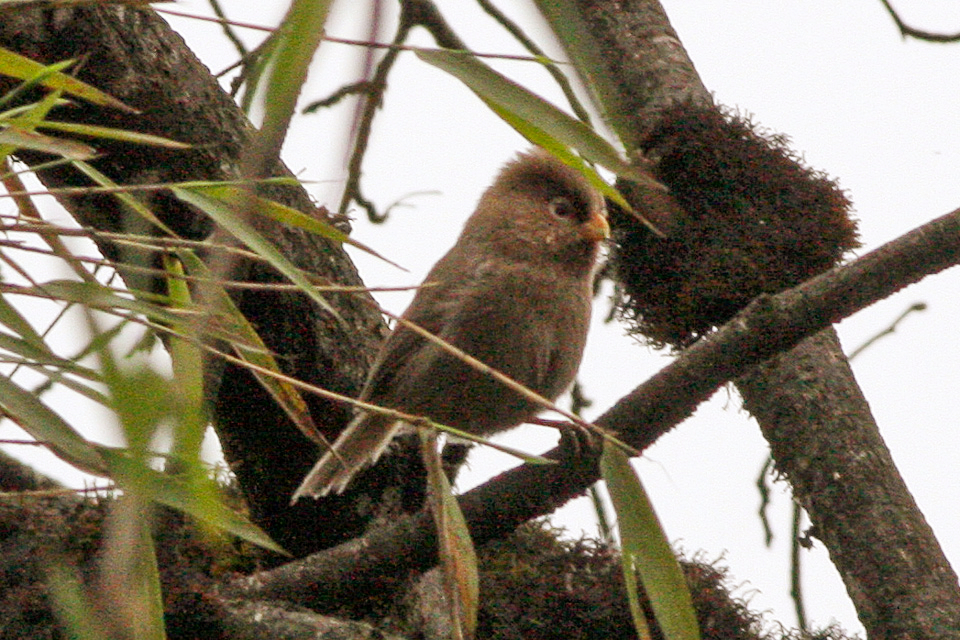
White-breasted Parrotbill
Psittiparus ruficeps
Order: Passeriformes / Family: Sylviidae

Wikimedia Commons
About the White-breasted Parrotbill
The White-breasted Parrotbill, scientifically known as Psittiparus ruficeps, occupies a unique niche within the avian community of Asia. This small bird belongs to the family Sylviidae and is primarily found in the montane forests of the Eastern Himalayas, extending across Bhutan, India, Nepal, and parts of Tibet. Its presence in these biodiverse regions underscores its role in the ecosystem as both a consumer of insects and a potential agent of seed dispersal due to its varied diet. The White-breasted Parrotbill's striking plumage, with its white breast contrasting against a rufous head, makes it a visually remarkable species for birdwatchers and researchers alike. The ecological significance of the White-breasted Parrotbill becomes apparent when considering its habitat preferences. It thrives in dense undergrowth and bamboo thickets, often at elevations ranging from 1,500 to 3,000 meters. Here, it contributes to the health of the forest ecosystem by helping control insect populations. The bird's seasonal behaviors include slight altitudinal movements, particularly during colder months, when it may descend to lower elevations in search of food. This altitudinal migration highlights the bird's adaptability and resilience in the face of changing environmental conditions. The White-breasted Parrotbill plays a crucial role in the food web, serving as both predator and prey. Its diet includes a range of insects and, occasionally, berries and small seeds. This flexibility in diet allows it to adjust to seasonal fluctuations in food availability, ensuring its survival throughout the year. Moreover, its role as a prey species for larger birds of prey and mammals makes it a vital link in maintaining the balance within its ecosystem. Despite its relatively stable population, the White-breasted Parrotbill faces threats from habitat loss due to deforestation and agricultural expansion. Conservation efforts are essential to ensure the preservation of its natural habitats, safeguarding not only the White-breasted Parrotbill but also the myriad of other species that share its environment.
The White-breasted Parrotbill belongs to the family Sylviidae, within the order Passeriformes. These birds typically live 5-7 years with a maximum recorded of 9 years.
How to Identify a White-breasted Parrotbill
The White-breasted Parrotbill is a small bird, measuring roughly 18 centimeters in length. Its most distinguishing feature is its white breast, which stands in stark contrast to its warm rufous head and nape. Adults exhibit a predominantly brown back and wings, while the tail is also brown but edged with lighter feathering. In terms of sexual dimorphism, males and females appear quite similar, making it challenging to distinguish between the sexes in the field. Juveniles, however, may present a slightly duller coloration, lacking the full vibrancy of the adult's rufous head. The bird's robust bill is another identifying characteristic, adapted for cracking seeds and catching insects, which reinforces its place within the Parrotbill family. In flight, the White-breasted Parrotbill shows a compact silhouette with rapid, direct wingbeats. When perched, it tends to hold a slightly hunched posture, often seen clinging to bamboo stalks or dense foliage. This posture, combined with its distinctive coloration, aids in field identification. While similar species exist, such as other parrotbills within the region, the combination of the white breast and rufous head in Psittiparus ruficeps serves as a clear identifier.
Having trouble telling birds apart? Upload a photo to our bird identification tool for an instant species match.
White-breasted Parrotbill Habitat and Range
Preferred Habitat
The White-breasted Parrotbill predominantly inhabits montane forests, thriving in areas with dense undergrowth and bamboo thickets. These habitats are primarily located in the Eastern Himalayas, spanning countries such as Bhutan, India, and Nepal. Within these regions, the bird prefers elevations between 1,500 and 3,000 meters, where it finds ample food and suitable nesting sites. During colder months, the White-breasted Parrotbill may exhibit altitudinal movements, descending to lower elevations in search of food. This seasonal habitat shift ensures its survival in challenging conditions. Although primarily a forest dweller, the bird occasionally ventures into areas of secondary growth, especially in regions where forest cover has diminished. Urban environments do not typically host the White-breasted Parrotbill, as it favors the secluded and lush environments of montane forests.
Geographic Range
The White-breasted Parrotbill's range is concentrated in the montane regions of South Asia, particularly within the Eastern Himalayas. It is found in Bhutan, the northeastern states of India, Nepal, and parts of Tibet. The bird's breeding range aligns with these areas, taking advantage of the abundant resources and suitable nesting sites found at higher elevations. During winter, the White-breasted Parrotbill may shift to slightly lower altitudes, though it remains within its overall geographic range. While it does not undertake long-distance migrations, these altitudinal movements help the bird adapt to seasonal changes in temperature and food availability. Population density is generally higher in regions with extensive bamboo thickets, as these provide optimal conditions for foraging and nesting.
Want to know which birds visit your area? Browse our backyard birds by location guides for region-specific species lists.
What Does the White-breasted Parrotbill Eat?
The White-breasted Parrotbill has a diverse diet that mainly consists of insects, which it actively hunts among the dense undergrowth and bamboo thickets of its montane forest habitat. Insects such as beetles, caterpillars, and small spiders form the bulk of its diet, providing essential proteins and nutrients. Seasonally, the bird may also consume berries and small seeds, supplementing its insect diet with plant material. This dietary flexibility allows the White-breasted Parrotbill to adapt to varying food availability throughout the year. It forages by flitting through foliage, often using its robust bill to pry insects from crevices or under leaves. This foraging technique is complemented by its agile movements, enabling it to exploit a wide range of food sources. Feeding primarily occurs during daylight hours, with peaks in activity during early morning and late afternoon.
White-breasted Parrotbill Behavior and Social Structure
White-breasted Parrotbills exhibit social behavior, often moving in small flocks of 6 to 10 individuals. These flocks may join mixed-species feeding parties, enhancing their foraging efficiency and providing protection against predators. The bird is relatively territorial during the breeding season, defending its nesting area from intruders. However, outside this period, it shows a more communal nature, readily joining other parrotbills and small passerines. Courtship displays involve vocalizations and mutual preening, strengthening pair bonds. In response to predators, the White-breasted Parrotbill employs alarm calls and may engage in mobbing behavior to deter threats. Daily activities include foraging, preening, and resting, with peak activity occurring in the early morning and late afternoon.
White-breasted Parrotbill Nesting and Reproduction
White-breasted Parrotbills construct cup-shaped nests, often placed among dense bamboo thickets or low shrubs. The nest, built primarily by the female, consists of grasses, moss, and bamboo leaves, providing camouflage and protection for the clutch. Typically, the clutch consists of 2 to 4 eggs, which the female incubates over approximately 14 days. Both parents participate in feeding the chicks, which fledge about 15 to 18 days after hatching. The parental roles are well-defined, with the male often taking on the task of foraging for food during the incubation period. This species generally raises one brood per year, although favorable conditions may allow for a second.
White-breasted Parrotbill Sounds and Vocalizations
The White-breasted Parrotbill's primary song is a series of soft, melodious whistles interspersed with trills, creating a complex and pleasing tune. This song serves both to mark territory and to attract mates during the breeding season. Their calls include short, sharp 'chip' notes, often used for communication within flocks. Alarm calls are more urgent, consisting of rapid, repeated notes that alert conspecifics to danger. During the dawn chorus, their vocalizations become more frequent and varied, contributing to the vibrant soundscape of the montane forests. Their songs and calls, while distinctive, may sometimes be confused with those of other parrotbill species, requiring attentive listening to discern.
Interesting Facts About the White-breasted Parrotbill
- 1White-breasted Parrotbills are part of a group known as 'parrotbills,' named for their strong, curved bills similar to those of parrots.
- 2Despite their name, White-breasted Parrotbills are more closely related to Old World babblers than to true parrots.
- 3These birds often form flocks with other species, a behavior that increases foraging efficiency and predator awareness.
- 4Their nests are often expertly hidden within bamboo thickets, making them difficult for predators to find.
- 5White-breasted Parrotbills play a role in controlling insect populations, which helps maintain the ecological balance in their habitat.
- 6Their vocal repertoire is surprisingly complex for such a small bird, featuring a variety of whistles and trills.
- 7The White-breasted Parrotbill's adaptability to different elevations makes it a resilient species in the face of environmental changes.
White-breasted Parrotbill Conservation Status
The IUCN lists the White-breasted Parrotbill as a species of Least Concern, indicating a relatively stable population. However, habitat loss due to deforestation and agricultural expansion poses a significant threat to its long-term survival. Conservation efforts focus on protecting montane forest habitats and promoting sustainable land use practices in the regions where the bird resides. Historical population changes have been minimal, but ongoing monitoring is crucial to detect any potential declines. Efforts by local conservation groups aim to raise awareness about the importance of preserving these unique ecosystems, benefiting not only the White-breasted Parrotbill but also numerous other forest species.