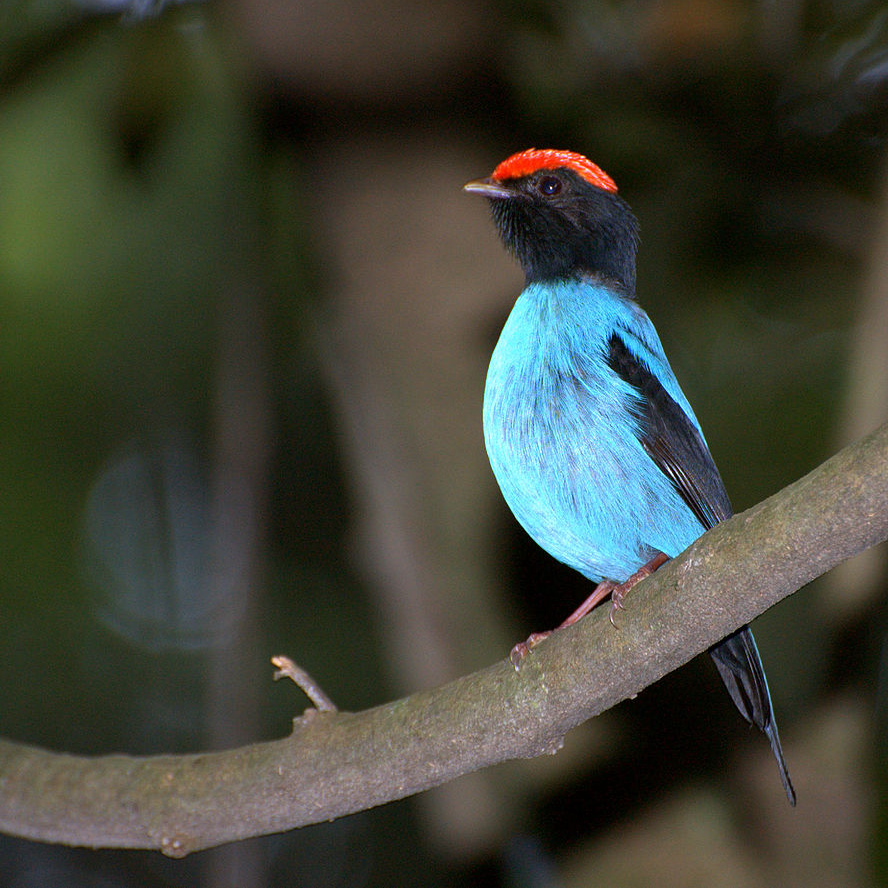
White-collared Manakin
Manacus candei
Order: Passeriformes / Family: Pipridae

Wikimedia Commons
About the White-collared Manakin
The White-collared Manakin (Manacus candei) is a small passerine bird belonging to the family Pipridae, commonly found in the tropical regions of Central America. Its presence spans from southeastern Mexico through Belize, Guatemala, and Honduras, extending into Nicaragua and Costa Rica. This bird plays a significant role in the forest ecosystems, primarily because of its frugivorous diet, which aids in seed dispersal. The species thrives in humid lowland forests, particularly favoring areas with dense understory vegetation that provide adequate cover and feeding opportunities. During the breeding season, which typically coincides with the wet months, male White-collared Manakins engage in elaborate display rituals to attract females. This courtship behavior is not only a spectacle for observers but also essential for the propagation of the species. The displays involve complex movements, including rapid jumps, wing snaps, and vocalizations, which occur in leks-communal display sites that are used by multiple males. Such behavior highlights the White-collared Manakin's ecological and evolutionary significance. The bird's preference for specific forest habitats makes it an important indicator species for the health of Central American rainforests. As human activities continue to alter these landscapes, the manakin's presence-or lack thereof-can signal changes in ecosystem integrity. Conservation efforts aimed at preserving these forests are crucial, not only for the White-collared Manakin but also for a multitude of other species that share its habitat.
The White-collared Manakin belongs to the family Pipridae, within the order Passeriformes. These birds typically live average 5-7 years with a maximum recorded of 11 years.
How to Identify a White-collared Manakin
Adult male White-collared Manakins are easily identified by their striking plumage. They feature a bright white throat and collar that contrasts sharply with their otherwise black wings and back. The belly and the rump are a vivid yellow, which aids in identification during their energetic courtship displays. Females and juveniles, however, present a more subdued appearance with olive-green plumage, making them more challenging to spot in the dense forest undergrowth. This sexual dimorphism is common among manakins, where the males are more colorful to attract mates. When observing these birds, pay attention to their small size and compact build, as well as their short tail and wings that contribute to their distinctive silhouette. Though they may be confused with the Orange-collared Manakin in areas where ranges overlap, the White-collared Manakin's white throat sets it apart. In flight, their rapid wingbeats and short bursts of activity are characteristic, while they perch horizontally on thin branches, making them relatively conspicuous in their preferred habitats.
Having trouble telling birds apart? Upload a photo to our bird identification tool for an instant species match.
White-collared Manakin Habitat and Range
Preferred Habitat
White-collared Manakins primarily inhabit the humid tropical lowland forests of Central America. They thrive in areas with dense understory growth, such as secondary forests and forest edges, where they can find ample fruiting trees and shrubs. These forests typically range from sea level to elevations of about 1000 meters. Seasonal habitat shifts are minimal, as these birds are largely non-migratory, opting instead to roam within their established territories in search of food. Unlike some other tropical species, the White-collared Manakin rarely ventures into urban areas, preferring the seclusion of dense forest cover. However, they may be found in nearby agricultural areas where forest patches remain intact.
Geographic Range
The White-collared Manakin's range spans the moist lowland forests of southeastern Mexico, extending through Belize, Guatemala, and Honduras, and into Nicaragua and Costa Rica. This range is largely confined to the Atlantic slope of Central America, where the bird is a year-round resident. Unlike some migratory species, the White-collared Manakin does not undertake long-distance migrations, although local movements within their range are not uncommon, particularly in response to food availability. Population density tends to be higher in areas with well-preserved habitats, such as national parks and reserves in Costa Rica and eastern Honduras, where conservation efforts have maintained suitable environments for these birds.
Want to know which birds visit your area? Browse our backyard birds by location guides for region-specific species lists.
What Does the White-collared Manakin Eat?
The diet of the White-collared Manakin primarily consists of fruit, which it forages in the understory and lower canopy levels of its forest habitat. These birds favor small berries and drupes from a variety of plant species, playing a significant role in seed dispersal. During the breeding season, when energy demands are higher, they may also supplement their diet with small insects, providing a protein boost. Foraging typically occurs in the early morning and late afternoon, avoiding the midday heat. Their feeding technique involves quick, darting flights to pluck fruit directly from branches, often followed by a brief hover to inspect the next meal. This nimble foraging strategy allows them to exploit a wide range of food resources within their habitat.
White-collared Manakin Behavior and Social Structure
White-collared Manakins are known for their fascinating social and courtship behaviors. Males are highly territorial and aggressively defend their lek sites from rivals. These communal display areas are where males perform elaborate dances to attract females, involving rapid jumps between branches, wing snaps, and a series of trills and whistles. Such displays not only serve in mate attraction but also reinforce social hierarchies among males. Outside the breeding season, the White-collared Manakin is relatively solitary, preferring the company of conspecifics only during feeding. Their daily activity patterns involve active foraging during cooler parts of the day and resting during peak heat. In response to predators, they rely on their agility and the dense understory for cover, quickly retreating to safety if threatened.
White-collared Manakin Nesting and Reproduction
The White-collared Manakin constructs its nest in the form of a shallow cup, typically placed low in the understory, often within thorny shrubs or small trees. The nest is made from fine plant fibers, leaves, and spider silk, providing both strength and flexibility. Females are solely responsible for nest construction, incubation, and chick rearing. A typical clutch consists of two eggs, which the female incubates for about 18-21 days. After hatching, the chicks remain in the nest for approximately 13-15 days before fledging. During this time, the female provides all necessary care, feeding the chicks with a diet of small fruits and insects. Typically, the White-collared Manakin has one to two broods per year, depending on food availability and environmental conditions.
White-collared Manakin Sounds and Vocalizations
The primary song of the White-collared Manakin is a series of sharp, high-pitched whistles that are often interspersed with rapid wing snaps produced during courtship displays. These sounds serve as both mate attraction calls and territorial signals. In addition to these vocalizations, the bird also produces a variety of call notes, including a short 'peep' used in communication between individuals. Alarm calls are less frequent but consist of rapid, harsh notes that alert other birds to potential danger. During the dawn chorus, males are particularly vocal as they establish their presence at lek sites, creating a vibrant soundscape in their forest habitats.
Interesting Facts About the White-collared Manakin
- 1White-collared Manakins are known for their unique courtship displays, which can involve up to 30 jumps per minute.
- 2The wing snaps produced during the manakin's display are created by modified wing feathers, a rare adaptation among birds.
- 3Despite their vibrant displays, male White-collared Manakins often fail to mate, with only a few males in a lek achieving success.
- 4These birds play a crucial role in seed dispersal, particularly for small understory trees and shrubs.
- 5The lekking behavior of manakins was first documented in the early 20th century, providing key insights into avian mating systems.
- 6White-collared Manakins can consume fruit equal to nearly half their body weight in a single day.
- 7The species' preference for dense forest understories contributes to difficulties in conducting accurate population surveys.
White-collared Manakin Conservation Status
The White-collared Manakin is currently listed as Least Concern by the IUCN, with stable population trends across much of its range. However, habitat loss due to deforestation poses a significant threat to local populations. Conservation efforts focus on preserving remaining forest habitats and promoting sustainable land-use practices. Historical data suggest that population numbers have fluctuated in response to habitat changes, but protected areas in countries like Costa Rica have proven effective in maintaining healthy populations. Continued efforts to safeguard critical habitats are essential for the long-term survival of this and other forest-dependent species.