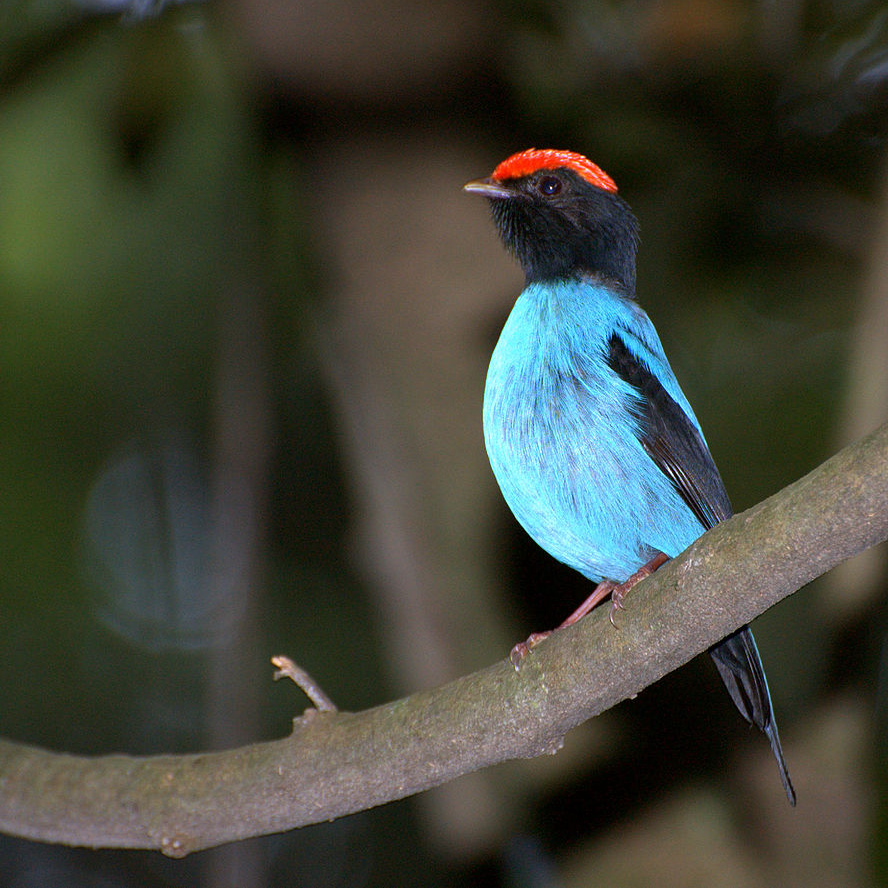
White-fronted Manakin
Lepidothrix serena
Order: Passeriformes / Family: Pipridae

Wikimedia Commons
About the White-fronted Manakin
The White-fronted Manakin, known scientifically as Lepidothrix serena, holds a distinctive place within the Pipridae family due to its vibrant coloration and unique behaviors. Found predominantly in the lush tropical forests of northern South America, this species thrives in the dense undergrowth where it plays a crucial role in seed dispersion. The White-fronted Manakin is a small passerine bird that exhibits remarkable sexual dimorphism, with males flaunting a striking combination of black and white plumage that contrasts sharply with the more subdued tones of the female. This bird's ecological significance extends beyond its visual appeal as it contributes to forest regeneration through its fruit-based diet.
Primarily located in countries such as Guyana, Suriname, and French Guiana, the White-fronted Manakin favors the humid and biodiverse regions of the Guiana Shield. Its habitat selection often includes lowland rainforests, where it occupies the lower to mid-canopy levels. The bird's preference for dense thickets provides ample cover from predators and a rich source of food. Seasonal behaviors are evident in this species, particularly during the breeding season when males engage in elaborate courtship displays to attract mates. These performances involve a series of acrobatic maneuvers and vocalizations intended to showcase their fitness and appeal.
The White-fronted Manakin's role in its ecosystem is multifaceted. As a frugivore, it assists in maintaining plant diversity by dispersing seeds across its range. Its reliance on a fruit-heavy diet underscores the interconnectedness of tropical forest species. During the dry season, when fruits are less abundant, these birds may shift their diet slightly to include more insects, thereby helping control insect populations. This adaptability makes the White-fronted Manakin a resilient species capable of navigating the challenges posed by fluctuating resources in its environment.
The White-fronted Manakin belongs to the family Pipridae, within the order Passeriformes. These birds typically live average 5-7 years..
How to Identify a White-fronted Manakin
Identifying the White-fronted Manakin in the field requires attention to several distinctive features. Adult males are particularly striking, with a white forehead and a glossy black body that makes them unmistakable among their forest habitat. In contrast, females and juveniles exhibit a more subdued olive-green plumage, aiding in camouflage among the foliage. This sexual dimorphism is a key characteristic of the species, with males using their vivid coloration to attract mates.
The male's white forehead and crown are the most distinguishing marks, setting them apart from similar manakin species. Females, however, may be easily confused with other greenish manakins, requiring observers to note subtle differences in size and behavior for accurate identification. In flight, the White-fronted Manakin displays rapid, buzzy wingbeats typical of small passerines, with a silhouette that appears compact and robust.
Perching behavior further aids in identification. Males often position themselves prominently during courtship displays, using their striking coloration to remain visible to potential mates. They frequently perform in open areas within the forest, allowing for clear observation of their plumage and behaviors. These characteristics make the White-fronted Manakin a fascinating subject for birders and researchers alike.
Having trouble telling birds apart? Upload a photo to our bird identification tool for an instant species match.
White-fronted Manakin Habitat and Range
Preferred Habitat
The White-fronted Manakin thrives in lowland tropical rainforests, preferring dense undergrowth and mid-canopy levels. It is commonly found in the Guiana Shield region, covering parts of Guyana, Suriname, and French Guiana. These forests provide the necessary cover and food resources for survival. The bird's habitat choice reflects a preference for areas with abundant fruiting plants, which are critical to its diet.
While primarily a forest dweller, the White-fronted Manakin can occasionally be found in secondary growth and forest edges, especially where fruit trees are present. This adaptability allows it to occupy a range of forested environments, although it remains absent from highly urbanized areas. Elevationally, the species is most commonly observed at lower altitudes, where the forest is dense and humid.
Seasonal changes can influence habitat use, particularly during the breeding season, when males seek out clearings or open patches within the forest to perform courtship displays. These areas allow for better visibility and acoustics, aiding in the attraction of females.
Geographic Range
The White-fronted Manakin's range is primarily restricted to the northeastern part of South America, encompassing the countries of Guyana, Suriname, and French Guiana. Within this range, it occupies lowland tropical rainforests, making it a resident species that does not engage in long-distance migration. Its distribution is closely tied to the availability of suitable forest habitats, which provide both shelter and food.
Although the White-fronted Manakin is considered a non-migratory bird, slight altitudinal movements may occur in response to seasonal changes in fruit availability. This ensures access to optimal feeding grounds throughout the year. The species does not extend into more southern or western parts of the continent, limiting its presence to the humid and biodiverse forests of the Guiana Shield.
Population density is generally highest in undisturbed forest areas where fruit resources are abundant. These hotspots offer ideal conditions for breeding and foraging, supporting stable populations of the species. Despite its limited geographic range, the White-fronted Manakin maintains a stronghold within its preferred habitat, benefiting from the relative stability of these forest ecosystems.
Want to know which birds visit your area? Browse our backyard birds by location guides for region-specific species lists.
What Does the White-fronted Manakin Eat?
The diet of the White-fronted Manakin is primarily frugivorous, with fruits constituting the bulk of its nutritional intake. This dietary preference plays a significant role in seed dispersal within its forest habitat, facilitating plant diversity and regeneration. The bird targets a variety of small fruits, typically those of understorey shrubs and mid-canopy trees, which it consumes whole.
During the dry season, when fruit availability declines, the White-fronted Manakin may incorporate insects and other small invertebrates into its diet. This shift not only provides necessary protein but also aids in controlling insect populations within the forest. Foraging is an active process, with individuals moving swiftly through the foliage to locate ripe fruits and catch insects on the wing.
The White-fronted Manakin typically forages during the early morning and late afternoon, taking advantage of cooler temperatures and reduced competition. Its feeding schedule aligns with the daily activity patterns of many forest fruits and insects, ensuring efficient energy acquisition throughout the day.
White-fronted Manakin Behavior and Social Structure
The White-fronted Manakin exhibits vibrant social and territorial behaviors, particularly during the breeding season. Males are known for their elaborate courtship displays, which involve acrobatic flights, wing-snaps, and vocalizations to attract females. These displays are often performed in designated lekking areas, where multiple males gather to compete for the attention of observing females.
Outside of the breeding season, the White-fronted Manakin tends to be more solitary, although it may occasionally join mixed-species foraging flocks. These flocks provide mutual benefits, such as increased vigilance against predators and enhanced foraging efficiency. The bird's alertness is crucial for detecting threats, and it exhibits quick, evasive maneuvers when faced with predators.
Daily activity patterns of the White-fronted Manakin are primarily diurnal, with most foraging and social interactions occurring during daylight hours. The bird's movements are characterized by rapid, direct flights interspersed with short periods of rest and preening. Territorial disputes are common, especially among males, and involve vocalizations and aggressive displays to establish dominance within a given area.
White-fronted Manakin Nesting and Reproduction
The nesting practices of the White-fronted Manakin are a fascinating aspect of its biology. Nests are typically constructed by the females and are cup-shaped structures built from twigs, leaves, and other plant materials. These nests are often positioned in the fork of a small tree or shrub, providing a stable and concealed environment for the eggs.
Clutch size generally consists of two eggs, which the female incubates alone while the male continues his courtship displays and territorial defense. The incubation period lasts approximately 18 to 20 days, after which the chicks hatch. Fledging occurs around two to three weeks post-hatching, with the female playing the primary role in feeding and caring for the young.
The White-fronted Manakin typically produces one to two broods per year, depending on environmental conditions and food availability. This reproductive strategy allows the species to maintain stable population levels despite the challenges of predation and habitat variability.
White-fronted Manakin Sounds and Vocalizations
The White-fronted Manakin's vocal repertoire is an essential component of its courtship and territorial behaviors. The primary song consists of a series of high-pitched, melodic whistles that can be heard echoing through the forest. These songs serve to attract females and establish the presence of the male within his territory.
In addition to its melodious song, the White-fronted Manakin also produces a variety of call notes, including sharp, alarm calls used to deter predators and communicate with fellow flock members. These calls often resemble short, piercing chips that alert others to potential danger.
During the dawn chorus, males are particularly vocal, using their songs to reinforce territory boundaries and attract early-rising females. The bird's vocalizations are a defining feature of its presence in the forest, contributing to the vibrant soundscape of its habitat.
Interesting Facts About the White-fronted Manakin
- 1The White-fronted Manakin can perform up to 50 wing-snaps per second during courtship displays, showcasing its agility and strength.
- 2Despite its small size, the White-fronted Manakin plays a crucial role in seed dispersal, helping regenerate tropical forest ecosystems.
- 3The striking white forehead of the male White-fronted Manakin is unique among its genus, setting it apart from other manakins.
- 4White-fronted Manakin males often gather in leks, where their synchronized displays can attract multiple females.
- 5This manakin's complex vocalizations include calls that resemble the sound of a creaking door, adding to its auditory repertoire.
- 6The White-fronted Manakin's preference for dense undergrowth provides it with protection from aerial predators.
- 7These birds have a diet that is over 80% fruit-based, emphasizing their role as key players in forest ecology.
White-fronted Manakin Conservation Status
The White-fronted Manakin is currently classified as a species of Least Concern by the IUCN. Its population trend appears stable, supported by the bird's adaptability and the continued presence of suitable forest habitats within its range. However, ongoing threats such as deforestation and habitat degradation pose potential risks to its long-term survival. Conservation efforts focus on preserving the tropical rainforest ecosystems that the White-fronted Manakin depends upon. Protected areas in regions like the Guiana Shield play a crucial role in maintaining biodiversity and providing sanctuary for this and other forest-dependent species. While historical population changes have been minimal, continued vigilance is necessary to ensure that the White-fronted Manakin's habitat remains intact in the face of increasing anthropogenic pressures. Collaborative conservation initiatives involving local communities and international organizations offer hope for the sustained preservation of this vibrant bird.