
White-lined Antbird
Percnostola lophotes
Order: Passeriformes / Family: Thamnophilidae

Wikimedia Commons
About the White-lined Antbird
The White-lined Antbird, scientifically known as Percnostola lophotes, belongs to the family Thamnophilidae and is a fascinating species native to the lush tropical forests of South America. This bird holds a special place in the ecosystem as both predator and participant in mixed-species flocks. Its primary habitat encompasses the dense undergrowth of Peru's rainforests, particularly thriving in regions like the foothills of the Andes and the Amazon Basin. The bird's ecological role is significant, as it participates actively in the control of insect populations, particularly ants, which are a substantial part of its diet.
Found predominantly in the lowland tropical forests, the White-lined Antbird prefers areas with abundant leaf litter and fallen branches, providing ample foraging opportunities. The species has adapted to these environments by developing keen senses that allow it to detect and capture prey with precision. The White-lined Antbird exhibits seasonal behaviors that are closely tied to the wet and dry seasons of its habitat. During the wet season, when insect activity peaks, these antbirds are particularly active, taking advantage of the abundance of food to sustain themselves and rear their young.
The significance of the White-lined Antbird extends beyond its ecological role. As a species endemic to specific regions of South America, it serves as an indicator of forest health. The presence of this bird often signifies a well-balanced ecosystem, as it relies on dense, undisturbed forest habitats. Conservation efforts are crucial for maintaining these habitats, especially as deforestation and habitat fragmentation pose significant threats to the species' survival. In the context of global biodiversity, the White-lined Antbird represents the intricate connections between species and their environments, highlighting the importance of preserving natural habitats in the face of environmental change.
The White-lined Antbird belongs to the family Thamnophilidae, within the order Passeriformes. These birds typically live estimated lifespan is around 5-7 years in the wild, with limited data on maximum longevity..
How to Identify a White-lined Antbird
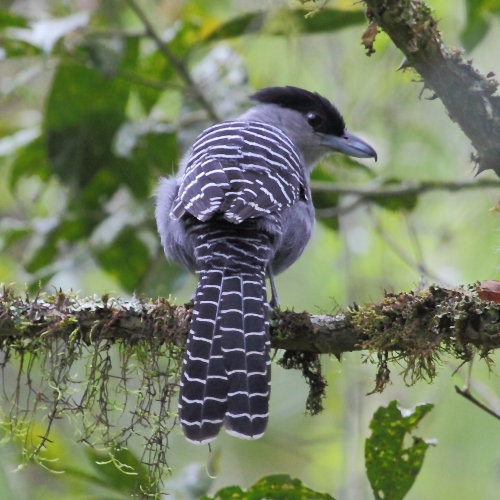
The White-lined Antbird is easily recognized by its striking plumage and distinctive markings. Adults display a rich combination of black and brown feathers, with a prominent white stripe running along the face, which gives the bird its common name. The white stripe is a key identifying feature, helping differentiate it from other antbirds in the region. Males and females share similar plumage, though females may exhibit slightly duller tones. Juveniles, on the other hand, have a more muted appearance, lacking the sharp contrast seen in adults. Their plumage gradually develops into the adults' characteristic pattern as they mature.
In the field, the White-lined Antbird can be confused with other species within the Thamnophilidae family, such as the Spot-winged Antbird. However, careful observation of the facial stripe and overall coloration helps in accurate identification. The bird's flight silhouette is not particularly distinctive, as it tends to stay low to the ground, flitting between bushes and undergrowth rather than engaging in long flights.
When perched, the White-lined Antbird often adopts a horizontal posture, with its body parallel to the branch and tail slightly cocked. This posture, combined with its habit of moving methodically through the underbrush, makes it a challenging bird to spot despite its conspicuous markings. Birders observing this species should focus on its behavior and distinctive call, which often reveal its presence even when the bird itself remains hidden from view.
Having trouble telling birds apart? Upload a photo to our bird identification tool for an instant species match.
White-lined Antbird Habitat and Range
Preferred Habitat
The White-lined Antbird inhabits the dense, humid lowland forests of Peru, thriving in regions where the forest floor is rich with leaf litter and debris. These environments provide an abundance of insects, particularly ants and other arthropods, which form the bulk of the bird's diet. The species is typically found at elevations ranging from sea level up to about 1,500 meters, preferring areas with minimal human disturbance. Within these forests, the White-lined Antbird often occupies the understory and mid-story layers, where it can forage effectively and find shelter.
While the bird primarily resides in tropical forests, it may also adapt to secondary growth and disturbed areas, provided that there is sufficient cover and food availability. During seasonal shifts, particularly in the wet season, the bird may move slightly to take advantage of areas where insect activity is highest. However, it generally does not undertake long migrations or significant habitat shifts, remaining relatively stationary throughout the year.
Urban presence of the White-lined Antbird is minimal, as the species relies heavily on undisturbed natural habitats. Conservation of these habitats is crucial, as deforestation and habitat fragmentation can severely impact the bird's ability to find food and reproduce. Efforts to protect tropical forests are vital for ensuring the survival of the White-lined Antbird and maintaining the biodiversity of the regions it inhabits.
Geographic Range
The range of the White-lined Antbird is largely confined to the tropical forests of Peru, making it an endemic species with a limited geographic distribution. Its breeding range encompasses the humid lowland regions and the foothills of the Andes, where the bird finds suitable nesting sites and abundant food sources. The bird's presence is most concentrated in areas with dense forest cover, such as the Amazon Basin, where it can thrive in the rich biodiversity these areas offer.
While the White-lined Antbird is not known for long-distance migration, it may exhibit local movements in response to food availability and seasonal changes. These movements are generally restricted to its established range, with the bird remaining within the forested areas of Peru throughout the year. As such, the White-lined Antbird does not have distinct wintering grounds outside its breeding range.
Within its range, population density can vary significantly depending on habitat quality and human impact. Regions with intact, undisturbed forests often support higher densities of the White-lined Antbird, while areas affected by deforestation or habitat degradation may see reduced populations. Conservation efforts aimed at preserving these critical habitats are essential for maintaining healthy populations of this unique and specialized bird.
Want to know which birds visit your area? Browse our backyard birds by location guides for region-specific species lists.
What Does the White-lined Antbird Eat?
The White-lined Antbird primarily feeds on insects, with ants forming a significant portion of its diet. This insectivorous diet is typical of many antbird species, which have evolved to exploit the rich insect life found in tropical forests. The bird's foraging strategy involves moving deliberately through the underbrush, often turning over leaves and probing the ground with its beak to uncover hidden prey. This methodical approach allows the White-lined Antbird to efficiently capture ants, beetles, and other small arthropods.
Seasonal changes in insect abundance can influence the bird's diet, with the wet season typically offering a greater variety of prey. During this time, the White-lined Antbird may expand its diet to include caterpillars, spiders, and other invertebrates that become more active in the humid conditions. The bird's ability to adapt its foraging behavior and diet to seasonal variations is a key factor in its survival and success.
The White-lined Antbird's feeding schedule is primarily diurnal, with peak foraging activity occurring in the early morning and late afternoon. During these times, the bird is most active, taking advantage of the cooler temperatures and increased insect activity. The bird's keen senses and specialized foraging techniques make it an effective predator within its ecological niche, playing an important role in controlling insect populations in its habitat.
White-lined Antbird Behavior and Social Structure
The White-lined Antbird exhibits a range of behaviors that reflect its adaptation to life in dense tropical forests. Socially, this species tends to be solitary or found in pairs, although it sometimes joins mixed-species flocks. These flocks can include various other insectivorous birds, allowing the White-lined Antbird to benefit from the collective vigilance and increased foraging success that comes with group living.
Territorial behavior is a notable aspect of the White-lined Antbird's lifestyle. Males are particularly vocal when defending their territories, using a series of distinctive calls to ward off intruders and communicate with mates. During the breeding season, which coincides with the wet season, males engage in courtship displays that include singing and synchronized movements designed to attract females.
In response to predators, the White-lined Antbird relies on its ability to remain inconspicuous. Its plumage provides effective camouflage against the forest floor, and the bird often freezes or flits silently to the nearest cover when threatened. This behavior, combined with the bird's acute awareness of its surroundings, helps minimize predation risk.
Daily activity patterns of the White-lined Antbird revolve around foraging and territory maintenance. The bird is most active during the cooler parts of the day, retreating to denser cover during the hottest hours. This pattern not only optimizes energy expenditure but also aligns with prey availability, as many insects are more active in the morning and late afternoon.
White-lined Antbird Nesting and Reproduction
Nesting behavior in the White-lined Antbird is closely tied to the wet season, when food resources are abundant, and conditions are favorable for raising young. The species constructs its nest in the dense underbrush, preferring locations that provide concealment and protection from predators. Nests are typically cup-shaped structures woven from twigs, leaves, and fibers, reflecting the bird's ability to utilize available materials in its environment.
Clutch size for the White-lined Antbird generally consists of two to three eggs, which are incubated by both parents. This shared responsibility is crucial for ensuring that the eggs are adequately protected and maintained at the proper temperature. The incubation period lasts approximately 14 to 16 days, after which the chicks hatch and require intensive care.
Both parents participate in feeding and caring for the young, a period lasting about 12 to 15 days until fledging. During this time, the chicks remain in the nest, relying on their parents for nourishment and protection. After fledging, the young birds continue to depend on their parents for a short period as they learn essential survival skills.
The White-lined Antbird typically raises one brood per year, aligning its breeding efforts with the seasonal availability of food. This strategy ensures that the young have the best chance of survival in the challenging environment of the tropical rainforest.
White-lined Antbird Sounds and Vocalizations
The vocalizations of the White-lined Antbird are a distinctive feature of this species, often serving as the first indication of its presence in the dense forest. The primary song consists of a series of short, sharp notes delivered in rapid succession, creating a rhythmic pattern that carries well through the undergrowth. This song is typically used by males during territorial displays and courtship, establishing their presence and attracting potential mates.
In addition to its primary song, the White-lined Antbird produces a variety of call notes that serve different purposes. Alarm calls are sharper and more abrupt, often signaling the presence of a predator or other threat. These calls serve to warn other birds in the vicinity, contributing to the overall vigilance of the mixed-species flocks that the antbird sometimes joins.
During the dawn chorus, the White-lined Antbird's vocalizations blend with those of other forest birds, creating a rich tapestry of sound that marks the beginning of the day. The bird's calls can be compared to the crisp, staccato sounds of a distant woodpecker tapping, although they are much more rhythmically structured and consistent.
Interesting Facts About the White-lined Antbird
- 1The White-lined Antbird is endemic to Peru, making it one of the few bird species found exclusively in this region.
- 2Despite their name, White-lined Antbirds do not follow army ant swarms, unlike many of their antbird relatives.
- 3White-lined Antbirds have been observed using their sharp bills to extract insects from crevices in bark and leaf litter.
- 4These antbirds are known for their distinctive white facial stripe, a key feature that helps in their identification.
- 5The White-lined Antbird's diet mainly consists of ants, but they are opportunistic feeders that adapt to seasonal prey availability.
- 6The bird's vocalizations are a key part of its behavior, with males using songs to establish territory and attract mates.
- 7The White-lined Antbird often participates in mixed-species flocks, benefiting from the collective vigilance and foraging opportunities.
White-lined Antbird Conservation Status
The White-lined Antbird currently holds a conservation status of Least Concern according to the IUCN Red List. However, its population trend shows signs of decline, primarily due to habitat loss and degradation. The primary threats to the species stem from deforestation and land conversion for agriculture and development, which fragment and reduce the available habitat. Conservation efforts for the White-lined Antbird focus on preserving the tropical forests of Peru, which are critical to its survival. These efforts include establishing protected areas and promoting sustainable land use practices that minimize environmental impact. Additionally, research and monitoring programs aim to gather more information on population dynamics and habitat needs, informing conservation strategies. Historically, the White-lined Antbird has maintained stable populations within its restricted range, but ongoing environmental changes pose significant challenges. By addressing these threats and promoting habitat conservation, it is possible to ensure the continued survival of this unique species and the ecosystems it inhabits.
Other Thamnophilidae Species



Birds Similar to the White-lined Antbird
These species are often confused with the White-lined Antbird due to similar appearance or overlapping range.

