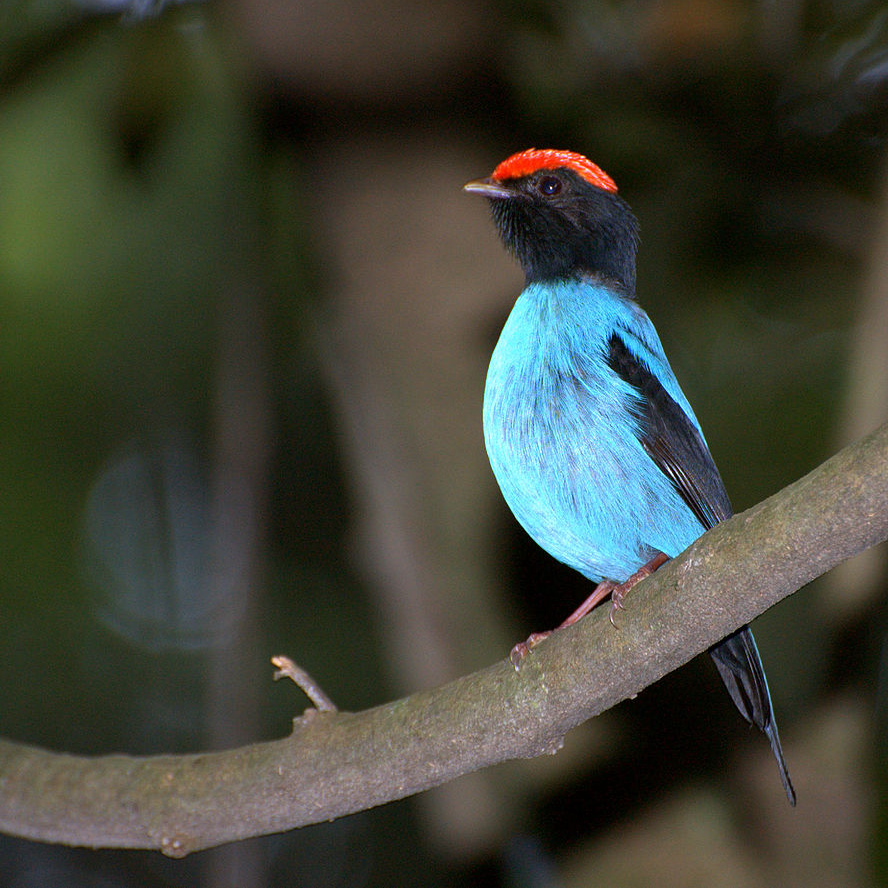
Wied's Tyrant-Manakin
Neopelma aurifrons
Order: Passeriformes / Family: Pipridae

Wikimedia Commons
About the Wied's Tyrant-Manakin
The Wied's Tyrant-Manakin (Neopelma aurifrons) is a small passerine bird belonging to the family Pipridae, a group renowned for their vivid plumage and elaborate courtship displays. This species, in particular, is recognized for its striking yellow plumage that graces its underparts, providing a vivid contrast to its more subdued olive-brown upperparts. Found primarily in the Atlantic Forest of eastern Brazil, the Wied's Tyrant-Manakin inhabits regions ranging from the state of Bahia to Rio de Janeiro. This bird plays a crucial ecological role within its habitat, acting as both a seed disperser and a pollinator. Unlike many of its manakin relatives, it is less showy in its courtship but nonetheless performs with precision and flair.
The significance of the Wied's Tyrant-Manakin extends beyond its visual appeal. It serves as an important indicator of forest health, given its reliance on undisturbed primary forests. The bird’s presence in a region often signals a well-preserved habitat, making it a species of interest for conservationists monitoring the health of the Brazilian Atlantic Forest. While its population is currently stable, ongoing deforestation and habitat fragmentation continue to pose significant threats.
Ecologically, the Wied's Tyrant-Manakin's role is multifaceted. It contributes to the maintenance of plant diversity through its feeding habits, which include consuming small fruits and insects. Such dietary preferences make it a vital player in seed dispersal, aiding in the propagation of various plant species. Additionally, its interaction with flowers while feeding on nectar facilitates pollination, a critical process for the reproduction of many forest plants. Seasonally, these birds are relatively sedentary, showing little to no migratory behavior, which underscores the importance of habitat conservation to ensure their continued survival.
The Wied's Tyrant-Manakin belongs to the family Pipridae, within the order Passeriformes. These birds typically live typically around 4-5 years in the wild..
How to Identify a Wied's Tyrant-Manakin
The Wied's Tyrant-Manakin can be identified by its bright yellow underparts and olive-brown upperparts. Adult males and females share similar coloration, but males often exhibit slightly more vibrant hues, particularly during the breeding season. Juveniles resemble adults but tend to have duller plumage overall. One of the distinguishing features is the bird's small size, with a body length typically ranging from 11 to 12 centimeters and a weight of about 10 to 12 grams.
In flight, the Wied's Tyrant-Manakin presents a somewhat rounded silhouette, with rapid, agile wingbeats. When perched, it often displays an upright posture, frequently observed on low branches within its forested environment. This posture aids in its identification, as it allows the bird to remain inconspicuous against the foliage, despite its bright underparts.
Confusion may arise with similar species such as the White-bearded Manakin, but the Wied's Tyrant-Manakin lacks the stark white throat and beard of the former. Additionally, its preference for lower forest strata differentiates it from other manakins that occupy higher canopy levels.
Having trouble telling birds apart? Upload a photo to our bird identification tool for an instant species match.
Wied's Tyrant-Manakin Habitat and Range
Preferred Habitat
Wied's Tyrant-Manakin inhabits tropical and subtropical moist lowland forests, primarily within the Atlantic Forest biome of eastern Brazil. This region, characterized by high biodiversity and endemism, provides the ideal environment for the species, with dense understory and a variety of fruiting plants. The bird typically prefers elevations up to 1000 meters, although it is most commonly found at lower altitudes where forest cover is more extensive.
This species shows a marked preference for primary forests, where it benefits from the rich array of food sources and nesting sites. However, it can occasionally be found in well-preserved secondary forests, indicating some level of adaptability to habitat changes, provided that the forest structure remains largely intact. Unlike some avian species that have adapted to urbanization, the Wied's Tyrant-Manakin remains predominantly in rural forested areas.
Seasonal habitat shifts are minimal for this species, largely due to its non-migratory nature. However, seasonal changes in fruit availability may prompt localized movements within its home range.
Geographic Range
The Wied's Tyrant-Manakin is endemic to Brazil, with its range confined to the Atlantic Forest region. This area extends from the southern part of the state of Bahia, through Espírito Santo, and into the northern portions of Rio de Janeiro. Within this geographic range, the species is more prevalent in areas of well-preserved forest, where it finds suitable conditions for feeding and breeding.
There is no significant evidence of long-distance migration for the Wied's Tyrant-Manakin, which maintains a relatively stable presence within its range year-round. The lack of migratory behavior underscores the species' reliance on the continuity of its forest habitat. Despite its localized range, the Wied's Tyrant-Manakin enjoys a relatively stable population, with certain areas, such as the Serra do Mar and Serra da Mantiqueira, serving as population density hotspots due to the availability of pristine forest habitats.
The bird's restricted range makes it particularly vulnerable to habitat loss, as any significant deforestation within this limited area can have immediate effects on its population numbers. Consequently, conservation efforts in these regions focus heavily on preserving forest cover and maintaining ecological corridors.
Want to know which birds visit your area? Browse our backyard birds by location guides for region-specific species lists.
What Does the Wied's Tyrant-Manakin Eat?
The diet of the Wied's Tyrant-Manakin primarily consists of small fruits, making it an important frugivore within its ecosystem. The bird frequently consumes fruit from plants such as melastomes and figs, which contribute to its role as a seed disperser. In addition to fruits, the Wied's Tyrant-Manakin occasionally supplements its diet with insects, providing an essential protein source, particularly during the breeding season when energy demands increase.
Seasonal variations in fruit availability can influence its dietary composition, with the bird showing flexibility in its feeding habits to adapt to changing conditions. During periods of fruit scarcity, it may increase its consumption of insects, which it typically gleans from leaves and branches in the understory.
The Wied's Tyrant-Manakin employs a foraging technique that involves short, agile flights between perches, allowing it to access a variety of food sources efficiently. It often feeds alone or in pairs, showing a preference for foraging during the early morning and late afternoon, times when fruit and insect activity is high.
Wied's Tyrant-Manakin Behavior and Social Structure
Wied's Tyrant-Manakin exhibits a mix of solitary and social behaviors, often seen alone or in pairs but occasionally joining mixed-species flocks. These flocks provide safety in numbers and increase foraging efficiency. The bird demonstrates territorial behavior, especially during the breeding season, when males become more vocal to defend their territory and attract mates.
Courtship displays in Wied's Tyrant-Manakin, while less elaborate than some other manakin species, involve a series of vocalizations and subtle movements designed to capture the attention of females. Males may perform these displays from a perch, using their bright plumage to stand out against the forest backdrop.
In response to predators, the Wied's Tyrant-Manakin relies on its small size and agility, often retreating to dense vegetation where it is difficult to spot. The bird follows a diurnal activity pattern, actively foraging and interacting during daylight hours and seeking cover as dusk approaches.
Wied's Tyrant-Manakin Nesting and Reproduction
Wied's Tyrant-Manakin constructs a cup-shaped nest, typically positioned in the fork of a small tree or shrub. The nest is made from a variety of materials, including fine twigs, rootlets, and leaves, often camouflaged with moss to blend into the surrounding vegetation. This strategic placement helps protect the nest from predators and environmental elements.
The species typically lays two to three eggs per clutch, with an incubation period lasting about 14 to 16 days. Both parents share responsibilities in feeding and caring for the chicks, although the female takes on the primary role of incubation. Once hatched, the young fledge approximately 18 to 20 days later, depending on food availability and predation pressures.
Wied's Tyrant-Manakin generally produces one brood per year, timing its breeding season to coincide with peak fruit availability in the forest. This ensures a steady food supply for the growing chicks, increasing their chances of survival.
Wied's Tyrant-Manakin Sounds and Vocalizations
The Wied's Tyrant-Manakin's primary song is a series of high-pitched, rapid notes that resemble a soft trill. This song often serves to establish territory and attract mates, particularly during the breeding season. In addition to its song, the bird emits short, sharp call notes used for communication among individuals, especially when forming mixed-species flocks.
Alarm calls are typically more abrupt and varied, serving as a warning to other birds when predators are near. During the dawn chorus, the Wied's Tyrant-Manakin joins other forest inhabitants in an avian symphony, contributing its distinctive song to the vibrant soundscape of the early morning.
Interesting Facts About the Wied's Tyrant-Manakin
- 1Wied's Tyrant-Manakin is named after Prince Maximilian of Wied, a 19th-century naturalist who contributed extensively to the study of Brazilian wildlife.
- 2This species stays within a relatively small home range, often not venturing more than a few kilometers from its birthplace.
- 3Despite its vibrant yellow underparts, the Wied's Tyrant-Manakin can be surprisingly elusive, blending seamlessly into the dappled sunlight of the forest understory.
- 4The bird's ability to consume a wide variety of fruits makes it a vital seed disperser, helping to maintain plant diversity in its habitat.
- 5Wied's Tyrant-Manakin's subtle courtship displays are thought to be an adaptation to dense forest environments, where elaborate displays might go unseen.
Wied's Tyrant-Manakin Conservation Status
The Wied's Tyrant-Manakin currently holds a conservation status of 'Least Concern' according to the IUCN. However, its population is showing a decreasing trend due to ongoing habitat loss and fragmentation. Primary threats include deforestation for agriculture and urban development, which reduce the availability of suitable habitat. Conservation efforts focus on protecting the remaining tracts of the Atlantic Forest through the establishment of protected areas and ecological corridors. Encouragingly, some areas have seen successful reforestation projects, which help to restore habitat and maintain biodiversity. Historical population changes highlight the impact of habitat loss, but continuous conservation actions aim to stabilize and eventually increase population numbers.