
Yellow-throated Antwren
Myrmotherula ambigua
Order: Passeriformes / Family: Thamnophilidae

Wikimedia Commons
About the Yellow-throated Antwren
The Yellow-throated Antwren (Myrmotherula ambigua) is a small passerine bird that captures the admiration of ornithologists and birdwatchers with its striking appearance and dynamic behavior. This species belongs to the Thamnophilidae family and inhabits the rich forests of Central and South America. The bird is mainly found in the humid lowland forests of Colombia and Panama, where it thrives in the understory and mid-levels of the forest canopy. Its presence is a vital component of the forest ecosystem as it plays significant roles in insect population control and seed dispersal. With a body length of approximately 10-11 cm, this antwren is perfectly adapted to maneuver through the dense foliage, making it an expert at foraging for insects hidden in the undergrowth. The Yellow-throated Antwren contributes to the biodiversity of its habitat by participating in mixed-species feeding flocks, a behavior that enhances foraging efficiency and reduces predation risk. This bird's ecological role extends beyond its immediate environment, influencing the health and dynamics of the forest ecosystem. Seasonal behaviors of the Yellow-throated Antwren include variations in vocal activity and foraging patterns. During the breeding season, both males and females become more territorial, defending their chosen nesting sites with vigor. Their vocalizations increase, serving both as a deterrent to potential rivals and as an attraction for mates. Outside the breeding season, the Yellow-throated Antwren is less territorial, often joining mixed-species flocks that roam the forest in search of food. These flocks can include other antwrens, flycatchers, and tanagers, showcasing the bird's adaptability and its symbiotic relationships with other forest inhabitants. The Yellow-throated Antwren's significance extends beyond its ecological role; it is also an indicator of the health of tropical forests. The presence or absence of this species can signal changes in forest composition and health, providing valuable data for conservationists monitoring the impacts of deforestation and habitat degradation. This bird faces various challenges, including habitat loss due to deforestation for agriculture and urban development, making it a species of interest in conservation efforts.
The Yellow-throated Antwren belongs to the family Thamnophilidae, within the order Passeriformes. These birds typically live 5 years average, with a maximum recorded of 8 years..
How to Identify a Yellow-throated Antwren
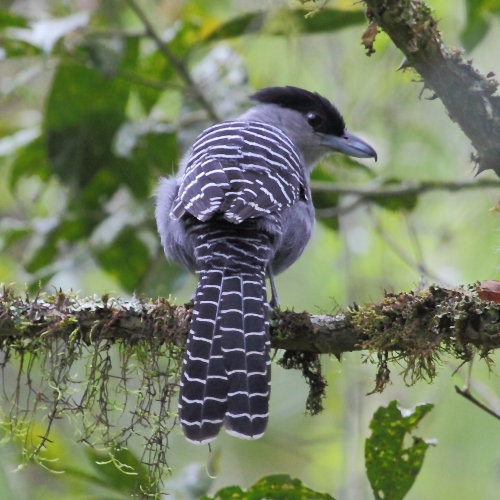
The Yellow-throated Antwren is easily identified by its bright yellow throat and breast, which contrast sharply with its otherwise dark gray plumage. Adult males display a more vibrant yellow on the throat, while females exhibit a slightly paler shade, aiding in sexual differentiation. This antwren's wings and tail are marked with subtle white spots that are more pronounced in males than in females. Juveniles resemble adults but have a duller overall appearance, lacking the distinct yellow throat patch until they mature. In flight, the Yellow-throated Antwren exhibits a fluttering, somewhat weak flight pattern typical of small forest-dwelling birds. Its short, rounded wings and long tail assist in agile maneuvering through dense foliage. When perched, the antwren often adopts an upright posture, with its tail cocked slightly upwards, allowing for better balance when foraging among branches. The Yellow-throated Antwren can be confused with similar species such as the White-flanked Antwren, which shares its habitat. However, the distinct yellow throat of Myrmotherula ambigua and the absence of a white flank stripe help differentiate it from its close relatives.
Having trouble telling birds apart? Upload a photo to our bird identification tool for an instant species match.
Yellow-throated Antwren Habitat and Range
Preferred Habitat
The Yellow-throated Antwren prefers dense, humid lowland forests, frequently inhabiting areas rich in tangled vines and thick understory vegetation. It is most commonly found in tropical forests in Colombia and Panama, thriving at elevations ranging from sea level to about 1000 meters. This bird shows a preference for areas that remain relatively undisturbed, as it relies on the rich biodiversity of these habitats for food and shelter. Seasonal habitat shifts are minimal for this species due to its non-migratory nature. However, it may move slightly in elevation or to different parts of the forest in response to food availability during various times of the year. While primarily a forest dweller, the Yellow-throated Antwren can occasionally be observed in forest edges and secondary growth areas, particularly if these regions are adjacent to primary forests. Despite the ongoing encroachment of urban areas, this bird maintains a strong preference for natural habitats, seldom being found in urban environments.
Geographic Range
The breeding range of the Yellow-throated Antwren primarily encompasses the tropical forests of Central and northern South America. This bird is most prevalent in Colombia and Panama, where it occupies the humid lowland and foothill forests. The species does not undertake long-distance migrations, preferring to remain within its established range throughout the year. However, local movements may occur in response to changes in food availability or habitat conditions. Population density hotspots include regions along the Pacific slope of Colombia and areas within the Darién region of Panama, where the forest habitat is both extensive and relatively intact. These areas provide the dense understory and abundant insect prey necessary for the species' survival. While the Yellow-throated Antwren is not considered migratory, its presence in specific regions may fluctuate seasonally due to habitat alterations or environmental pressures. Conservation efforts focus on preserving its forest habitats, ensuring that this colorful bird continues to thrive in its natural range without the pressures of significant range shifts.
Want to know which birds visit your area? Browse our backyard birds by location guides for region-specific species lists.
What Does the Yellow-throated Antwren Eat?
The Yellow-throated Antwren primarily feeds on a diet of small insects and arthropods, including ants, beetles, and spiders. Its foraging technique involves gleaning from leaves and branches within the forest understory, where it uses its sharp beak to pick off prey concealed beneath foliage. Seasonal diet changes are minimal, but the bird may adjust its foraging behavior to exploit temporary insect outbreaks or shifts in prey availability. The antwren is known for its active and agile foraging style, often seen hopping rapidly through branches as it searches for food. It typically forages in mixed-species flocks, a strategy that maximizes foraging efficiency and reduces the risk of predation. Prey size is generally small, with the bird focusing on insects that can be easily captured and consumed in one bite. Feeding occurs throughout the day, with peaks in activity during the cooler morning and late afternoon hours when insect activity is highest.
Yellow-throated Antwren Behavior and Social Structure
Yellow-throated Antwrens are social birds often seen in pairs or small groups. They exhibit territorial behavior during the breeding season, with males defending their territories through vocal displays and physical posturing. The courtship displays of this species include wing-flicking and tail-spreading, accompanied by soft calls to attract mates. Outside the breeding season, the Yellow-throated Antwren participates in mixed-species flocks, enhancing its foraging success and reducing predation risks. This bird displays a strong response to predators, using alarm calls to alert nearby individuals of potential threats. Daily activity patterns are influenced by the availability of food and environmental conditions, with the antwren being most active during cooler parts of the day. The Yellow-throated Antwren's social structure is flexible, adapting to changes in group composition and habitat conditions. Its interactions with other species in mixed flocks highlight its adaptability and ecological significance in maintaining forest dynamics.
Yellow-throated Antwren Nesting and Reproduction
The Yellow-throated Antwren constructs a cup-shaped nest made from fine plant materials, such as grasses and leaves, often reinforced with spider silk for added stability. Nests are typically placed low in the understory, concealed within dense vegetation to protect against predators. Clutch size ranges from two to three eggs, which are incubated primarily by the female for about 14 days. Both parents participate in feeding the chicks, which fledge approximately 10-12 days after hatching. The fledglings remain dependent on their parents for several weeks, gradually learning to forage independently. The Yellow-throated Antwren typically raises one to two broods per year, depending on environmental conditions and food availability. Parental roles are well-defined, with males often taking a more active role in territory defense while females focus on incubation and early chick care.
Yellow-throated Antwren Sounds and Vocalizations
The primary song of the Yellow-throated Antwren is a series of rapid, high-pitched notes delivered in a descending pattern. These notes are clear and melodious, often described as a 'tsee-tsee-tsee' that increases in tempo towards the end. Call notes are shorter and less musical, used primarily for communication between mates or signaling alarm. Alarm calls are sharp and insistent, serving to alert other birds of potential predators. During the dawn chorus, the Yellow-throated Antwren's song becomes more frequent and intense, contributing to the rich soundscape of the tropical forest. The vocalizations of this species are distinctive yet blend harmoniously with the ambient sounds of its habitat, making it a familiar and cherished presence among the avian community.
Interesting Facts About the Yellow-throated Antwren
- 1The Yellow-throated Antwren can cover an area in search of food in less than 10 minutes, highlighting its efficient foraging strategy.
- 2Despite its small size, the Yellow-throated Antwren has a surprisingly loud and distinctive song that carries through the dense forest.
- 3This species often forages in mixed-species flocks, sometimes comprising more than 10 different bird species, enhancing its foraging success.
- 4The Yellow-throated Antwren's vivid yellow throat is an important identifier, as similar species lack this striking feature.
- 5This antwren plays a crucial role in controlling insect populations within its habitat, contributing to the ecological balance of tropical forests.
- 6The species is highly adapted to life in the understory, where its agility allows it to navigate dense vegetation with ease.
- 7The Yellow-throated Antwren's presence in an area is often used as an indicator of the health and biodiversity of the forest ecosystem.
Yellow-throated Antwren Conservation Status
The Yellow-throated Antwren is currently classified as a species of Least Concern by the IUCN, but its population trend is decreasing due to ongoing habitat destruction. Primary threats include deforestation for agriculture and urban expansion, which reduce the available habitat for this forest-dependent species. Conservation efforts focus on protecting and restoring its natural habitats, particularly in regions where forest cover is critically declining. Historically, the population of this species has been stable, but recent environmental pressures highlight the need for continued conservation attention. Efforts include the establishment of protected areas and sustainable land-use practices in key regions. Awareness campaigns and research initiatives aim to monitor population trends and habitat health, ensuring that the Yellow-throated Antwren remains a thriving component of its ecosystem.
Other Thamnophilidae Species



Birds Similar to the Yellow-throated Antwren
These species are often confused with the Yellow-throated Antwren due to similar appearance or overlapping range.

