
Ainley's Storm-Petrel
Oceanodroma cheimomnestes
Order: Procellariiformes / Family: Hydrobatidae

Wikimedia Commons
About the Ainley's Storm-Petrel
Ainley's Storm-Petrel, scientifically known as Oceanodroma cheimomnestes, is an intriguing species of seabird belonging to the family Hydrobatidae. This bird is primarily found in the North Pacific, particularly around the waters of Baja California, Mexico. Ainley's Storm-Petrel plays a crucial role in the marine ecosystem by acting as both a predator and prey. It predominantly feeds on small fish and zooplankton, contributing to the regulation of these populations.
The ecological significance of Ainley's Storm-Petrel cannot be overstated. It is an indicator species, reflecting the health of the marine environment. Changes in its population can signal shifts in marine ecosystems, often linked to climate change or pollution. As a seabird, it spends most of its life on the wing, gliding over the open ocean far from land. During the breeding season, it returns to specific islands to nest, often selecting isolated and rocky terrains that offer protection from predators.
Seasonal behaviors of Ainley's Storm-Petrel include long migratory flights. Outside the breeding season, these birds disperse widely across the Pacific Ocean. In winter, they may travel as far south as Central America. This extensive range aids in their survival, as they can exploit different food resources and environmental conditions throughout the year. Their presence in diverse marine environments underscores their adaptability and resilience in facing various ecological challenges.
The Ainley's Storm-Petrel belongs to the family Hydrobatidae, within the order Procellariiformes. These birds typically live average 12 years with max recorded at 16 years.
How to Identify a Ainley's Storm-Petrel
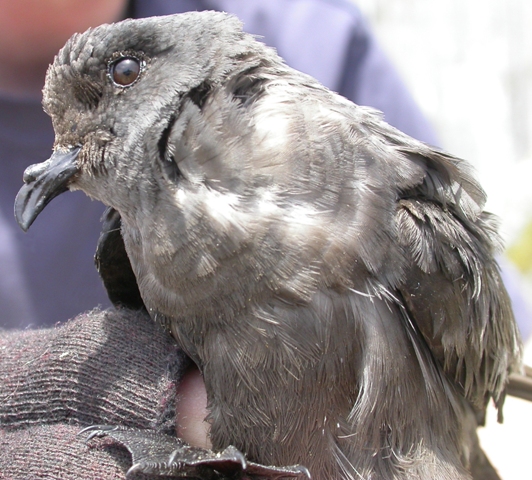
Ainley's Storm-Petrel is a small bird, measuring approximately 20 centimeters in length with a wingspan of about 46 centimeters. The adult plumage is predominantly dark, with a sooty brown body and long, narrow wings. A distinguishing feature is the white rump patch, which can be seen in flight. Juveniles resemble adults but may have more worn feathers towards the end of the breeding season.
Male and female Ainley's Storm-Petrels are visually similar, making sex differentiation in the field challenging without close observation. Their flight pattern is characterized by quick, erratic movements, interspersed with glides on stiff wings. This flight behavior is typical among storm-petrels and aids in distinguishing them from other seabirds.
When observing Ainley's Storm-Petrel, note the bird's silhouette against the sky. Its wings appear long and angular, and the bird often flutters low over the water. Unlike larger seabirds, it rarely perches on land except during the breeding season. This combination of features helps avoid confusion with similar species such as the Leach's Storm-Petrel, which has a more forked tail and different vocalizations.
Having trouble telling birds apart? Upload a photo to our bird identification tool for an instant species match.
Ainley's Storm-Petrel Habitat and Range
Preferred Habitat
Ainley's Storm-Petrel is predominantly a pelagic species, inhabiting the open ocean of the North Pacific. They thrive in marine environments and are most commonly sighted over deep waters near the continental shelf. During the breeding season, they return to coastal islands, favoring rocky cliffs and islets that offer shelter from terrestrial predators.
While primarily marine, these birds are not typically found near urban environments. They prefer remote, uninhabited islands, which provide the solitude necessary for nesting. Their habitat usage shifts seasonally, with breeding occurring on islands and non-breeding periods spent entirely at sea, sometimes thousands of kilometers from their nesting sites.
Elevation range does not significantly impact Ainley's Storm-Petrel, as they remain close to sea level, both over the ocean and when nesting on coastal cliffs. This preference for low elevations aligns with their life history as a seabird adapted to a life spent largely over water.
Geographic Range
Ainley's Storm-Petrel has a breeding range concentrated along the Pacific coasts of North America, particularly around Baja California, Mexico. They also breed on islands in the Gulf of California. During the non-breeding season, they disperse widely across the Pacific Ocean.
Migration corridors for Ainley's Storm-Petrel can be extensive. After breeding, these birds travel south along the west coast of the Americas, reaching as far as Central America. This range allows them to exploit different oceanic regions for feeding and survival.
Population density hotspots include the waters surrounding their breeding islands, where they congregate in significant numbers during the breeding season. However, their distribution becomes more diffuse during the winter months, with individuals spread across a vast expanse of the Pacific. This wide-ranging distribution aids their resilience against localized environmental changes.
Want to know which birds visit your area? Browse our backyard birds by location guides for region-specific species lists.
What Does the Ainley's Storm-Petrel Eat?
The diet of Ainley's Storm-Petrel consists mainly of small fish and zooplankton. They forage by skimming the ocean surface, often capturing prey during flight. Their diet includes lanternfish and various crustaceans, which they detect using acute vision.
Seasonal variations in diet occur, particularly during the breeding season when they require higher energy intake. During this time, they may also consume squid and other cephalopods. Their foraging technique involves hovering and dipping, taking advantage of oceanic upwellings where prey is more abundant.
Prey size is generally small, ranging from a few millimeters to several centimeters, allowing them to swallow it whole. Feeding typically occurs during daylight hours, although Ainley's Storm-Petrel is known to take advantage of bioluminescent prey in dim light conditions, a testament to their adaptability in foraging strategies.
Ainley's Storm-Petrel Behavior and Social Structure
Ainley's Storm-Petrel exhibits a social structure typical of many seabird species. During the breeding season, they form loose colonies on isolated islands. These colonies are not as densely packed as those of some other seabirds, reflecting their need for individual nesting space.
Courtship involves aerial displays, where males perform complex flight maneuvers to attract females. After pair bonding, both partners participate in nest building and incubation duties, highlighting their cooperative breeding behavior.
Flocking patterns vary; while generally solitary at sea, they may form loose groups when feeding over productive waters. In response to predators, Ainley's Storm-Petrel relies on its agile flight to evade aerial threats like gulls or skuas. Their daily activity patterns are diurnal, with peak activity during daylight when visibility aids their foraging effectiveness.
Ainley's Storm-Petrel Nesting and Reproduction
Ainley's Storm-Petrel nests on isolated islands, preferring crevices in rocky cliffs or burrows in soft soil. These nests, often lined with dried vegetation, provide a secure environment for egg laying. The typical clutch size is a single egg, reflecting the species' investment in offspring survival.
The incubation period lasts approximately 40 to 50 days, during which both parents share duties. After hatching, the chick remains in the nest for about 65 days before fledging. Parental care involves both adults feeding the chick regurgitated food, ensuring sufficient nourishment.
Ainley's Storm-Petrel typically raises one brood per year, aligning with their long-lived seabird strategy. This single brood focus maximizes the chances of chick survival in the challenging marine environment they inhabit.
Ainley's Storm-Petrel Sounds and Vocalizations
The vocalizations of Ainley's Storm-Petrel are distinct, consisting of a series of high-pitched, rapid twittering notes. These calls serve as communication between mates and are most commonly heard at breeding colonies.
Alarm calls are sharper and more abrupt, serving to alert others of potential threats. These sounds are particularly noticeable during the nesting season when territoriality peaks.
Ainley's Storm-Petrel does not participate in a dawn chorus as many passerines do, but its night-time calls can be heard when approaching nesting sites. These vocalizations aid in reinforcing pair bonds and establishing colony territories.
Interesting Facts About the Ainley's Storm-Petrel
- 1Ainley's Storm-Petrel can travel over 10,000 kilometers during its migratory journeys, showcasing its incredible endurance.
- 2Despite being a seabird, Ainley's Storm-Petrel rarely swims, preferring to forage while flying at the ocean surface.
- 3These birds can live for over 20 years in the wild, a testament to their adaptation to the harsh marine environment.
- 4Ainley's Storm-Petrel's white rump makes it easier to identify during flight against the ocean's backdrop.
- 5During breeding, Ainley's Storm-Petrel relies on a single egg strategy, reflecting a high investment in offspring care.
- 6The species is named after ornithologist David Ainley, who conducted extensive research on storm-petrels.
- 7Ainley's Storm-Petrel uses olfactory cues to locate prey, a rare ability among birds, enhancing its foraging success.
Ainley's Storm-Petrel Conservation Status
Ainley's Storm-Petrel is currently classified as Least Concern by the IUCN, reflecting a relatively stable population. However, threats such as habitat destruction, introduced predators, and marine pollution persist. Conservation efforts focus on protecting breeding habitats, particularly island nesting sites, from invasive species like rats and cats. Historical population changes have seen declines in some areas due to human activity, but conservation actions have stabilized many populations. Continued monitoring and habitat protection are vital for maintaining Ainley's Storm-Petrel populations. Efforts include international cooperation to preserve critical migratory and feeding areas, ensuring the species' long-term survival.
Other Hydrobatidae Species



Birds Similar to the Ainley's Storm-Petrel
These species are often confused with the Ainley's Storm-Petrel due to similar appearance or overlapping range.

