
Leach's Storm-Petrel
Hydrobates leucorhous
Order: Procellariiformes / Family: Hydrobatidae

Wikimedia Commons
About the Leach's Storm-Petrel
The Leach's Storm-Petrel, scientifically known as Hydrobates leucorhous, is an intriguing seabird that spends the majority of its life over the open ocean. This bird is part of the family Hydrobatidae within the order Procellariiformes and is adapted to a life at sea. Its presence is a significant component of marine ecosystems, where it plays a crucial role in controlling small fish and plankton populations. Often spotted far from land, Leach's Storm-Petrels are pelagic birds that breed on islands in the North Atlantic and North Pacific Oceans. During the breeding season, they return to remote, predator-free islands such as the Aleutian Islands and the British Isles. Here, they nest in burrows or crevices, utilizing their nocturnal habits to avoid predators. Outside the breeding season, Leach's Storm-Petrels disperse widely across the ocean. In the North Atlantic, they are known to migrate to the open waters off the western coast of Africa, while those in the North Pacific may travel to the subtropical and tropical waters of the Pacific Ocean. This migratory behavior highlights their remarkable endurance and navigation capabilities. The ecological role of Leach's Storm-Petrel extends beyond their immediate interactions with prey. They serve as indicators of ocean health and can be affected by changes in marine conditions, such as prey availability and pollution. As part of the marine avian community, they contribute to the nutrient cycling within oceanic ecosystems. Understanding the life and habits of the Leach's Storm-Petrel offers insight into the broader health of marine environments, emphasizing the importance of conservation efforts targeting marine and avian biodiversity.
The Leach's Storm-Petrel belongs to the family Hydrobatidae, within the order Procellariiformes. These birds typically live average lifespan is 15-20 years, with a maximum recorded of over 30 years..
How to Identify a Leach's Storm-Petrel
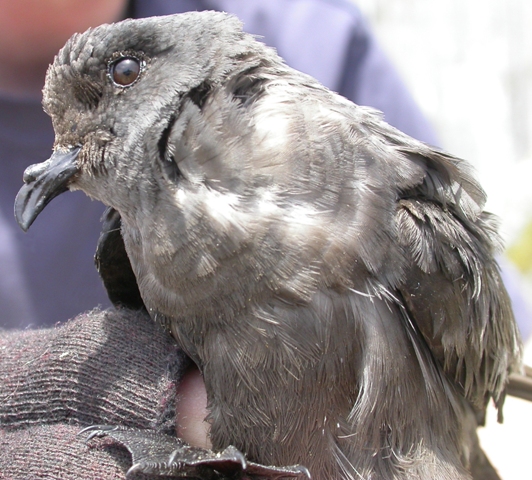
Leach's Storm-Petrel is a small seabird measuring approximately 18-21 cm in length with a wingspan of 43-48 cm. It is characterized by its sooty black plumage, which contrasts with a pale rump and a slightly forked tail. This forked tail distinguishes it from the similar-looking Wilson's Storm-Petrel, which has a square tail. The bird's legs are long and extend beyond the tail in flight, a useful field mark. Adults of both sexes have similar plumage, making gender differentiation challenging in the field. Juveniles closely resemble adults but may have fresher plumage with more distinct white feather edges. In flight, Leach's Storm-Petrel exhibits a distinctive, erratic fluttering pattern, often interspersed with glides. Its flight silhouette is unique due to its long wings and forked tail, aiding identification even at a distance. When resting on the water, it adopts a low profile with its body nearly submerged, distinguishing it from other pelagic birds that sit higher on the water. Observers should note the subtle variations in plumage and flight pattern to correctly identify this species amid the vast oceanic expanse.
Having trouble telling birds apart? Upload a photo to our bird identification tool for an instant species match.
Leach's Storm-Petrel Habitat and Range
Preferred Habitat
Leach's Storm-Petrel primarily inhabits pelagic zones of the open ocean. It breeds on remote islands with soft soil suitable for burrow nesting, such as the islands off the coast of Scotland and Alaska. These breeding sites are typically free from terrestrial predators, allowing the birds to nest securely. Outside the breeding season, they are found over deep ocean waters, often far from land. They prefer cooler waters but can be seen in a broad range of marine environments, from temperate to subtropical regions. Their presence is generally absent from urban areas, remaining strictly marine. Seasonal shifts in habitat are marked by their migratory patterns, where they move from northern breeding grounds to southern wintering areas, traversing vast oceanic expanses.
Geographic Range
Leach's Storm-Petrel has a widespread range across the North Atlantic and North Pacific Oceans. During the breeding season, they are found on islands off the coasts of North America and Europe, including Newfoundland, Greenland, and Iceland. In the North Pacific, breeding ranges include the Aleutian Islands and the Kuril Islands. After breeding, they migrate to wintering grounds in the open ocean, with Atlantic populations moving towards the waters off western Africa and the South American coast. Similarly, Pacific populations venture into the central and south Pacific. The migration corridors are vast, spanning thousands of kilometers across open waters, with certain areas like the Bay of Biscay acting as important stopover points. The dense populations in breeding colonies contrast with their dispersed nature at sea.
Want to know which birds visit your area? Browse our backyard birds by location guides for region-specific species lists.
What Does the Leach's Storm-Petrel Eat?
The diet of Leach's Storm-Petrel consists mainly of small fish, planktonic crustaceans, and squid. These birds feed by picking prey off the ocean surface while flying or by making shallow dives. In the breeding season, they focus on areas rich in plankton and fish, adjusting their foraging strategies to local prey availability. During migration and winter, their diet diversifies slightly to include a broader range of oceanic organisms. They often feed at night, taking advantage of the diel vertical migration of prey species towards the ocean surface. The size of prey ranges from several millimeters to a few centimeters, allowing the storm-petrel to exploit a wide size range of available marine life.
Leach's Storm-Petrel Behavior and Social Structure
Leach's Storm-Petrel exhibits unique behavioral traits adapted to life at sea. These birds are highly social, often seen in flocks during foraging, which can number from a few individuals to several dozen. Despite their social nature at sea, they exhibit solitary nesting behavior. During the breeding season, they return to their natal colonies at night to avoid predation. Courtship involves elaborate aerial displays, where males and females engage in synchronized flight patterns. They do not exhibit territorial behavior at sea but are highly territorial around nesting sites. Their response to predators, such as gulls and skuas, includes swift evasive flight and retreat into their burrows. Daily activity patterns are largely nocturnal, especially during the breeding season, as they return to their nests under the cover of darkness.
Leach's Storm-Petrel Nesting and Reproduction
Leach's Storm-Petrel nests in burrows excavated in soft soil or in natural crevices among rocks. These burrows are typically located on remote islands with minimal predator presence. Nesting occurs in dense colonies, where individual pairs maintain a small territory around their burrow entrance. The typical clutch size is one egg, which both parents incubate for about 40-50 days. Chicks are altricial and remain in the nest for several weeks, being fed regurgitated food by both parents. Fledging occurs after 60-70 days, with young birds making their first flight to sea independently. Typically, only one brood is raised per year, reflecting the energy-intensive nature of their breeding strategy.
Leach's Storm-Petrel Sounds and Vocalizations
The vocalizations of Leach's Storm-Petrel are distinctive and serve as a key identification feature during nocturnal hours at breeding colonies. Their primary song consists of a series of rapid, chattering notes, often described as 'churrs' or 'purrs.' These sounds have a repetitive, mechanical rhythm that can be likened to a small motor. Call notes used for communication between mates are softer and more subdued. Alarm calls, triggered by the presence of predators, are sharper and more insistent. Unlike many land birds, Leach's Storm-Petrel does not participate in a dawn chorus, as their vocal activity peaks during the night.
Interesting Facts About the Leach's Storm-Petrel
- 1Leach's Storm-Petrel can live over 30 years, demonstrating remarkable longevity for a bird of its size.
- 2These birds can travel several thousand kilometers during migration, showcasing their impressive endurance.
- 3Leach's Storm-Petrel uses a unique sense of smell to locate food over vast oceanic distances.
- 4Their erratic flight is highly energy-efficient, enabling them to cover large areas while foraging.
- 5Despite their small size, they are capable of surviving harsh ocean storms, a testament to their adaptability.
- 6The species was named after British zoologist William Elford Leach in recognition of his contributions to ornithology.
- 7Leach's Storm-Petrels are one of the few bird species that are more active at night, especially during the breeding season.
Leach's Storm-Petrel Conservation Status
Currently, Leach's Storm-Petrel is classified as Vulnerable on the IUCN Red List. Its population trend shows a decline, primarily due to threats from invasive species on breeding islands, such as rats and cats, which prey on eggs and chicks. Pollution, especially plastic debris, poses additional risks by affecting adult health and chick development. Conservation efforts focus on habitat protection and invasive species eradication on critical breeding islands. Historical population estimates suggest greater numbers before human impact altered many of their nesting sites. Continued monitoring and protective measures are necessary to ensure the survival of this species.
Other Hydrobatidae Species



Birds Similar to the Leach's Storm-Petrel
These species are often confused with the Leach's Storm-Petrel due to similar appearance or overlapping range.
