
Ashy Storm-Petrel
Hydrobates homochroa
Order: Procellariiformes / Family: Hydrobatidae
Wikimedia Commons
About the Ashy Storm-Petrel
The Ashy Storm-Petrel (Hydrobates homochroa) is a small seabird that belongs to the family Hydrobatidae. Renowned for its elusive nature, this species primarily inhabits the cool, nutrient-rich waters of the eastern Pacific Ocean. Its range is strictly limited to the coastal regions from central California to northern Baja California. This bird plays a crucial role in the marine ecosystem, serving as both predator and prey. With a global population estimated at fewer than 10,000 individuals, the Ashy Storm-Petrel is considered one of the more specialized members of its family. Its presence is a key indicator of oceanic health, as it thrives in areas with abundant plankton and small fish populations. During the breeding season, the Ashy Storm-Petrel nests in crevices and caves on offshore islands, relying on the relative safety these isolated locales provide. The Channel Islands and the Farallon Islands off the coast of California are particularly significant breeding sites. During this time, the bird exhibits nocturnal behavior, likely to avoid predation. The ecological role of the Ashy Storm-Petrel is multifaceted. As a predator, it focuses on small fish and invertebrates, while as prey, it supports higher trophic levels including larger seabirds and marine mammals. This dual role underscores the bird's significance in maintaining the balance of its marine habitat. Seasonally, the Ashy Storm-Petrel shows limited movement compared to other seabirds. Instead of extensive migrations, it exhibits a pattern of local dispersal, moving slightly offshore during the non-breeding season. This behavior minimizes energy expenditure and allows the bird to remain within nutrient-rich waters year-round. Conservation efforts are crucial for the Ashy Storm-Petrel, given its restricted range and vulnerability to environmental changes. The species faces threats from oil spills, light pollution, and introduced predators on nesting islands. Consequently, understanding its ecological role and specific habitat requirements can aid in devising effective conservation strategies.
The Ashy Storm-Petrel belongs to the family Hydrobatidae, within the order Procellariiformes. These birds typically live average lifespan is 10 years, with a maximum recorded of 34 years..
How to Identify a Ashy Storm-Petrel
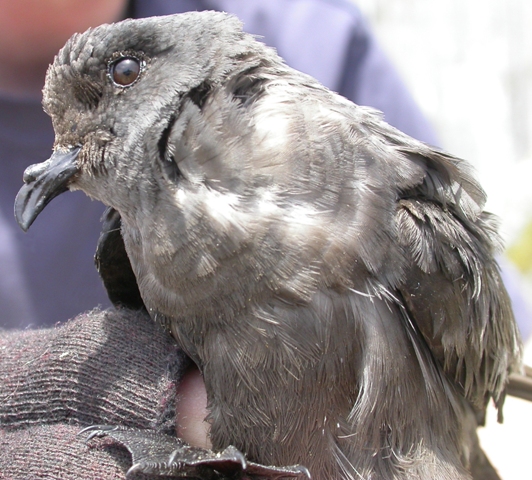
The Ashy Storm-Petrel is a small seabird, measuring approximately 18 to 21 centimeters in length with a wingspan ranging from 38 to 42 centimeters. Its plumage is predominantly sooty gray with a slightly paler rump, which can be a key distinguishing feature when observing the bird in flight. Unlike some other storm-petrels, it lacks the white rump patch that can often lead to confusion with species like the Black Storm-Petrel or Wilson's Storm-Petrel. Males and females appear similar, with no significant differences in plumage. Juveniles resemble adults but may have fresher, more uniformly colored feathers when they first fledge. The flight silhouette of the Ashy Storm-Petrel is characterized by its long, narrow wings and forked tail, which it uses to maneuver deftly over ocean swells. In terms of perching, the bird often rests on the water's surface, bobbing lightly with the waves, although it rarely comes to rest on land outside of the nesting season. During field observations, note the bird’s rapid, fluttering flight interspersed with glides, a common trait among storm-petrels.
Having trouble telling birds apart? Upload a photo to our bird identification tool for an instant species match.
Ashy Storm-Petrel Habitat and Range
Preferred Habitat
The Ashy Storm-Petrel is intimately associated with the coastal and pelagic waters of the eastern Pacific Ocean. Preferring cool, nutrient-rich environments, its habitat primarily includes areas where upwelling currents bring plankton to the surface. This seabird frequents the waters off central and southern California and northern Baja California, rarely venturing far from the continental shelf. The Ashy Storm-Petrel shows a marked preference for nesting on remote offshore islands, such as the Channel Islands and the Farallon Islands, where it uses rocky crevices and caves to hide from predators. While it remains a strictly marine bird, spending much of its life over the open ocean, it is occasionally seen near shore, particularly during the breeding season. Unlike many seabirds, the Ashy Storm-Petrel does not exhibit significant seasonal habitat shifts, maintaining a consistent presence in its preferred marine environments throughout the year.
Geographic Range
The Ashy Storm-Petrel's range is confined to the eastern Pacific Ocean, predominantly along the coast of the United States and Mexico. Its breeding range is particularly concentrated around the Channel Islands and the Farallon Islands in California. These islands provide the necessary isolation and safety for nesting. Outside of the breeding season, the Ashy Storm-Petrel remains relatively close to these areas, exhibiting limited dispersal rather than long-distance migration. The bird’s wintering grounds overlap significantly with its breeding range. Although it does not undertake extensive migratory journeys, some individuals may venture slightly further out to sea during the non-breeding months. Population density hotspots include the waters surrounding these breeding islands, where the birds concentrate to exploit the abundant marine resources. Despite the species’ limited range, its presence is a consistent feature along the California Current, a dynamic oceanographic system that supports diverse marine life.
Want to know which birds visit your area? Browse our backyard birds by location guides for region-specific species lists.
What Does the Ashy Storm-Petrel Eat?
The Ashy Storm-Petrel's diet primarily consists of small fish and zooplankton, such as krill and other crustaceans. During the breeding season, it often targets areas with high concentrations of these food resources, facilitated by oceanic upwellings. The bird employs a distinctive feeding technique known as surface seizing, where it skims the water's surface with its bill to capture prey. Occasionally, it also uses a method akin to pattering, where it briefly touches the water with its feet to maintain balance while feeding. The bird's diet may shift slightly with the seasons, reflecting changes in prey availability. Small fish, typically no longer than a few centimeters, form a consistent part of its diet. Feeding activity peaks during crepuscular hours, particularly at dawn and dusk, when prey is more accessible at the water’s surface. The Ashy Storm-Petrel's foraging efficiency and dietary flexibility are crucial for its survival in the dynamic marine environment.
Ashy Storm-Petrel Behavior and Social Structure
The Ashy Storm-Petrel exhibits a range of behaviors adapted to its pelagic lifestyle. Social structures are evident in its tendency to form loose flocks, particularly during foraging. These aggregations offer advantages such as increased foraging efficiency and protection from predators. Despite this social foraging behavior, the bird maintains a solitary or paired existence during the breeding season, with pairs often returning to the same nesting sites annually. Courtship displays are subtle, involving synchronized flight patterns above the nesting colonies. The bird exhibits a strong territorial instinct over its nesting crevice, vigorously defending it against intruders. In response to predators, such as gulls and owls, the Ashy Storm-Petrel adopts nocturnal habits, reducing its vulnerability by returning to the nest under the cover of darkness. Daily activity patterns revolve around feeding and resting, interspersed with periods of preening and social interaction. Flocking patterns are particularly evident during non-breeding periods, when birds gather in larger numbers at sea.
Ashy Storm-Petrel Nesting and Reproduction
The nesting behavior of the Ashy Storm-Petrel is characterized by its preference for secluded and hard-to-reach locations. Nests are typically found in crevices or burrows on rocky offshore islands, such as the Channel Islands and Farallon Islands. These sites offer protection from terrestrial predators and harsh weather conditions. The bird uses minimal nesting material, often relying on existing substrate within the chosen crevice. Clutch size is usually limited to a single egg, a common trait among storm-petrels. Incubation lasts approximately 40 to 50 days, with both parents sharing duties equally. After hatching, the chick remains in the nest for about 60 to 70 days before fledging. Parental care is extensive, with both parents providing food through regurgitation. Typically, the Ashy Storm-Petrel raises only one brood per year, aligning with its life strategy of investing significant resources into the survival of a single offspring. The nesting period is a critical time for the bird, as it balances the demands of chick-rearing with the need to evade predators.
Ashy Storm-Petrel Sounds and Vocalizations
The Ashy Storm-Petrel produces a variety of vocalizations, though it is generally considered a quiet bird compared to other seabirds. Its primary song, heard mainly at night near nesting sites, consists of soft, repetitive whistles and chirps. These sounds serve as communication between mates and as territory markers. The pitch is relatively high, and the rhythm is steady but not musical. Call notes include short, sharp clicks, often delivered in rapid succession, which can function as contact calls when birds are in flight. Alarm calls are infrequent but consist of louder, more agitated chirps, usually in response to potential threats. During the dawn chorus, the Ashy Storm-Petrel's vocalizations blend into the ambient sounds of the colony, creating a subtle but persistent background noise.
Interesting Facts About the Ashy Storm-Petrel
- 1The Ashy Storm-Petrel is capable of living up to 30 years, a remarkable lifespan for such a small bird, highlighting its adaptability to the marine environment.
- 2Despite its name, the Ashy Storm-Petrel rarely ventures into stormy conditions, preferring calmer seas where it can efficiently hunt for prey.
- 3The species is one of the few seabirds that does not undergo long-distance migrations, staying close to its breeding grounds year-round.
- 4During the breeding season, Ashy Storm-Petrels are known to travel up to 100 kilometers in a single night to forage for food.
- 5The bird's nocturnal habits during the breeding season help it avoid predation by diurnal birds of prey such as gulls and hawks.
- 6Ashy Storm-Petrels use a technique called 'pattering' to feed, where they tap the water surface with their feet to catch prey.
- 7The bird relies heavily on bio-luminescent prey, which can make up a significant portion of its diet during certain times of the year.
Ashy Storm-Petrel Conservation Status
The Ashy Storm-Petrel is currently listed as Near Threatened on the IUCN Red List, with its population trend showing signs of decline. Primary threats include habitat disturbance from human activities, introduced predators such as rats and cats on nesting islands, and pollution, particularly oil spills. Light pollution near urban coastal areas also disrupts the bird's nocturnal activities, leading to increased mortality. Conservation efforts focus on habitat protection, such as the eradication of invasive species from nesting islands and the establishment of marine protected areas. Historically, the population has faced fluctuations due to these threats, coupled with the natural variability of marine resources. Active monitoring and research continue to play a vital role in understanding and mitigating the risks facing the Ashy Storm-Petrel.
Other Hydrobatidae Species


Birds Similar to the Ashy Storm-Petrel
These species are often confused with the Ashy Storm-Petrel due to similar appearance or overlapping range.