
Band-rumped Storm-Petrel
Hydrobates castro
Order: Procellariiformes / Family: Hydrobatidae

Wikimedia Commons
About the Band-rumped Storm-Petrel
The Band-rumped Storm-Petrel, scientifically named Hydrobates castro, is a small seabird in the family Hydrobatidae, well-known for its wide-ranging pelagic lifestyle. This species inhabits the open ocean, rarely coming to land except for breeding purposes. It plays a crucial ecological role as a predator of small fish and planktonic crustaceans, helping regulate these populations in marine ecosystems. The Band-rumped Storm-Petrel is found across various regions, notably the Atlantic and Pacific Oceans, where it uses both temperate and tropical waters for foraging.
Breeding colonies of the Band-rumped Storm-Petrel are located on isolated oceanic islands, such as those in the Azores, Madeira, and parts of Japan. In the Atlantic, these birds breed on islands like the Cape Verde and Canary Islands. During the non-breeding season, they disperse widely across the oceans, indicating their strong adaptability to different marine environments.
This storm-petrel exhibits seasonal behaviors related to its breeding cycle. They return to breeding colonies at night, an adaptation likely developed to avoid predation. During the breeding season, which varies depending on the location, they exhibit a unique pattern of nocturnal activity. Outside of the breeding season, the Band-rumped Storm-Petrel remains largely solitary, spreading out across vast oceanic expanses.
As a nocturnal feeder, the Band-rumped Storm-Petrel utilizes a surface-seizing feeding technique, skimming the ocean surface for prey. Their presence in the oceanic food web highlights their importance in energy transfer within marine ecosystems, linking primary consumers to higher trophic levels. The Band-rumped Storm-Petrel's capacity to thrive in remote and harsh oceanic environments underscores its ecological significance and adaptability.
The Band-rumped Storm-Petrel belongs to the family Hydrobatidae, within the order Procellariiformes. These birds typically live average lifespan of 10-15 years, with a maximum recorded of over 20 years..
How to Identify a Band-rumped Storm-Petrel
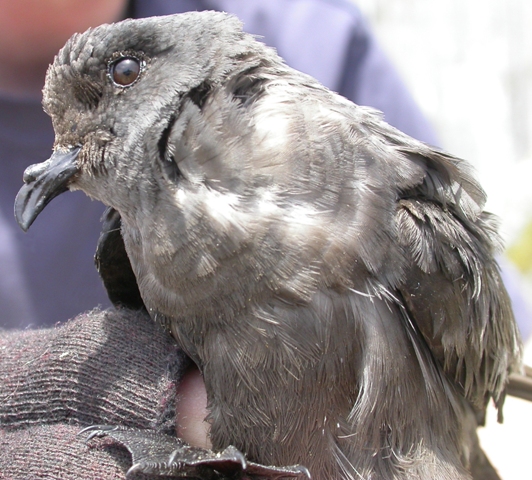
The Band-rumped Storm-Petrel is a small, dark seabird with a wingspan ranging from 43 to 46 centimeters. One of its most distinctive field marks is the prominent white band across its rump, which contrasts sharply with its otherwise dark brown to black plumage. This feature aids in distinguishing it from similar species, such as the Leach's Storm-Petrel, which lacks a continuous white rump band.
Adult Band-rumped Storm-Petrels exhibit uniform dark upperparts and underparts, with a slight fork in their tail. Juveniles resemble adults but may have fresher plumage and slightly less prominent rump markings. There are no significant differences in plumage between males and females, making sexing in the field challenging.
In flight, their silhouette is characterized by long, narrow wings that are slightly rounded at the tips. They exhibit an agile, erratic flight pattern, often gliding low over the waves. When perching, typically on rocky ledges or burrows during the breeding season, they display a slightly hunched posture, with their wings held close to the body.
Having trouble telling birds apart? Upload a photo to our bird identification tool for an instant species match.
Band-rumped Storm-Petrel Habitat and Range
Preferred Habitat
The Band-rumped Storm-Petrel primarily inhabits pelagic zones, thriving in open ocean environments far from land. These birds are highly adapted to life at sea, rarely venturing close to shorelines except during the breeding season. Breeding colonies are found on remote, rocky islands such as those in the Azores and Madeira.
They prefer higher elevations for nesting, often selecting steep cliffs or rocky outcrops that provide protection from predators and harsh weather. During non-breeding periods, they roam extensively across the ocean, showing little preference for specific oceanic regions. Unlike some seabirds, the Band-rumped Storm-Petrel is rarely seen in urban or coastal environments.
Seasonal habitat shifts occur mainly during the breeding season when they return to land. Outside of breeding, they are truly pelagic, adapting to various oceanic conditions, from warmer tropical waters to cooler temperate regions.
Geographic Range
The Band-rumped Storm-Petrel has a wide-ranging distribution, primarily across the Atlantic and Pacific Oceans. Breeding colonies are located on several remote islands, including the Azores, Madeira, Cape Verde, and the Canary Islands in the Atlantic. In the Pacific, breeding sites are found on Japanese islands and parts of the Hawaiian archipelago.
During the non-breeding season, these birds disperse widely across the oceans, though specific migration corridors are not well-documented due to their pelagic nature. They are known to migrate over vast distances, reaching areas as far as the coasts of South America and the eastern United States.
Population density hotspots are often found around breeding islands, where colonies can be dense. However, at sea, they tend to be solitary or in small groups, making them less conspicuous. Their wide-ranging presence across both tropical and temperate zones highlights their adaptability.
Want to know which birds visit your area? Browse our backyard birds by location guides for region-specific species lists.
What Does the Band-rumped Storm-Petrel Eat?
The Band-rumped Storm-Petrel primarily feeds on small fish, squid, and planktonic crustaceans, utilizing a surface-seizing technique. They often feed at night, capitalizing on the vertical migration of prey organisms that rise closer to the surface under the cover of darkness.
Their diet varies slightly with the seasons, aligning with the availability of prey. During the breeding season, energy-rich prey such as squid and fish are more frequently consumed to meet the nutritional demands of egg production and chick rearing. In contrast, during non-breeding months, their diet might include more planktonic crustaceans, which are abundant in oceanic waters.
The Band-rumped Storm-Petrel's foraging technique involves skimming the ocean surface while in flight, using their keen eyesight to detect prey. They are known to feed in association with other seabirds and marine mammals, often exploiting feeding opportunities created by larger predators driving prey to the surface.
Band-rumped Storm-Petrel Behavior and Social Structure
The Band-rumped Storm-Petrel is a largely solitary bird outside of the breeding season, though it may associate loosely with other seabirds while foraging. During the breeding season, they exhibit highly social behavior, nesting in dense colonies on remote islands. This colonial nesting is crucial for predator avoidance and cooperative chick rearing.
Courtship displays include aerial chases and vocalizations, which occur primarily at night to minimize predation risk. The species is known for its strong site fidelity, often returning to the same nesting site year after year. Territorial behavior is observed within colonies, with pairs defending their nesting burrows from intruders.
In response to predators, the Band-rumped Storm-Petrel relies on its nocturnal habits and remote nesting locations. Their daily activity patterns are largely governed by their nocturnal feeding habits, as they spend daylight hours resting on the ocean surface or at sea.
Band-rumped Storm-Petrel Nesting and Reproduction
The Band-rumped Storm-Petrel nests in burrows or crevices on remote, rocky islands. These burrows provide protection from predators and harsh weather conditions. The species shows strong site fidelity, often returning to the same nesting site each year.
Typically, the female lays a single egg per breeding season. Both parents share incubation duties, which last approximately 40 to 50 days. After hatching, the chick remains in the burrow and is fed regurgitated food by both parents.
Fledging occurs after about 60 to 70 days, during which the chick grows rapidly and molts into juvenile plumage. The Band-rumped Storm-Petrel typically raises only one brood per year, given the extensive parental investment required for each chick.
Band-rumped Storm-Petrel Sounds and Vocalizations
The Band-rumped Storm-Petrel's vocalizations are primarily heard at night within breeding colonies. Their calls include a series of soft, chattering notes that resemble a rapid 'chirrup,' often described as insect-like.
These vocalizations serve as communication between mates and as a means of establishing territory within crowded colonies. Alarm calls are sharper and more abrupt, used to alert other birds of potential danger.
The species' calls can be difficult to detect at sea due to their low volume and the bird's pelagic lifestyle. However, within the confines of a nesting colony, their chorus can be a constant backdrop during nocturnal hours.
Interesting Facts About the Band-rumped Storm-Petrel
- 1The Band-rumped Storm-Petrel can travel thousands of kilometers across the ocean without returning to land.
- 2This species is also known as the Madeiran Storm-Petrel, named after one of its breeding islands.
- 3Despite their small size, Band-rumped Storm-Petrels can withstand harsh oceanic conditions year-round.
- 4Their unique feeding technique involves skimming over the water surface, a method called surface seizing.
- 5Band-rumped Storm-Petrels are known to breed during different times of the year, depending on the colony location.
- 6The species can live up to 15 years in the wild, showcasing their adaptability to marine life.
- 7DNA studies have shown that different populations of Band-rumped Storm-Petrels might represent distinct species.
Band-rumped Storm-Petrel Conservation Status
The Band-rumped Storm-Petrel is currently listed as Least Concern by the IUCN, although its populations face several threats. Predation by introduced species such as rats and cats on nesting islands poses a significant risk. Conservation efforts focus on habitat protection and predator control on breeding islands. These include eradication programs for invasive species and legal protection of nesting sites. Population trends for some colonies suggest stability, though comprehensive data is lacking due to the species' wide-ranging oceanic habits. Historical records indicate some population declines, likely linked to habitat disturbance and climate change impacts on marine ecosystems.
Other Hydrobatidae Species



Birds Similar to the Band-rumped Storm-Petrel
These species are often confused with the Band-rumped Storm-Petrel due to similar appearance or overlapping range.
