
Amazonian Umbrellabird
Cephalopterus ornatus
Order: Passeriformes / Family: Cotingidae

Wikimedia Commons
About the Amazonian Umbrellabird
The Amazonian Umbrellabird (Cephalopterus ornatus) is an enigmatic avian species found primarily in the tropical rainforests of the Amazon Basin. This bird is a member of the Cotingidae family and is noted for its distinctive umbrella-shaped crest and resonant calls that echo through the forest. The Amazonian Umbrellabird plays a crucial ecological role as both a seed disperser and a predator of various insects, thus contributing to the biodiversity of its habitat. Found across Colombia, Ecuador, Peru, Brazil, and Venezuela, the species thrives in the lowland and foothill forests, particularly in regions with high humidity and dense canopy cover. By consuming a diverse diet of fruits, especially those from palm trees, and small invertebrates, the Amazonian Umbrellabird serves as an important agent of seed dispersal, aiding in forest regeneration. During the breeding season, which coincides with the rainy season, the male performs elaborate displays and vocalizations to attract females, often becoming more conspicuous than during the rest of the year. As the dry season approaches, the birds may move slightly in response to food availability, though they are generally considered sedentary. Despite their ecological importance, the Amazonian Umbrellabird faces significant threats from habitat destruction due to logging and agricultural expansion. Conservation efforts focus on preserving their natural habitat and mitigating the impacts of deforestation. Understanding the Amazonian Umbrellabird's behavior and ecological role remains a priority for researchers and conservationists aiming to protect this unique species and its environment.
The Amazonian Umbrellabird belongs to the family Cotingidae, within the order Passeriformes. These birds typically live 10-12 years, with a max recorded of 20 years.
How to Identify a Amazonian Umbrellabird
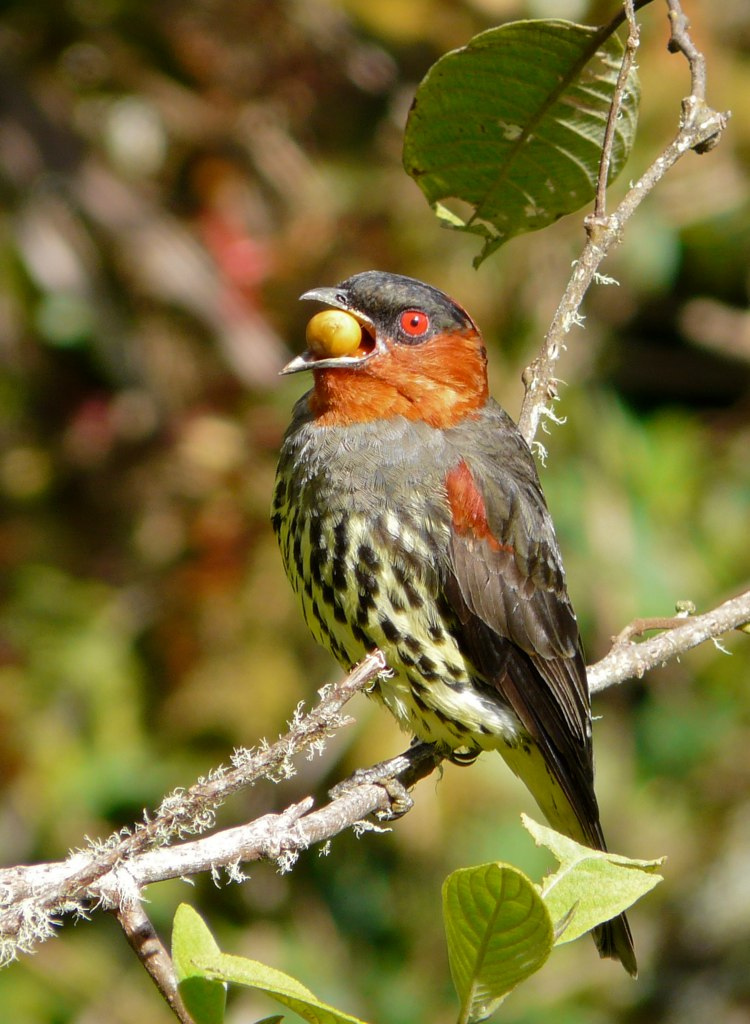
Adult Amazonian Umbrellabirds are primarily black with a striking crest that resembles an upturned umbrella, a feature that is more pronounced in males. This crest can be raised or lowered and serves as a key distinguishing mark. The males also exhibit a conspicuous wattle on their throat, which is used during courtship displays. Females and juveniles are similar in appearance but have less developed crests and wattles. The bird's robust size, often about 40 centimeters in length, makes it one of the larger passerine birds. In flight, the Amazonian Umbrellabird displays broad wings and a straight tail, contributing to a silhouette that is distinctive among its forest habitat. When perched, it often remains motionless on high branches, blending into the foliage thanks to its dark plumage. While there are no other species that share its unique combination of features, the Amazonian Umbrellabird could potentially be confused with the smaller and less crested members of its genus, though their habitats often do not overlap.
Having trouble telling birds apart? Upload a photo to our bird identification tool for an instant species match.
Amazonian Umbrellabird Habitat and Range
Preferred Habitat
The Amazonian Umbrellabird inhabits the dense and humid rainforests of the Amazon Basin, thriving in areas with a rich canopy and abundant fruiting trees. It prefers lowland and foothill forests up to elevations of around 1400 meters. This species is particularly associated with primary forests, although it can occasionally be found in well-preserved secondary forests. Seasonal habitat shifts are minimal due to its largely sedentary nature, but the bird may adjust its range slightly in search of food during different times of the year. Unlike some other tropical birds, the Amazonian Umbrellabird does not frequent urban areas, as it relies heavily on the undisturbed forest environment for breeding and feeding. Conservation of its habitat is crucial, as deforestation poses a significant threat to its survival.
Geographic Range
The Amazonian Umbrellabird's range extends across the northern and western regions of the Amazon Basin. It is found in countries such as Colombia, Ecuador, Peru, Brazil, and Venezuela. The bird's breeding range overlaps extensively with its year-round habitat, as the species does not typically engage in long-distance migrations. However, some local movements may occur in response to changes in food availability. Population density tends to be highest in areas with large tracts of undisturbed forest, particularly in protected areas and national parks. Despite its extensive range, the bird is not commonly seen due to its elusive nature and preference for dense canopy cover.
Want to know which birds visit your area? Browse our backyard birds by location guides for region-specific species lists.
What Does the Amazonian Umbrellabird Eat?
The Amazonian Umbrellabird primarily feeds on a diet of fruits and small invertebrates. Its strong bill is well adapted for consuming a variety of fruits, particularly those from palm trees and other canopy species. During the wet season, the availability of fruits increases, allowing the bird to focus on foraging in the upper canopy. In the dry season, when fruits are less abundant, it supplements its diet with insects and small vertebrates, contributing to its role as a predator. The Amazonian Umbrellabird employs a sit-and-wait foraging technique, often perching quietly before making targeted forays to capture its food. Feeding primarily occurs during early morning and late afternoon, when the forest is most active.
Amazonian Umbrellabird Behavior and Social Structure
The Amazonian Umbrellabird exhibits a fascinating array of behaviors, particularly during the breeding season. Males are known for their elaborate courtship displays, which include raising their umbrella-like crests and throat wattles while producing deep, booming calls to attract females. These displays often take place in lek-like gatherings, where multiple males compete for the attention of potential mates. Outside the breeding season, the Amazonian Umbrellabird is generally solitary or found in small family groups. It is a territorial species, with males defending their display areas from rivals. Despite its large size, the bird is relatively inconspicuous, moving through the forest canopy with ease and often remaining stationary for long periods. When threatened by predators, the Amazonian Umbrellabird will often freeze or retreat into dense foliage, relying on its camouflaging plumage for protection. Daily activity patterns are characterized by periods of intense foraging interspersed with rest, usually during the midday heat.
Amazonian Umbrellabird Nesting and Reproduction
The nesting behavior of the Amazonian Umbrellabird involves constructing a cup-shaped nest high in the forest canopy. The nest is typically made from twigs, leaves, and moss, carefully woven to provide stability. Preferred nesting locations are often in tall trees, away from potential ground-based predators. The female lays a clutch of one to two eggs, which she incubates alone for approximately 18 to 20 days. Post-hatching, both parents participate in feeding the chicks, bringing a variety of fruits and insects to the nest. The fledging period lasts about 30 to 35 days, after which the young birds gradually gain independence. The Amazonian Umbrellabird generally raises one brood per year, although favorable conditions may occasionally lead to a second.
Amazonian Umbrellabird Sounds and Vocalizations
The Amazonian Umbrellabird's vocalizations are distinctive and primarily consist of deep, resonant calls that can carry over long distances in the dense forest. The primary song is a series of low, booming notes, often compared to the sound of a distant drum or a foghorn. These calls play a crucial role in courtship and territorial displays, particularly during the breeding season. Apart from its characteristic song, the bird also produces a variety of softer, more subtle calls used for communication between mates and family members. Alarm calls are sharp and brief, designed to alert others to the presence of predators. The dawn chorus in the Amazonian rainforest frequently features the Amazonian Umbrellabird's unique vocalizations, adding to the rich acoustic environment.
Interesting Facts About the Amazonian Umbrellabird
- 1The Amazonian Umbrellabird's crest can measure up to 20 centimeters in length and is used during courtship displays.
- 2Despite being one of the largest passerines, the Amazonian Umbrellabird is adept at moving through dense forest canopies.
- 3Males use their inflatable throat wattles to amplify their calls, which can be heard up to half a kilometer away.
- 4The bird's diet includes a significant amount of palm fruits, making it an important pollinator in its ecosystem.
- 5Amazonian Umbrellabirds are rarely seen on the ground, preferring to remain high in the forest canopy.
- 6The species was first described by Sir William Jardine in 1856, highlighting its long-standing intrigue among ornithologists.
- 7Its resonant calls have inspired local legends and myths within indigenous communities in the Amazon.
Amazonian Umbrellabird Conservation Status
The Amazonian Umbrellabird is currently listed as Vulnerable by the IUCN, with populations suspected to be declining due to habitat loss and fragmentation. Deforestation for agriculture and logging poses the greatest threat to its survival, as the bird relies heavily on intact forest ecosystems. Conservation efforts focus on preserving large tracts of rainforest and establishing protected areas to safeguard remaining populations. Historical population declines have been attributed to the expanding human footprint in the Amazon Basin. Continued research and monitoring are essential to assess population trends and inform conservation strategies.
Other Cotingidae Species



Birds Similar to the Amazonian Umbrellabird
These species are often confused with the Amazonian Umbrellabird due to similar appearance or overlapping range.

