
Chestnut-crested Cotinga
Ampelion rufaxilla
Order: Passeriformes / Family: Cotingidae
Wikimedia Commons
About the Chestnut-crested Cotinga
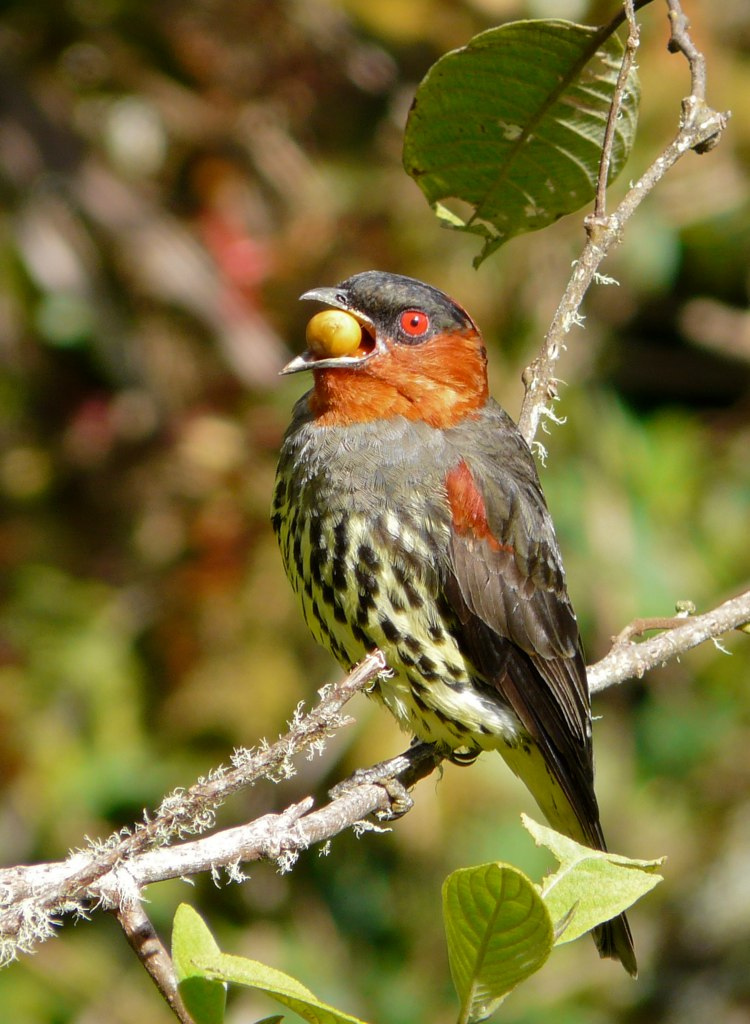
The Chestnut-crested Cotinga (Ampelion rufaxilla) is a captivating member of the Cotingidae family, known for its vibrant chestnut crest and striking plumage. This species is predominantly found in the montane forests of the Andes, ranging from Venezuela through Colombia, Ecuador, Peru, and into Bolivia. These high-altitude habitats provide a unique environment where the Cotinga plays a significant ecological role as both predator and prey. As frugivores, they consume a variety of fruits, thereby aiding in seed dispersal, which is crucial for forest regeneration and maintaining biodiversity.
The Chestnut-crested Cotinga's preference for elevations between 1,800 and 3,400 meters allows it to thrive in cloud forests, where its presence is often marked by its distinctive call. These birds are adapted to their cool, humid environment and can be observed partaking in seasonal altitudinal migrations, moving to lower elevations during inclement weather or when food becomes scarce. Despite their bright plumage, these birds can be challenging to spot due to their habit of perching quietly among dense foliage.
Ecologically, the Chestnut-crested Cotinga serves as a vital component of its environment. Its role as a seed disperser helps sustain the montane forest ecosystem. The species also acts as a bioindicator, reflecting the health of its habitat. By analyzing population trends and behaviors of the Chestnut-crested Cotinga, conservationists gain insights into broader environmental changes within its range. As human activities continue to impact these highland forests, understanding and protecting species like the Chestnut-crested Cotinga becomes increasingly important.
The Chestnut-crested Cotinga belongs to the family Cotingidae, within the order Passeriformes. These birds typically live average 7-9 years, with the oldest recorded at 11 years..
How to Identify a Chestnut-crested Cotinga
The Chestnut-crested Cotinga is most easily identified by its vibrant chestnut crown, which contrasts sharply with its predominantly grayish body. Adult males and females are similar in appearance, though the males tend to have a slightly more pronounced crest. Their underparts are a lighter gray, and the wings exhibit dark brown feathers with subtle chestnut edging. Juveniles resemble adults but can appear duller, lacking the full intensity of the chestnut crest seen in mature birds.
In flight, the Chestnut-crested Cotinga exhibits a characteristic silhouette with broad, rounded wings and a short tail, which helps distinguish it from other cohabitants. When perched, it maintains an upright posture, often remaining still for long periods, making it seem less conspicuous despite its striking coloration. This behavior, combined with its preference for high canopy perches, can make field identification challenging.
Confusion with similar species, such as the Rufous-tailed Tyrant, can occur, but the Cotinga's larger size and distinct crest provide reliable differentiators. Observers should take note of the Cotinga's vocalizations, which, along with its unique plumage, assist in accurate identification.
Having trouble telling birds apart? Upload a photo to our bird identification tool for an instant species match.
Chestnut-crested Cotinga Habitat and Range
Preferred Habitat
The Chestnut-crested Cotinga primarily inhabits montane cloud forests, thriving at elevations between 1,800 and 3,400 meters. These environments are characterized by high humidity, frequent fog, and dense vegetation, providing ample food resources and shelter. The species demonstrates a strong preference for undisturbed forest areas, where it can find the mature fruiting trees that form the core of its diet.
While the Cotinga is predominantly found in remote, high-altitude regions, it may occasionally venture into lower elevation foothill forests during periods of food scarcity or when weather conditions in higher altitudes become unfavorable. Despite its ability to adapt to different elevations, the species is rarely seen in urban settings, preferring the seclusion and safety of rural, forested areas.
Seasonal shifts in habitat use are primarily driven by food availability and weather conditions. During the dry season, when fruiting trees become less abundant at higher elevations, the Cotinga may migrate to lower altitudes where food resources are more reliable. This altitudinal migration is essential for survival, allowing the species to exploit different ecological niches throughout the year.
Geographic Range
The Chestnut-crested Cotinga's range extends along the Andes, from western Venezuela through Colombia and Ecuador, reaching into northern Peru and western Bolivia. It occupies a continuous stretch of montane forest, favoring the humid, cloud-covered regions typical of the Andean slopes. This distribution aligns closely with the presence of suitable habitat types, where the species can access the fruiting trees essential to its diet.
Within this range, the Cotinga is primarily a resident species, though it exhibits some altitudinal movement in response to seasonal changes. During periods of food scarcity or adverse weather, it may move to lower elevations, but it remains within its general geographic range year-round. The highest population densities occur in regions where mature montane forests remain relatively undisturbed by human activity.
The Cotinga's range does not extend into the lowland Amazon basin, where differing ecological conditions and competition with other species limit its presence. Instead, it thrives in the specific microclimates provided by the Andean cloud forests, which offer the necessary resources for its survival and reproduction.
Want to know which birds visit your area? Browse our backyard birds by location guides for region-specific species lists.
What Does the Chestnut-crested Cotinga Eat?
The diet of the Chestnut-crested Cotinga is primarily frugivorous, consisting largely of berries and fruits found within its montane forest habitat. Key components include fruits from the Lauraceae and Melastomataceae families, which the bird skillfully plucks from branches with its strong bill. During periods when fruit is less abundant, the Cotinga may supplement its diet with insects and small invertebrates, though these form a minor part of its nutritional intake.
Seasonal changes in fruit availability drive the Cotinga's foraging behavior, prompting it to move altitudinally to locate food. During the wet season, when fruiting is at its peak, the Cotinga can be observed feeding in the forest canopy, often in the company of other frugivorous species. This opportunistic feeding strategy helps ensure a steady food supply throughout the year.
Feeding occurs primarily during the early morning and late afternoon, capitalizing on the cooler temperatures and reduced competition. The Cotinga's ability to efficiently locate and consume fruits plays a critical role in seed dispersal, contributing to the health and regeneration of its forest habitat.
Chestnut-crested Cotinga Behavior and Social Structure
The Chestnut-crested Cotinga is a solitary or loosely social bird, often observed alone or in pairs rather than in large flocks. It exhibits territorial behavior, especially during the breeding season, when males become more vocal and active in defending their chosen areas. Courtship involves a combination of vocal displays and physical posturing, with the male showcasing its crest and plumage to attract a mate.
Throughout the day, the Cotinga alternates between periods of active foraging and passive perching, where it remains motionless for extended durations. This behavior conserves energy and aids in predator avoidance. When faced with potential threats, the Cotinga relies on its cryptic coloration and stillness to evade detection. However, if startled, it will take swift, direct flight to dense cover.
Dawn and dusk mark periods of heightened activity, with the Cotinga participating in the dawn chorus, a cacophony of calls that serves to establish territory and communicate with mates. Despite its relatively sedentary nature, the species engages in altitudinal migration in response to environmental changes, ensuring access to food resources throughout the year.
Chestnut-crested Cotinga Nesting and Reproduction
Chestnut-crested Cotingas construct cup-shaped nests using a variety of materials, including twigs, moss, and leaves, often located high in the fork of a tree branch. The selection of well-concealed sites helps protect their nests from predators. The female primarily undertakes nest-building, while the male may assist by gathering materials or defending the nesting territory.
Clutch size generally ranges from one to two eggs, with the female responsible for incubation. The incubation period lasts approximately 18 to 20 days, during which the female leaves the nest only briefly to feed. Once hatched, both parents participate in feeding the chicks, providing a diet rich in fruits and supplemented by small insects.
Fledging occurs roughly 20 to 25 days after hatching, with young Cotingas remaining dependent on parental care for a short period afterwards. The species typically raises one brood per year, aligning breeding activity with peak fruit availability to ensure ample food supply for the growing chicks.
Chestnut-crested Cotinga Sounds and Vocalizations
The Chestnut-crested Cotinga's song is a series of melodious whistles, delivered in a clear, fluty tone that resonates through the montane forests. These vocalizations serve multiple purposes, including mate attraction and territory establishment. The primary song's rhythm is steady, with a deliberate pace that distinguishes it from the calls of other forest dwellers.
In addition to its song, the Cotinga produces shorter call notes, often described as sharp and slightly nasal, used for communication between mates or signaling alarm. During the dawn chorus, the Cotinga's voice contributes to the vibrant symphony of avian calls characteristic of its habitat.
Alarm calls are more abrupt and harsh, alerting others to potential dangers. These vocalizations, though less frequent, play a vital role in the bird's survival strategy, allowing it to coordinate with others in its territory and respond effectively to predators.
Interesting Facts About the Chestnut-crested Cotinga
- 1The Chestnut-crested Cotinga's vibrant crown is more than just an ornament; it plays a key role in mate selection and territorial displays.
- 2Despite its striking appearance, the Chestnut-crested Cotinga is adept at blending into the forest canopy, using its coloration for camouflage.
- 3The Cotinga's diet of fruit makes it an important seed disperser, contributing significantly to forest regeneration and biodiversity.
- 4During altitudinal migrations, the Chestnut-crested Cotinga may travel several hundred meters in elevation to locate adequate food resources.
- 5The species' preference for high-altitude cloud forests means it often inhabits remote, pristine environments far from human disturbance.
- 6Chestnut-crested Cotingas have been known to participate in mixed-species foraging flocks, where they benefit from the vigilance of other birds.
- 7Their melodious song is considered one of the most beautiful in the Andean forests, a true signature of their presence.
Chestnut-crested Cotinga Conservation Status
The Chestnut-crested Cotinga currently holds a status of Least Concern according to the IUCN Red List, with stable population trends. However, habitat loss due to deforestation poses a significant threat to its montane forest environment. The expansion of agriculture and logging activities in the Andes have led to fragmentation of the Cotinga's habitat, which could impact future population stability. Conservation efforts focus on preserving the high-altitude cloud forests that the Cotinga depends on. Protected areas and national parks within its range provide some refuge, but continued vigilance is necessary to mitigate further habitat degradation. Historical population changes have been minimal, reflecting the species' resilience, yet ongoing monitoring is essential to ensure that this stability persists. Engagement with local communities and sustainable land-use practices are crucial components in preserving the Cotinga's native habitat, thereby safeguarding its future.
Other Cotingidae Species


Birds Similar to the Chestnut-crested Cotinga
These species are often confused with the Chestnut-crested Cotinga due to similar appearance or overlapping range.
