
Scaled Fruiteater
Ampelioides tschudii
Order: Passeriformes / Family: Cotingidae

Wikimedia Commons
About the Scaled Fruiteater
The Scaled Fruiteater, scientifically known as Ampelioides tschudii, is a captivating member of the Cotingidae family, an assemblage of birds known for their vibrant colors and diverse vocalizations. This medium-sized bird inhabits the lush forests of South America, specifically thriving in montane zones. Found predominantly in the Andean regions, the Scaled Fruiteater holds a significant role in the complex ecosystems of countries like Colombia, Ecuador, Peru, and Bolivia. It prefers elevations ranging from 1,500 to 3,000 meters, where it can often be seen perched quietly among the dense canopy.
As a frugivorous species, the Scaled Fruiteater plays a crucial ecological role in seed dispersal, contributing to the maintenance and regeneration of tropical forests. Its diet primarily consists of a wide variety of fruits and berries, which it consumes in abundance. This feeding behavior not only sustains the bird but also facilitates the growth of numerous plant species by distributing seeds across its habitat.
The Scaled Fruiteater exhibits seasonal movements, often descending to lower elevations during the non-breeding season. This altitudinal migration allows it to exploit different food resources and maintain its diet throughout the year. Despite its reliance on specific habitats, the bird adapts well to fragmented landscapes, demonstrating a surprising resilience to certain levels of habitat disturbance.
Beyond its ecological contributions, the Scaled Fruiteater holds cultural and aesthetic significance. Birdwatchers and naturalists are drawn to its distinctive appearance and behavior, making it a sought-after species for birding tours in its native regions. However, its existence is closely tied to the health of its forest environment, underscoring the importance of conservation efforts in preserving these biodiverse areas.
The Scaled Fruiteater belongs to the family Cotingidae, within the order Passeriformes. These birds typically live average of 5-7 years, with the oldest recorded at 9 years..
How to Identify a Scaled Fruiteater
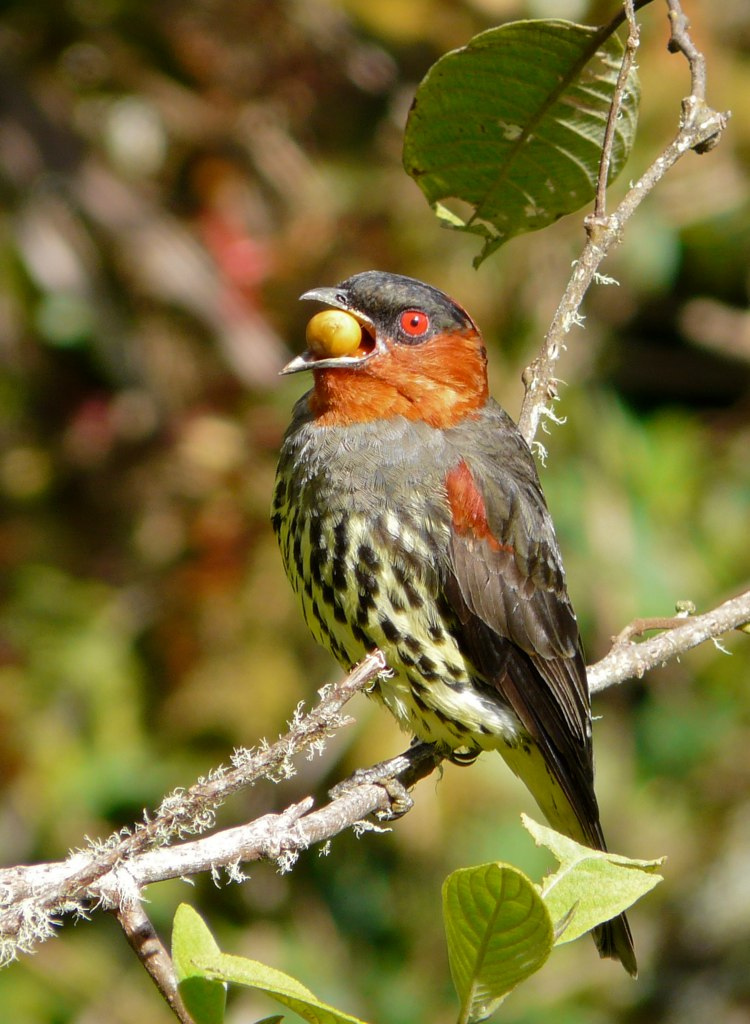
The Scaled Fruiteater is immediately recognizable by its unique plumage, which resembles scales, giving the bird its common name. Adult males display a striking combination of olive-green upperparts and a richly mottled breast. The scale-like appearance comes from the dark edges of each feather, creating a patterned effect that is both protective and decorative. Females are similarly adorned but tend to have slightly duller hues and less pronounced patterning.
Juvenile Scaled Fruiteaters resemble females but with even more subdued coloration, making them less conspicuous in the dense foliage. Both sexes possess a stout bill well-suited for fruit consumption and a relatively short tail. In flight, they reveal broad, rounded wings and a steady, buoyant flight pattern typical of many frugivorous birds.
When perched, the Scaled Fruiteater maintains an upright posture, often remaining motionless for extended periods as it surveys its surroundings. This can make it challenging to spot unless one is attuned to its presence. While there are few birds that closely resemble the Scaled Fruiteater, its unique plumage pattern sets it apart from other cotingas and forest dwellers within its range.
Having trouble telling birds apart? Upload a photo to our bird identification tool for an instant species match.
Scaled Fruiteater Habitat and Range
Preferred Habitat
The Scaled Fruiteater primarily inhabits montane cloud forests, thriving in cool, moist environments characterized by dense foliage and rich biodiversity. It favors elevations between 1,500 and 3,000 meters, where the lush canopy provides ample food resources and shelter. These forests, found along the Andean slopes, offer a complex habitat composed of diverse plant species, including fruit-bearing trees vital to the bird's diet.
During certain times of the year, the Scaled Fruiteater may venture into lower montane forests or even subtropical regions, particularly when food becomes scarce at higher elevations. This altitudinal migration highlights its adaptability to varying environmental conditions while maintaining a preference for forest habitats.
Unlike many birds that have adapted to urban environments, the Scaled Fruiteater remains closely tied to its natural habitats, relying on the continuity and health of forested areas. Its presence serves as an indicator of forest integrity and biodiversity in the regions it occupies.
Geographic Range
The Scaled Fruiteater is native to the northern and central Andes of South America. Its range extends from the mountainous regions of Colombia through Ecuador, Peru, and into Bolivia. Within these countries, it is typically found along the eastern slopes of the Andes, where the forested terrain provides suitable habitat.
This bird is primarily a resident species, with individuals typically remaining in their territories throughout the year. However, some populations exhibit altitudinal movements, descending to lower elevations during certain seasons, particularly when food resources are scarcer at higher altitudes.
While the Scaled Fruiteater is generally uncommon and localized, certain areas with pristine montane forests may host higher population densities. These hotspots include the cloud forests of Ecuador's Mindo Valley and the Manu National Park in Peru, where birdwatchers often seek out this elusive species.
Want to know which birds visit your area? Browse our backyard birds by location guides for region-specific species lists.
What Does the Scaled Fruiteater Eat?
The Scaled Fruiteater's diet is predominantly frugivorous, with a primary focus on consuming a wide variety of fruits and berries. These birds exhibit a preference for small to medium-sized fruits, which they deftly pluck from trees using their stout bills. In their forest habitats, they often feed on fruits from species such as Cecropia, Ficus, and various Lauraceae.
While fruits constitute the majority of its diet, the Scaled Fruiteater may occasionally consume insects, particularly during the breeding season when nutritional demands increase. This opportunistic feeding helps provide the necessary protein for rearing young.
Foraging typically occurs during the early morning and late afternoon, times when fruit availability and bird activity peak. The Scaled Fruiteater employs a methodical approach to foraging, moving deliberately among the canopy and often pausing to survey its surroundings before selecting its next meal.
Scaled Fruiteater Behavior and Social Structure
The Scaled Fruiteater exhibits a solitary or loosely social behavior, often seen alone or in pairs. It tends to remain within a well-defined territory, especially during the breeding season, when males may become more vocal and visible to defend their area from intruders.
Courtship displays in the Scaled Fruiteater are subtle compared to some other cotingids. Males may engage in gentle vocalizations and perch near females, occasionally offering food as part of the bonding process. These behaviors strengthen pair bonds and ensure successful mating.
In response to predators, the Scaled Fruiteater relies on its cryptic plumage to blend into the forest canopy. When threatened, it may freeze and remain motionless, relying on camouflage to avoid detection. However, it can also take swift flight if necessary, using its strong wings to escape potential danger.
Daily activity patterns for the Scaled Fruiteater typically include periods of foraging interspersed with rest and preening. The bird is most active during the cooler parts of the day, avoiding the midday heat common at its montane elevation.
Scaled Fruiteater Nesting and Reproduction
The nesting habits of the Scaled Fruiteater are characterized by a discreet and well-concealed approach, typical of many forest-dwelling birds. It builds its nest in dense foliage, often selecting a horizontal branch or a fork in a tree to provide stability and cover.
The nest itself is a relatively simple structure, constructed from twigs, leaves, and other plant materials. The female typically lays a clutch of two eggs, which she incubates for approximately 18 to 20 days. During this period, the male may assist by providing food and guarding the nest site.
Once hatched, the chicks are altricial, requiring significant parental care. They remain in the nest for about 20 to 25 days, during which both parents participate in feeding and protecting the young. The Scaled Fruiteater typically raises one brood per year, a strategy that aligns with its stable, albeit specific, ecological niche.
Scaled Fruiteater Sounds and Vocalizations
The Scaled Fruiteater's vocalizations are subtle yet distinctive, comprising a series of soft, melodious notes delivered at a moderate tempo. The primary song consists of a series of ascending and descending whistles, each note clear and flute-like, creating a harmonious melody that filters through the forest canopy.
In addition to its song, the Scaled Fruiteater produces various call notes, often used for communication between mates or to signal alarm. These calls are shorter and more abrupt, lacking the musical quality of its song.
During the dawn chorus, the Scaled Fruiteater participates with increased vocal activity, its song blending with those of other montane forest birds. While not as loud or varied as some other cotingas, its gentle music is a welcome sound for early morning forest dwellers.
Interesting Facts About the Scaled Fruiteater
- 1The Scaled Fruiteater is one of the few birds with plumage that mimics the appearance of reptilian scales, a unique adaptation.
- 2Despite being a relatively quiet bird, the Scaled Fruiteater's song is melodious and flute-like, contrasting with its cryptic appearance.
- 3Males and females of the Scaled Fruiteater are similar in plumage, a characteristic not common among many bird species.
- 4The Scaled Fruiteater participates in altitudinal migration, moving between different elevations instead of long-distance travel.
- 5In its forest habitat, the Scaled Fruiteater acts as an important seed disperser, aiding in forest regeneration and biodiversity.
- 6The Scaled Fruiteater belongs to the diverse Cotingidae family, known for its vibrant members like the Andean Cock-of-the-rock.
- 7With its preference for montane cloud forests, the Scaled Fruiteater contributes to the rich avian diversity of the Andean regions.
Scaled Fruiteater Conservation Status
The Scaled Fruiteater currently holds a status of Least Concern according to the IUCN Red List, with populations considered stable in its native range. However, ongoing habitat degradation poses a potential threat to its long-term survival. Deforestation for agriculture and logging in the Andean regions could lead to habitat loss, impacting the species' ability to maintain its population levels. Conservation efforts aimed at protecting montane forest ecosystems benefit the Scaled Fruiteater, helping preserve the biodiversity these birds depend on. Initiatives include the establishment of protected areas and sustainable land-use practices that minimize environmental impact. Historically, the Scaled Fruiteater has maintained a relatively stable population, with its range largely confined to high-altitude forested regions. Continued conservation efforts remain essential to ensure this unique bird continues to thrive in its natural habitat.
Other Cotingidae Species



Birds Similar to the Scaled Fruiteater
These species are often confused with the Scaled Fruiteater due to similar appearance or overlapping range.

