
Red-crested Cotinga
Ampelion rubrocristatus
Order: Passeriformes / Family: Cotingidae

Wikimedia Commons
About the Red-crested Cotinga
The Red-crested Cotinga, known scientifically as Ampelion rubrocristatus, inhabits the high-altitude cloud forests of the Andes, spanning from Venezuela down to Bolivia. This medium-sized passerine bird is part of the Cotingidae family, a group known for its vibrant plumage and complex vocalizations. The bird's striking red crest is a standout feature against its predominantly gray body, making it a captivating subject for bird watchers and ornithologists alike.
This species plays a vital ecological role within its habitat. By feeding on a variety of fruits, the Red-crested Cotinga aids in seed dispersal, contributing to the maintenance of the rich biodiversity found in Andean forests. The bird's presence is a strong indicator of the health of these ecosystems, which are increasingly threatened by deforestation and climate change. The Red-crested Cotinga is not just a beautiful resident of these regions; it serves as a critical component of its ecological community.
During different seasons, the Red-crested Cotinga exhibits varied behaviors. In the breeding season, which typically occurs from September to February, males become more territorial and vocal, often displaying their crests more prominently to attract mates and ward off rivals. Outside the breeding season, these birds may be less conspicuous, blending into the dense foliage of the forest canopy. Despite their striking appearance, their preference for high-altitude habitats often makes them challenging to observe.
The Red-crested Cotinga's ecological significance extends beyond its immediate environment. As a part of the Andean avian community, this species contributes to the overall diversity of birdlife in the region, influencing both local and migratory patterns. Understanding its role provides insights into the complex interactions that sustain these dynamic ecosystems. The conservation of the Red-crested Cotinga, therefore, is not only about preserving a single species but about maintaining the intricate web of life within the Andean cloud forests.
The Red-crested Cotinga belongs to the family Cotingidae, within the order Passeriformes. These birds typically live average 6-8 years, with a maximum recorded of 10 years..
How to Identify a Red-crested Cotinga
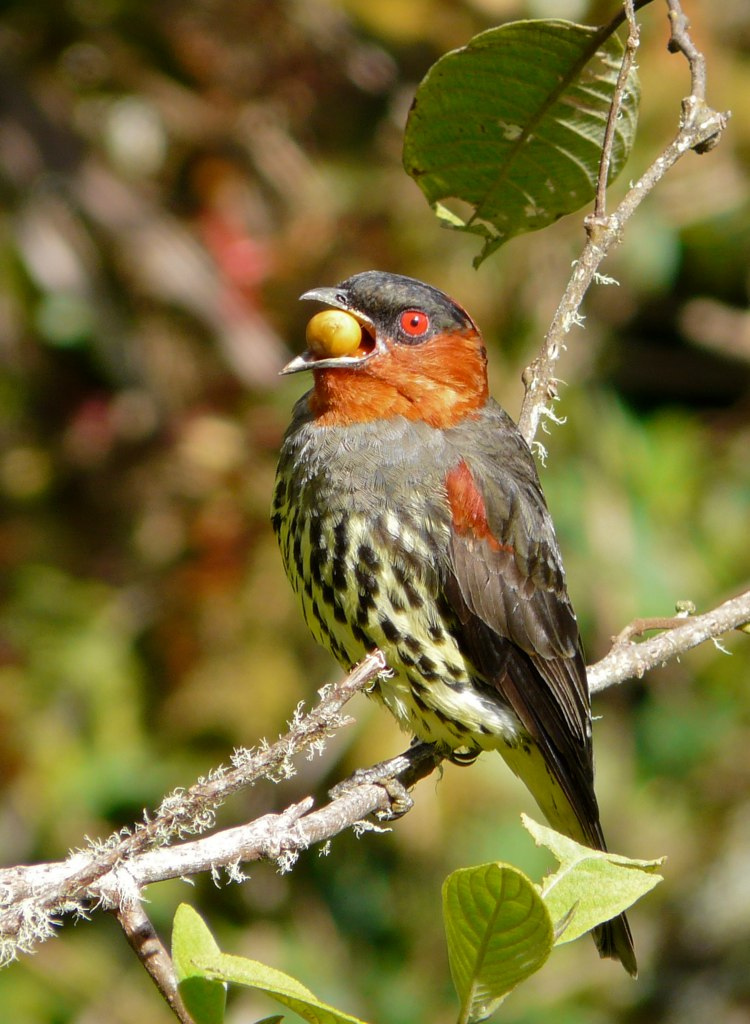
The Red-crested Cotinga is easily recognizable due to its vibrant red crest, which is most prominent in mature males. The adult plumage features a mainly gray body with subtle shading variations, complemented by white underparts. In contrast, females and juveniles display more subdued coloration, with the red crest appearing less pronounced in young birds. These differences in plumage are crucial for field identification, especially when distinguishing between genders and age classes.
In terms of size, this bird measures approximately 20 to 24 centimeters in length, with a wingspan that supports its agile flight through dense forest canopies. Their flight silhouette is characterized by broad, rounded wings and a relatively short tail, which provide stability and maneuverability amid the thick foliage of their habitat. When perched, the Red-crested Cotinga adopts an upright posture, often positioning itself on prominent branches within the mid to upper canopy layers.
Confusion may arise with similar species, such as the Band-tailed Fruiteater, which also inhabits similar altitudinal ranges. However, the fruiteater lacks the distinctive red crest and exhibits a different body shape. Observing the unique combination of crest, coloration, and posture aids in correctly identifying the Red-crested Cotinga in the field.
Having trouble telling birds apart? Upload a photo to our bird identification tool for an instant species match.
Red-crested Cotinga Habitat and Range
Preferred Habitat
The Red-crested Cotinga thrives in the montane cloud forests of the Andes, preferring elevations ranging from 1,500 to 3,500 meters. These habitats are characterized by high humidity, frequent cloud cover, and diverse plant communities. The dense canopies of these forests provide ample foraging opportunities and nesting sites, making them ideal for the cotinga's needs.
Seasonal habitat shifts are minimal for this species, as it tends to be a sedentary resident throughout its range. However, slight altitudinal movements may occur in response to food availability or climatic conditions. While the Red-crested Cotinga is primarily found in undisturbed forest areas, it can occasionally be spotted in secondary growth forests, provided that these areas retain sufficient canopy cover.
Unlike some bird species that adapt well to urban environments, the Red-crested Cotinga remains largely restricted to its natural forest habitats. Its reliance on specific ecological conditions underscores the importance of preserving these unique environments against the pressures of deforestation and human encroachment.
Geographic Range
The Red-crested Cotinga's range stretches along the Andean mountain chain, covering countries such as Venezuela, Colombia, Ecuador, Peru, and Bolivia. This distribution is primarily associated with the montane cloud forests that define the Andean regions.
Within these countries, the cotinga occupies a relatively narrow altitudinal band, favoring elevations between 1,500 and 3,500 meters. While it is a resident bird, meaning it does not undertake significant migratory movements, local populations may exhibit some altitudinal shifts in response to seasonal changes in food resources.
Population densities tend to be higher in areas where the forest remains relatively undisturbed. Hotspots for observing the Red-crested Cotinga include national parks and protected areas such as Manu National Park in Peru and Podocarpus National Park in Ecuador. These regions offer a glimpse into the bird's preferred habitat and provide opportunities for researchers and bird enthusiasts to study its behaviors and ecological interactions.
Want to know which birds visit your area? Browse our backyard birds by location guides for region-specific species lists.
What Does the Red-crested Cotinga Eat?
The diet of the Red-crested Cotinga primarily consists of a variety of fruits, which it forages adeptly from the mid to upper levels of the forest canopy. These fruits serve as the mainstay of its diet, providing essential nutrients and energy. The cotinga is particularly fond of small to medium-sized fruits, which it plucks delicately using its short, robust bill.
Seasonal variations in fruit availability can influence its dietary habits, prompting the bird to adjust its foraging strategies accordingly. During periods of fruit scarcity, the cotinga may expand its diet to include insects and other small invertebrates, although these constitute a minor component of its overall intake.
The Red-crested Cotinga employs a methodical foraging technique, often seen hopping along branches and making short flights to access fruits. Its feeding schedule aligns with the availability of its preferred food sources, with peak activity typically occurring in the early morning and late afternoon when it is cooler and less energetically demanding.
Red-crested Cotinga Behavior and Social Structure
The social structure of the Red-crested Cotinga is relatively solitary, with individuals or pairs observed more frequently than large flocks. During the breeding season, males exhibit territorial behavior, defending their chosen area with vocalizations and displays, which include raising their characteristic red crests.
Courtship displays involve a combination of visual and auditory signals. Males perform a series of acrobatic flights and elevated perch displays to attract females. These displays are accompanied by a complex array of calls, which serve to establish dominance and facilitate pair bonding.
While generally non-aggressive towards other bird species, the Red-crested Cotinga shows heightened territoriality when nesting. It responds to predators with alarm calls and evasive maneuvers, often retreating to dense foliage for cover. Daily activity patterns consist of foraging during the cooler morning and afternoon hours, with periods of rest or preening during the hotter midday.
In response to environmental cues and predator presence, these cotingas exhibit a range of behaviors that underscore their adaptability to the dynamic and often challenging conditions of their high-altitude habitats.
Red-crested Cotinga Nesting and Reproduction
The nesting habits of the Red-crested Cotinga involve constructing a delicate cup-shaped nest made primarily of moss, lichens, and fine twigs. These materials are skillfully woven together and positioned within the dense branches of the forest canopy, providing both support and camouflage.
Preferred nesting locations include the forks of horizontal branches, typically at heights ranging from 5 to 15 meters above the ground. Such positioning not only offers protection from ground-based predators but also reduces exposure to the elements.
A typical clutch consists of two to three eggs, which are incubated primarily by the female. The incubation period lasts approximately 18 to 20 days, during which the male provides food and protection. After hatching, chicks remain in the nest for about 20 to 25 days before fledging.
Throughout the breeding season, which usually spans from September to February, Red-crested Cotingas may raise one to two broods, depending on environmental conditions and food availability. Cooperative parenting ensures that both parents contribute to feeding and caring for the young, enhancing their survival prospects.
Red-crested Cotinga Sounds and Vocalizations
The vocal repertoire of the Red-crested Cotinga is characterized by a series of melodious whistles and trills, which are emitted primarily by males during the breeding season. These songs, varying in pitch and rhythm, serve to establish territory and attract mates.
Call notes consist of short, high-pitched sounds that facilitate communication between individuals, especially when navigating dense forest habitats. Alarm calls, on the other hand, are sharp and piercing, alerting others to potential dangers such as predators or intruders.
During the dawn chorus, the Red-crested Cotinga contributes a distinctive melody that resonates through the forest, adding to the symphony of sounds typical of Andean cloud forests. Its vocalizations, though not as complex as some songbirds, play a crucial role in its social interactions and territorial dynamics.
Interesting Facts About the Red-crested Cotinga
- 1The Red-crested Cotinga's bright red crest is not just for show; it plays a crucial role in courtship displays.
- 2Despite its striking appearance, the Red-crested Cotinga can be difficult to spot due to its preference for high canopies.
- 3The Red-crested Cotinga contributes significantly to seed dispersal in the Andean cloud forests, aiding in forest regeneration.
- 4This species exhibits minimal migratory behavior, largely remaining within its montane forest habitats year-round.
- 5Red-crested Cotingas are known to occasionally join mixed-species flocks, benefiting from the collective vigilance against predators.
- 6They have a unique feeding technique, often plucking fruits mid-flight during short aerial maneuvers.
- 7The Red-crested Cotinga's vocalizations can be heard echoing through the forests at dawn, adding to the symphony of Andean birdlife.
Red-crested Cotinga Conservation Status
The Red-crested Cotinga currently holds a status of Least Concern on the IUCN Red List, indicating a stable population trend. However, ongoing threats such as habitat loss due to deforestation and agricultural expansion pose significant risks to its long-term survival. Conservation efforts focus on preserving key habitat areas, particularly within national parks and reserves that harbor significant biodiversity. Initiatives aimed at sustainable land use and reforestation are critical in maintaining the ecological integrity of these regions. Historically, the Red-crested Cotinga has maintained a stable population, largely due to its preference for remote and often inaccessible habitats. Continued conservation focus ensures that this species remains a thriving component of the Andean avian community, safeguarding its future for generations to come.
Other Cotingidae Species



Birds Similar to the Red-crested Cotinga
These species are often confused with the Red-crested Cotinga due to similar appearance or overlapping range.
