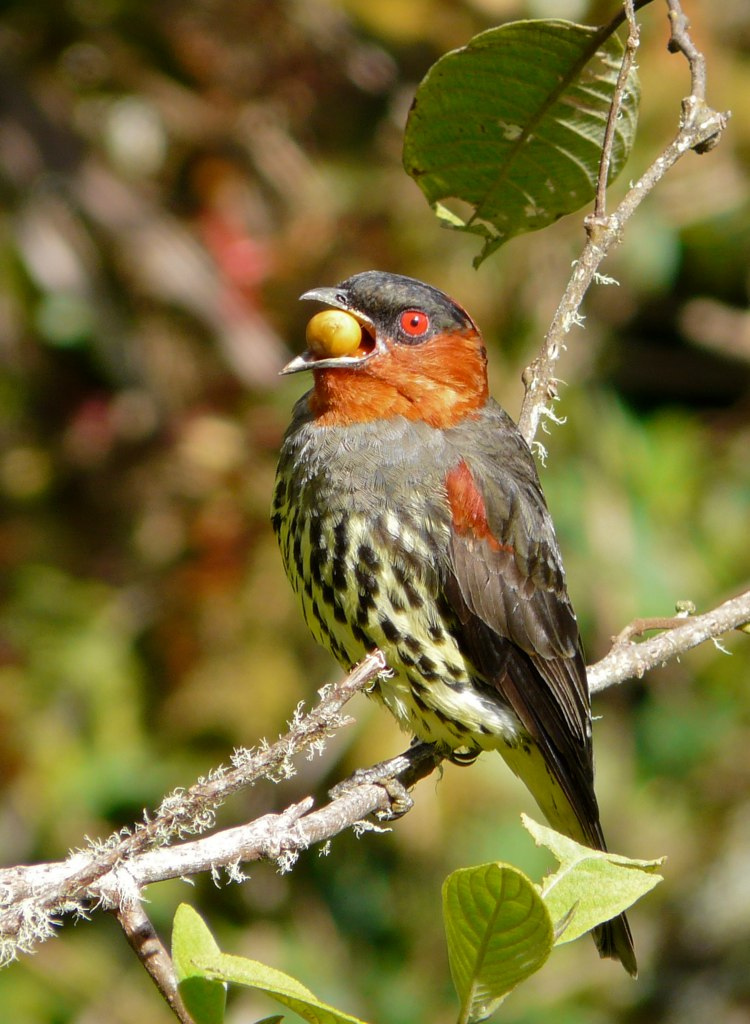
Andean Laniisoma
Laniisoma buckleyi
Order: Passeriformes / Family: Cotingidae

Wikimedia Commons
About the Andean Laniisoma
The Andean Laniisoma (Laniisoma buckleyi) is a captivating bird species within the Cotingidae family, endemic to the Andean mountain range in South America. This bird is primarily found in subtropical and tropical moist montane forests, thriving at elevations between 1,000 and 2,400 meters. It plays a crucial ecological role as both a seed disperser and an insect predator, contributing to the health and diversity of its habitat. The Andean Laniisoma's distribution primarily spans the countries of Ecuador, Peru, and Colombia, where it navigates the dense canopies of cloud forests. Observations suggest that this species engages in altitudinal migrations, moving to lower elevations during the wetter months to adapt to seasonal climate changes. Its presence in such biodiverse regions underscores its importance in maintaining ecological balance. Despite its elusive nature, the Andean Laniisoma has garnered interest from ornithologists due to its distinctive vocalizations and the challenges it presents for study in its natural habitat. The bird's role as both a predator of insects and a disperser of seeds highlights its dual contribution to the ecosystem. It participates in controlling insect populations while facilitating the spread of various plant species, thus supporting forest regeneration and health. Its ecological significance becomes even more apparent when considering the interconnectedness of species within these montane environments. The Andean Laniisoma's interactions with other forest inhabitants, including pollinators and other seed dispersers, contribute to a complex web of life that sustains the region's rich biodiversity. As a species adapted to the unique conditions of elevation, temperature, and humidity found in its habitat, the Andean Laniisoma serves as an indicator for the health of Andean montane ecosystems. Its presence or absence can reflect changes in habitat quality, making it a valuable species for monitoring environmental shifts. The bird's challenges in breeding and feeding amidst the dense forest foliage demonstrate its specialized adaptations and the fine-tuned balance it maintains with its habitat.
The Andean Laniisoma belongs to the family Cotingidae, within the order Passeriformes. These birds typically live average 7 years with a maximum recorded of 10 years.
How to Identify a Andean Laniisoma
Identifying the Andean Laniisoma involves recognizing its unique plumage and physical characteristics. Adult males exhibit a striking combination of olive-green upperparts and vibrant yellow underparts, with a slightly more subdued coloration in females. The head is marked by a blackish cap that contrasts with the bird's lighter throat and eye ring. Juveniles tend to have more muted tones, lacking the stark contrasts seen in adults. Both sexes share a similar overall body structure, characterized by a medium-sized, compact build and a relatively short tail. The Andean Laniisoma's flight silhouette is compact, with rounded wings that allow for agile maneuvering through dense forest canopies. When perched, the bird often assumes an upright posture, which can aid birders in identifying it from a distance. Its calls, although not loud, carry a musical quality that can assist in locating this otherwise elusive species. Confusion with similar species may occur, especially with sympatric cotingas or manakins. However, the Andean Laniisoma's combination of olive and yellow, along with its distinct vocalizations, usually differentiates it from other birds in the same habitat. Observers should note the subtle differences in plumage between individuals, as well as any seasonal variations that might influence appearance.
Having trouble telling birds apart? Upload a photo to our bird identification tool for an instant species match.
Andean Laniisoma Habitat and Range
Preferred Habitat
The Andean Laniisoma primarily inhabits montane cloud forests, a habitat characterized by high humidity, persistent cloud cover, and a rich diversity of plant life. These forests are typically found at elevations ranging from 1,000 to 2,400 meters, providing a unique environment that supports a myriad of specialized flora and fauna. Within this habitat, the bird favors areas with dense canopy cover, where it can forage for insects and fruit. Seasonal changes in its habitat can prompt altitudinal shifts, as the bird moves to lower elevations during the rainy season in search of more favorable conditions. The Andean Laniisoma's presence is generally limited to rural and undeveloped forested areas, as it relies on the complexity and richness of these ecosystems for survival. Its dependence on such specific habitats highlights the importance of preserving these environments, particularly in the face of increasing deforestation and habitat fragmentation.
Geographic Range
The Andean Laniisoma's range is largely confined to the northern Andes, specifically within countries like Ecuador, Peru, and Colombia. Its breeding range is concentrated in these regions, where it inhabits montane cloud forests. The bird is not known for long-distance migrations, but it does exhibit altitudinal movements in response to seasonal environmental changes, such as shifts in food availability and weather patterns. Population density hotspots are often found in well-preserved forest areas, where the necessary habitat conditions are met. Due to its limited range and specific habitat requirements, the Andean Laniisoma is considered rare and localized, with populations often restricted to isolated patches of suitable forest. Conservation efforts focus on protecting these critical habitats to ensure the long-term survival of the species.
Want to know which birds visit your area? Browse our backyard birds by location guides for region-specific species lists.
What Does the Andean Laniisoma Eat?
The diet of the Andean Laniisoma primarily consists of insects and fruit, reflecting its role as both a predator and seed disperser. During the breeding season, insects form a substantial part of its diet, providing the necessary protein for raising young. It forages actively within the forest canopy, using its agile flight to catch flying insects mid-air or glean them from foliage. Fruit becomes a more prominent food source during other times of the year, with the bird consuming a variety of berries and small fruits available in its montane habitat. The size of prey taken by the Andean Laniisoma can vary, but it typically targets small to medium-sized insects, ensuring a balanced diet. Its foraging schedule tends to peak during the early morning and late afternoon, aligning with periods of increased insect activity and fruit availability.
Andean Laniisoma Behavior and Social Structure
The Andean Laniisoma exhibits a range of intriguing behaviors that provide insight into its life in the montane forests. It is generally solitary or found in pairs, reflecting a territorial nature during the breeding season. Courtship displays involve vocalizations and visual cues, with males often singing from prominent perches to attract females. These displays are crucial for pair bonding and successful mating. The bird's response to predators involves both vocal alarm calls and evasive maneuvers, utilizing its agile flight to escape threats. Daily activity patterns show a preference for foraging during cooler parts of the day, with periods of rest during midday heat. While not known for forming large flocks, the Andean Laniisoma may join mixed-species foraging groups, benefiting from the increased vigilance and foraging efficiency these groups offer. Its interactions with conspecifics and other species underscore the complex social dynamics present in montane forest ecosystems.
Andean Laniisoma Nesting and Reproduction
Nesting behavior in the Andean Laniisoma reflects its adaptation to the dense forest environment. The bird typically constructs a cup-shaped nest using a variety of materials, including twigs, leaves, and moss, which provide both support and camouflage. Nests are usually situated in the fork of a tree or concealed within dense foliage to protect against predators. Clutch sizes range from two to three eggs, with an incubation period lasting approximately 14 to 16 days. Both parents share responsibilities in incubating the eggs and feeding the chicks, highlighting a cooperative breeding strategy. The fledging timeline for the young is around 20 to 25 days, during which the chicks develop rapidly under the care of both parents. The Andean Laniisoma typically raises one brood per year, aligning its reproductive efforts with the peak availability of food resources in its habitat.
Andean Laniisoma Sounds and Vocalizations
The primary song of the Andean Laniisoma is a melodious series of whistles and trills, characterized by a clear, rhythmic pattern. This song is often delivered from a prominent perch during the early morning hours, serving both as a territorial marker and an attraction for potential mates. Call notes are generally softer and more subdued, used for communication between individuals, particularly during foraging or when alarmed. Alarm calls tend to be sharper and more urgent, designed to alert conspecifics to the presence of predators. The bird's vocalizations contribute to the auditory landscape of the montane forests, adding to the rich tapestry of sounds that define these biodiverse habitats.
Interesting Facts About the Andean Laniisoma
- 1The Andean Laniisoma's song is so distinct that it can be used to identify the bird even in dense forests where visibility is low.
- 2Unlike many other birds, the Andean Laniisoma is more vocal during misty mornings, when its song carries farthest through the mountain air.
- 3The species was rediscovered in Colombia in 2009 after being considered locally extinct for several decades.
- 4The Andean Laniisoma can live up to 10 years in the wild, showcasing remarkable longevity for a bird of its size.
- 5The bird's olive and yellow plumage provides excellent camouflage against the moss-covered branches and leaves of its montane forest home.
- 6Studies have shown that the Andean Laniisoma plays a crucial role in controlling insect populations within its habitat.
- 7The Andean Laniisoma's altitudinal migrations align with the fruiting schedules of certain forest plants, ensuring a steady food supply.
Andean Laniisoma Conservation Status
The Andean Laniisoma is currently classified as Near Threatened according to the IUCN Red List, with population trends indicating a decline due to habitat loss. Primary threats include deforestation and habitat fragmentation driven by agricultural expansion and logging activities. Conservation efforts focus on protecting critical habitats within its range, particularly in countries like Ecuador and Peru, where conservation areas and national parks offer some refuge. Historical population changes have seen fluctuations in numbers, largely influenced by environmental changes and human activities. Continued monitoring and habitat preservation are essential for ensuring the species' long-term survival, requiring collaboration between conservation organizations and local communities.