Ashambu Laughingthrush
Montecincla meridionalis
Order: Passeriformes / Family: Leiothrichidae

Wikimedia Commons
About the Ashambu Laughingthrush
The Ashambu Laughingthrush, Montecincla meridionalis, inhabits the lush, montane forests of the Western Ghats, specifically in the Ashambu Hills in southern India. This region is a biodiversity hotspot, providing a unique ecological niche for this bird. The Ashambu Laughingthrush thrives in these dense, evergreen forests, where it plays a crucial role in seed dispersal and insect control. Its presence indicates a healthy forest ecosystem, as it relies on the intricate web of forest life for sustenance. Typically, these birds are found at elevations ranging from 1,200 to 2,000 meters, where the climate remains cool and moist throughout the year.
The Ashambu Laughingthrush is of significant conservation interest due to its limited range and specialized habitat requirements. As a species endemic to the Western Ghats, it exemplifies the rich avian diversity of this area. The bird's survival hinges on the preservation of its forest habitat, which faces threats from deforestation and habitat fragmentation. Conservationists emphasize the importance of protecting these forests not only for the Ashambu Laughingthrush but also for the myriad of other species that share its home.
Ecologically, the Ashambu Laughingthrush acts as both a predator and prey. It consumes a variety of insects and small fruits, thereby aiding in pest control and seed dispersal. Its foraging behavior often involves moving in small groups, which helps in locating food resources efficiently while maintaining vigilance against predators. During the breeding season, typically from March to August, these birds become more territorial, aggressively defending their nesting sites. The Ashambu Laughingthrush's ability to adapt its diet and behavior to seasonal changes underscores its integral role in the forest ecosystem, contributing to the overall health and resilience of its habitat.
The Ashambu Laughingthrush belongs to the family Leiothrichidae, within the order Passeriformes. These birds typically live average 6-8 years with max recorded up to 10 years..
How to Identify a Ashambu Laughingthrush
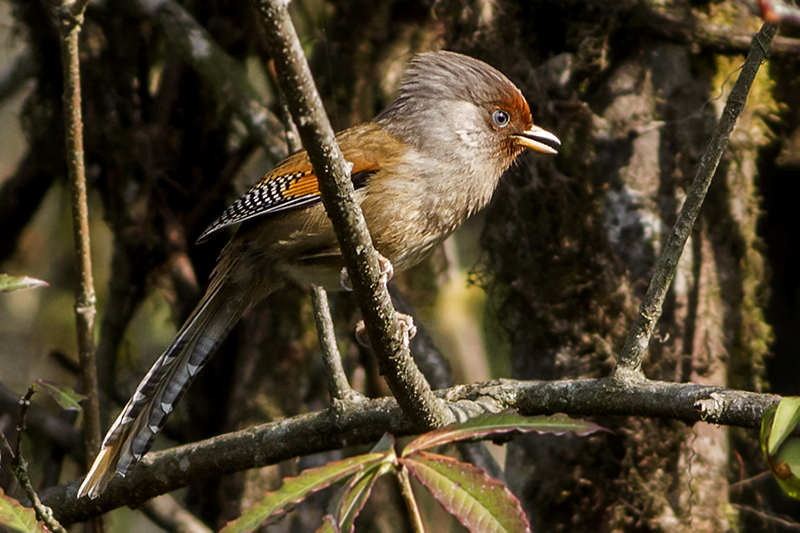
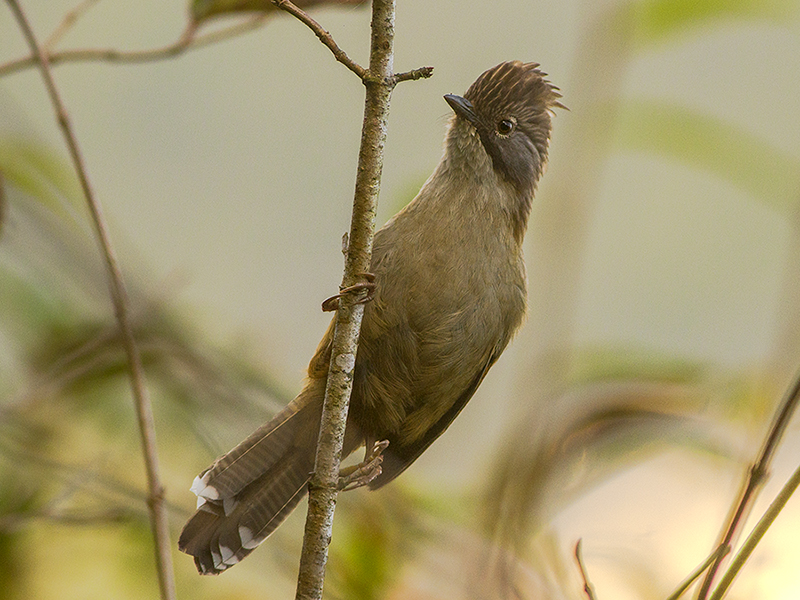
The Ashambu Laughingthrush is a medium-sized bird, measuring approximately 23 to 25 centimeters in length. Its plumage is predominantly olive-brown, with a striking contrast created by its white throat and facial markings. The eye-catching white spectacles around its eyes are a key identification feature, enhancing its sharp gaze. Adult males and females exhibit similar plumage, but subtle differences can be noted during the breeding season when males may display slightly brighter plumage.
Juvenile Ashambu Laughingthrushes resemble adults but tend to have duller, less defined markings. As they mature, their plumage develops the distinct patterning typical of the species. In flight, the Ashambu Laughingthrush presents a compact silhouette, with rounded wings and a slightly elongated tail. While perched, it often adopts an upright posture, accentuating its slender frame.
Distinguishing the Ashambu Laughingthrush from similar species, such as other laughingthrushes found in the same region, relies on careful observation of its unique vocalizations and the specific white markings on its throat and face. Its vocal repertoire is distinct and vibrant, often serving as a reliable clue in the dense forest environment.
Having trouble telling birds apart? Upload a photo to our bird identification tool for an instant species match.
Ashambu Laughingthrush Habitat and Range
Preferred Habitat
The Ashambu Laughingthrush occupies montane evergreen forests within the Western Ghats, specifically thriving in the Ashambu Hills. These forests are characterized by dense canopy cover, high humidity, and a rich understory of shrubs and small trees. The elevation range of 1,200 to 2,000 meters provides an ideal climate for this species, with moderate temperatures and abundant rainfall. Unlike some birds that adapt to human-altered landscapes, the Ashambu Laughingthrush is rarely found outside pristine forest habitats.
Seasonal habitat shifts are minimal due to its preference for stable forest environments. However, slight movements within the forest may occur in response to food resource availability and breeding needs. Urban presence is virtually nonexistent, as the species is closely tied to undisturbed forested areas. Conservation of these habitats is crucial for the survival of the Ashambu Laughingthrush, highlighting the importance of protected forest reserves.
Geographic Range
The range of the Ashambu Laughingthrush is highly restricted, confined to the southernmost part of the Western Ghats in India. Its primary habitat is within the Ashambu Hills, located in the states of Kerala and Tamil Nadu. This limited distribution makes the species particularly vulnerable to habitat loss and environmental changes. There is no significant migration observed, as the bird is largely resident within its range.
Population density is highest in areas where forest cover remains intact, and human disturbance is minimal. The bird's restricted range emphasizes the need for targeted conservation efforts to maintain and protect these critical habitats. Within its range, the Ashambu Laughingthrush serves as an indicator species, reflecting the health of the forest ecosystems it inhabits.
Want to know which birds visit your area? Browse our backyard birds by location guides for region-specific species lists.
What Does the Ashambu Laughingthrush Eat?
The diet of the Ashambu Laughingthrush consists primarily of insects and small fruits, with seasonal variations depending on availability. Insects such as beetles, caterpillars, and ants form the core of its diet, especially during the breeding season when protein demand is high. The bird employs a foraging technique known as 'gleaning,' where it picks insects from foliage and bark with precision.
Fruits become a more substantial part of the diet during certain times of the year when they are abundant. These include berries and small drupes from native forest plants. The Ashambu Laughingthrush's diet plays an essential role in pest control and seed dispersal within its ecosystem.
The bird typically forages in the early morning and late afternoon, taking advantage of cooler temperatures and increased insect activity. The Ashambu Laughingthrush's adaptable diet allows it to exploit various food resources throughout the year, contributing to its resilience in the face of environmental changes.
Ashambu Laughingthrush Behavior and Social Structure
The social structure of the Ashambu Laughingthrush revolves around small family groups, often consisting of 4 to 6 individuals. These groups display strong territorial behavior, especially during the breeding season when they defend their nesting sites vigorously. Courtship displays include vocal duets, where pairs engage in synchronized singing to strengthen pair bonds and deter rivals.
Flocking patterns are more prominent outside the breeding season, when the birds may join mixed-species foraging flocks. This behavior enhances foraging efficiency and predator detection. The Ashambu Laughingthrush exhibits a keen awareness of its surroundings, often using alarm calls to alert group members of potential threats.
Daily activity patterns show peak activity during the early morning and late afternoon. These birds are diurnal, with most of their activities concentrated during daylight hours. Their response to predators involves seeking cover in dense foliage and using their vocalizations to coordinate with group members. The Ashambu Laughingthrush's social and territorial behaviors underscore its adaptation to the challenging forest environment.
Ashambu Laughingthrush Nesting and Reproduction
The Ashambu Laughingthrush constructs cup-shaped nests, typically located in dense shrubs or small trees within its forest habitat. The nest is composed of twigs, leaves, and moss, providing a camouflaged and secure environment for the eggs. Preferred nesting sites are often at elevations of 1 to 3 meters above ground, offering protection from ground predators.
Clutch size usually consists of 2 to 3 eggs, with both parents sharing incubation duties. The incubation period lasts approximately 14 to 16 days, after which the chicks hatch and are fed by both parents. Fledging occurs about 14 to 18 days post-hatching, with young birds remaining under parental supervision for several weeks to learn foraging skills.
The Ashambu Laughingthrush typically raises one brood per year, though favorable conditions may allow for a second. Parental roles are well-defined, with both male and female birds contributing to all aspects of rearing the young. Successful nesting requires intact forest habitats, emphasizing the need for continued conservation efforts.
Ashambu Laughingthrush Sounds and Vocalizations
The primary song of the Ashambu Laughingthrush is characterized by a series of melodious whistles and trills, often described as a raucous, laughter-like sequence. The rhythm is variable, with each song session lasting several seconds and repeated at intervals throughout the day. Call notes include sharp 'chit' and 'twick' sounds, used for communication within the group.
Alarm calls are more abrupt and harsh, serving as warnings against potential threats. During the dawn chorus, the Ashambu Laughingthrush's song stands out with its lively and resonant quality, often forming a key part of the forest soundscape. The bird's vocalizations play a vital role in social interactions and territory establishment, marking its presence audibly in the dense forest environment.
Interesting Facts About the Ashambu Laughingthrush
- 1The Ashambu Laughingthrush is named after the Ashambu Hills, one of the biodiversity hotspots in the Western Ghats.
- 2Unlike many other bird species, the Ashambu Laughingthrush shows minimal sexual dimorphism, making male and female birds difficult to distinguish.
- 3The Ashambu Laughingthrush's vocalizations are often compared to human laughter, a trait shared by several other laughingthrush species.
- 4This bird species relies heavily on the dense canopies of evergreen forests, avoiding open areas and agricultural lands.
- 5The Ashambu Laughingthrush is a non-migratory bird, remaining within its forest range year-round despite seasonal changes in resource availability.
- 6Its presence in an area often indicates a healthy, undisturbed forest ecosystem due to its reliance on dense vegetation.
- 7The Ashambu Laughingthrush was once considered part of the same species complex as the Palani Laughingthrush but is now recognized as a distinct species based on vocal and morphological differences.
Ashambu Laughingthrush Conservation Status
The IUCN currently lists the Ashambu Laughingthrush as Vulnerable due to its restricted range and the ongoing threat of habitat loss. Deforestation and land conversion for agriculture are primary threats, leading to habitat fragmentation and population decline. Conservation efforts focus on habitat protection and restoration, with several forest reserves established to safeguard its environment. Population trends indicate a decreasing pattern, underscoring the need for continued conservation action. Historical data suggest that the Ashambu Laughingthrush once had a more extensive range, but human activities have significantly reduced its available habitat. Efforts to raise awareness and promote sustainable land-use practices are crucial for the long-term survival of this species.