Assam Laughingthrush
Trochalopteron chrysopterum
Order: Passeriformes / Family: Leiothrichidae

Wikimedia Commons
About the Assam Laughingthrush
The Assam Laughingthrush (Trochalopteron chrysopterum) is a captivating bird found in the dense forests and subtropical woodlands of the eastern Himalayas. Its range extends primarily through the northeastern Indian states, particularly Assam, Arunachal Pradesh, and Nagaland, spreading into the surrounding regions of Bhutan and western Myanmar. This bird is known for its vibrant plumage and melodious calls, characteristic of the Leiothrichidae family. These laughingthrushes play a crucial role in their ecosystem as both seed dispersers and insect controllers, contributing to the health and diversity of their habitat.
With a preference for altitudes ranging from 600 to 2500 meters, Assam Laughingthrushes thrive in thick underbrush and bamboo thickets, often near streams or damp areas where dense vegetation provides ample cover and feeding grounds. Their presence is a sign of rich biodiversity, as they inhabit areas teeming with life. Seasonal behaviors of the Assam Laughingthrush include altitudinal migrations, where they move to lower elevations during harsher winter months, returning to higher grounds as spring ushers in milder conditions.
The Assam Laughingthrush is a gregarious species, often seen in small flocks that move through the forest with agility, foraging for food. Their social nature is evident in their constant communication, using a variety of calls to maintain contact and coordinate movements. The bird's ecological significance extends beyond its immediate habitat, as it serves as an indicator species for the health of subtropical forests in the region.
The Assam Laughingthrush belongs to the family Leiothrichidae, within the order Passeriformes. These birds typically live usually around 6-7 years, with some living up to 12 years..
How to Identify a Assam Laughingthrush
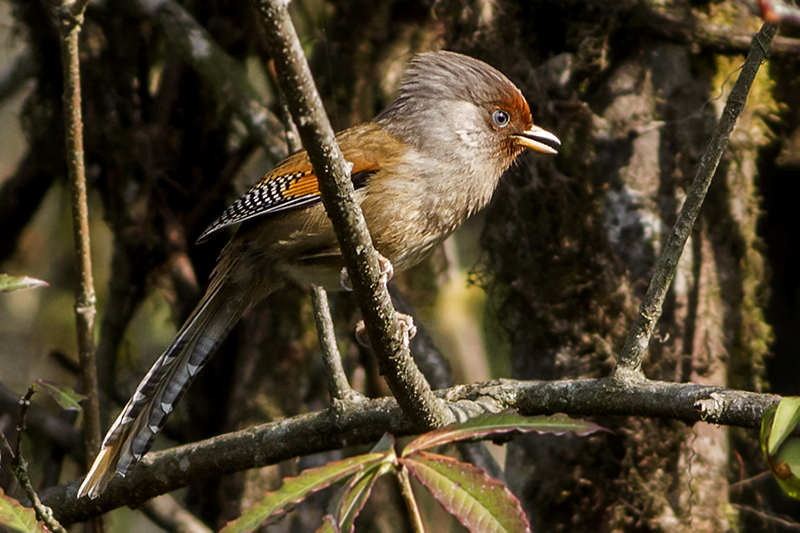
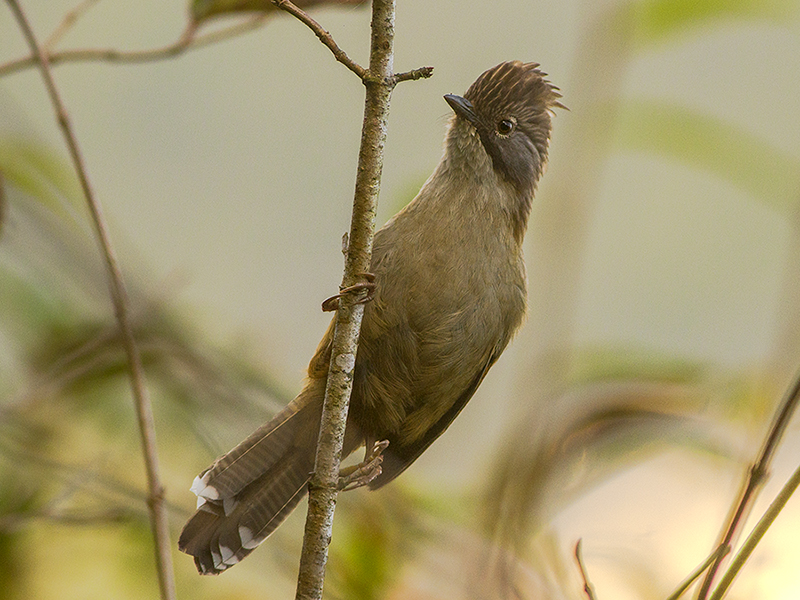
Identifying the Assam Laughingthrush involves noting its medium-sized build and distinctive coloration. Adults sport a rich chestnut hue on their wings and back, contrasted sharply by a white throat and chest. The head features subtle slate-gray tones, while the underparts are a muted olive-gray. The bird's eyes are encircled by a prominent white eye-ring, which aids in recognition.
Juveniles exhibit a slightly duller version of the adult plumage, lacking the distinct contrast between the chestnut wings and the rest of the body. Both sexes appear similar, making gender identification challenging in the field unless observed during breeding behaviors.
In flight, the Assam Laughingthrush presents a rounded silhouette with broad wings and a somewhat short tail, which fans slightly during maneuvering. When perched, it maintains an upright posture, often cocking its tail slightly upward, giving it a lively, alert appearance. Confusion may arise with the similar-looking Rufous-necked Laughingthrush, but the latter has a more extensive rufous coloring across the neck and lacks the distinctive white throat.
Having trouble telling birds apart? Upload a photo to our bird identification tool for an instant species match.
Assam Laughingthrush Habitat and Range
Preferred Habitat
The Assam Laughingthrush inhabits subtropical and tropical moist lowland forests, with a strong preference for areas with dense undergrowth. It is frequently found in bamboo forests, secondary growth, and along forest edges where tangled vegetation provides shelter and food resources. The bird is adaptable to a range of elevations, from 600 to 2500 meters, making it a versatile resident of the eastern Himalayan foothills.
Seasonal habitat shifts are observed, with the species moving to lower elevations during winter to escape the colder temperatures of higher altitudes. Although primarily a forest dweller, the Assam Laughingthrush occasionally ventures into rural gardens and tea plantations, especially where these areas border forested regions, but it remains absent from urban centers, preferring the tranquility and cover of more natural settings.
Geographic Range
The Assam Laughingthrush has a restricted range, primarily within the eastern Himalayan region. It breeds across the northeastern states of India, including Assam, Arunachal Pradesh, Meghalaya, and Nagaland. Its range extends into Bhutan and the hills of western Myanmar, where suitable habitat exists.
This bird does not undertake long-distance migrations like some other passerines. Instead, it exhibits altitudinal movements, descending to lower elevations during the colder months and returning to higher altitudes in spring and summer. Population densities are highest in areas where forest cover and bamboo thickets are abundant, with hotspots in the evergreen and semi-evergreen forests of Assam and Arunachal Pradesh.
Want to know which birds visit your area? Browse our backyard birds by location guides for region-specific species lists.
What Does the Assam Laughingthrush Eat?
The Assam Laughingthrush is primarily insectivorous, feeding on a diverse array of insects and other invertebrates. Its diet includes beetles, caterpillars, and spiders. During certain seasons, particularly when insects are less abundant, it supplements its diet with fruit, seeds, and berries, making it an important agent of seed dispersal within its habitat.
Foraging typically occurs in the understory, where the bird deftly moves through foliage, probing into leaf litter and crevices in search of hidden prey. The Assam Laughingthrush often forages in small groups, which helps in covering larger areas and increasing foraging efficiency. The bird's feeding schedule is diurnal, with peak activity in the early morning and late afternoon when insect activity is highest.
Assam Laughingthrush Behavior and Social Structure
The Assam Laughingthrush exhibits a social structure characterized by small flocks that typically consist of family groups. These birds are highly vocal, using a range of calls and songs to communicate within the group, maintain social bonds, and coordinate foraging.
Territorial behavior is evident during the breeding season when pairs or small groups defend their nesting areas aggressively against intruders. Courtship displays involve synchronized movements and vocalizations that strengthen pair bonds. Flocking patterns are dynamic, with group sizes varying based on the availability of food resources and environmental conditions.
In response to predators, the Assam Laughingthrush employs a combination of alarm calls and evasive flight tactics, often retreating into dense cover to escape threats. Daily activity patterns are largely governed by daylight, with most foraging and social interactions taking place during morning and late afternoon.
Assam Laughingthrush Nesting and Reproduction
Assam Laughingthrushes build their nests in dense shrubs or low tree branches, often concealed within thick foliage to protect against predators. The nest is cup-shaped and constructed from a variety of materials, including twigs, leaves, roots, and moss, bound together with spider silk or other natural adhesives.
Typically, the female lays a clutch of 2 to 4 eggs, which she incubates for about 14 to 16 days. Both parents participate in feeding the chicks, which fledge approximately 12 to 14 days after hatching. Parental roles are shared, with both males and females actively involved in nest defense and chick rearing. The species often raises one to two broods per year, depending on environmental conditions and food availability.
Assam Laughingthrush Sounds and Vocalizations
The primary song of the Assam Laughingthrush is a melodious series of rich, flute-like notes that vary in pitch and rhythm, creating a laughing effect. These vocalizations are used for communication within flocks and during the breeding season to attract mates and establish territories.
Call notes are shorter and more abrupt, often used as contact calls between foraging individuals or as alarm signals in response to threats. The bird participates in the dawn chorus, adding its distinctive voice to the symphony of sounds that greet the morning in its forest habitat.
Interesting Facts About the Assam Laughingthrush
- 1The Assam Laughingthrush has a unique call that sounds like human laughter, which is where it gets its name.
- 2This bird is part of the Leiothrichidae family, known for their complex vocalizations and social behavior.
- 3The Assam Laughingthrush can often be seen participating in mixed-species foraging flocks, enhancing its foraging success.
- 4Despite its vibrant plumage, the Assam Laughingthrush is often difficult to spot due to its preference for dense undergrowth.
- 5The bird's altitudinal migration is a strategy to cope with seasonal changes in temperature and food availability.
- 6Assam Laughingthrushes play a crucial role in seed dispersal, contributing to forest regeneration and biodiversity.
- 7They have been observed using their strong beaks to peel bark off trees in search of insects, showcasing their adaptability.
Assam Laughingthrush Conservation Status
The IUCN currently lists the Assam Laughingthrush as a species of Least Concern, though its population trends require monitoring due to habitat loss and fragmentation. Deforestation for agriculture and human settlement poses significant threats, reducing available habitat and resources. Conservation efforts focus on preserving the subtropical forests and bamboo thickets essential for the species' survival, with emphasis on protected area management and community-based conservation initiatives. Historical population changes suggest that while the species remains relatively stable, localized declines have occurred in areas where habitat has been severely altered.