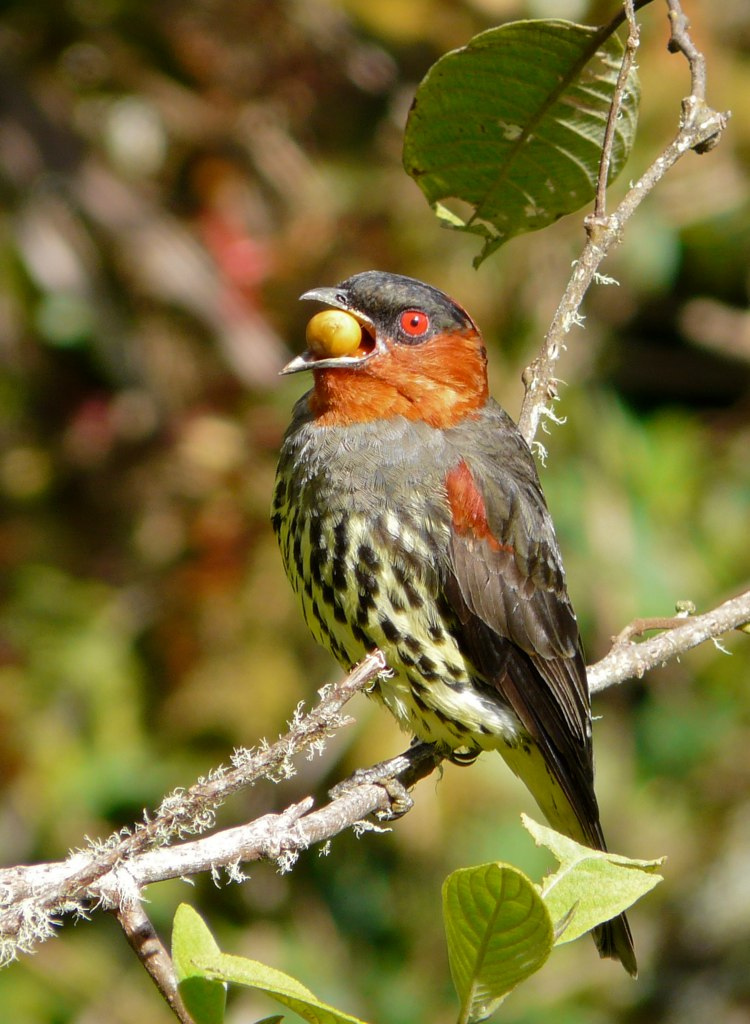
Band-tailed Fruiteater
Pipreola intermedia
Order: Passeriformes / Family: Cotingidae

Wikimedia Commons
About the Band-tailed Fruiteater
The Band-tailed Fruiteater (Pipreola intermedia), a member of the Cotingidae family, is a captivating bird species found primarily in the montane forests of the Andes. This bird is part of the rich tapestry of avian life that inhabits South America's mountainous regions, contributing significantly to the biodiversity of these ecosystems. The Band-tailed Fruiteater is known for its vivid green plumage, which provides excellent camouflage among the lush foliage of its habitat, and its striking red bill, which stands out as a beacon of color. These fruiteaters play a crucial ecological role as seed dispersers, aiding in the propagation of various plant species throughout the forest. By consuming fruits and subsequently expelling the seeds, they help maintain the health and diversity of the forest ecosystem. The Band-tailed Fruiteater can be found in the subtropical and tropical moist montane forests of countries like Colombia, Ecuador, Peru, and Bolivia. These regions offer the dense canopy and abundant fruit supply that the bird requires, supporting it year-round. With a preference for elevations ranging from 1,500 to 3,000 meters, this species does not undertake long migrations but may move slightly in response to fruit availability. Observing the Band-tailed Fruiteater during its feeding sessions provides insight into its role in the ecosystem. They are often seen alone or in pairs, methodically foraging for fruit among the trees. During the breeding season, which generally coincides with the peak fruiting periods, these birds become more vocal and active, engaging in courtship displays and nest building. Their ecological significance extends beyond seed dispersal; the Band-tailed Fruiteater also serves as an indicator species for the health of montane forest habitats. Changes in their population size or behavior can signal shifts in the ecological balance of these regions. As such, they are of interest not only to ornithologists but also to conservationists monitoring the impacts of habitat degradation and climate change.
The Band-tailed Fruiteater belongs to the family Cotingidae, within the order Passeriformes. These birds typically live average 6-9 years, with a maximum recorded of 11 years..
How to Identify a Band-tailed Fruiteater
The Band-tailed Fruiteater is a medium-sized bird, typically measuring about 20 cm in length. Adults exhibit a distinctive green plumage, which provides a perfect blend with their montane forest environment. One of the most striking features of the Band-tailed Fruiteater is its bright red bill, easily distinguishing it from other forest-dwelling birds. The underparts are a lighter green, creating a subtle contrast with the darker wings and back. In terms of sexual dimorphism, males and females are similar in appearance, although females may show slightly duller tones. Juvenile Band-tailed Fruiteaters resemble adults but often have a more subdued coloration, lacking the vibrancy of fully mature birds. The flight silhouette of the Band-tailed Fruiteater is characterized by broad, rounded wings and a relatively short tail. When perched, they exhibit a stately posture, often remaining motionless for extended periods as they survey their surroundings. This stillness, combined with their green coloration, can make them difficult to spot in dense foliage. In comparison to similar species, such as the Green-and-black Fruiteater, the Band-tailed Fruiteater's red bill serves as a key differentiator. Their calls, more so than their appearance, often alert observers to their presence in the forest canopy.
Having trouble telling birds apart? Upload a photo to our bird identification tool for an instant species match.
Band-tailed Fruiteater Habitat and Range
Preferred Habitat
Band-tailed Fruiteaters thrive in subtropical and tropical moist montane forests, particularly those found in the Andes. These forests provide a lush, dense canopy that supports a wide variety of fruiting trees and shrubs, crucial to the fruiteater's diet. Typically residing at elevations between 1,500 and 3,000 meters, the Band-tailed Fruiteater is well-adapted to the cooler, humid climate found at these heights. While they primarily inhabit pristine forests, they can also be found in secondary growth areas, provided there is adequate fruit supply. Unlike some bird species that adapt surprisingly well to urban environments, the Band-tailed Fruiteater remains a predominantly forest-dwelling species. Seasonal habitat shifts are minimal, as the availability of fruit across different elevations meets their dietary needs throughout the year. This makes them a year-round resident in most parts of their range, though they may exhibit slight altitudinal movements in search of food.
Geographic Range
The Band-tailed Fruiteater's range is confined to the Andean regions of South America, notably within Colombia, Ecuador, Peru, and Bolivia. Within these countries, they are most commonly found along the eastern slopes of the Andes, where the dense montane forests provide an ideal habitat. The bird's distribution is closely linked to the availability of suitable forested environments, and thus, their population density is highest in regions with extensive, undisturbed montane forests. Unlike many other bird species, the Band-tailed Fruiteater does not undertake long-distance migrations. However, there may be some altitudinal movement within their range, particularly in response to fruiting cycles of key plant species. These movements are generally localized and do not extend beyond the bird's primary range.
Want to know which birds visit your area? Browse our backyard birds by location guides for region-specific species lists.
What Does the Band-tailed Fruiteater Eat?
The diet of the Band-tailed Fruiteater primarily consists of fruits, which they forage for in the upper canopy of montane forests. Their preference for fruit is evident in their feeding behavior, often seen delicately picking fruit from branches with their strong, curved bills. They favor a variety of fruits, including berries and small drupes, which are abundant in their natural habitat. During periods of fruit scarcity, they may supplement their diet with insects, although this is relatively rare. Seasonal changes in fruit availability can lead to slight dietary shifts, with the fruiteater showing remarkable adaptability in its foraging techniques. This adaptability allows them to maintain a consistent food supply throughout the year. By aiding in seed dispersal through their fruit consumption, the Band-tailed Fruiteater plays a pivotal role in maintaining the ecological balance of their forest environment.
Band-tailed Fruiteater Behavior and Social Structure
The Band-tailed Fruiteater exhibits a range of intriguing behaviors that reflect its adaptation to montane forest life. Socially, they are generally solitary or found in pairs, rarely forming large flocks. This tendency towards solitude is particularly evident outside the breeding season when food resources are more widely dispersed. During the breeding season, however, their behavior becomes more conspicuous. Males engage in courtship displays, which include vocalizations and physical displays to attract mates. Territorial behavior is also more pronounced in this period, with males defending prime foraging and nesting areas. The Band-tailed Fruiteater has a relatively sedate daily routine, often spending long periods perched quietly in the forest canopy. This calm demeanor changes when predators are near, triggering alarm calls and evasive maneuvers. Although not as vocal as some passerines, their calls increase during dawn and dusk, marking the boundaries of their territory and communicating with potential mates.
Band-tailed Fruiteater Nesting and Reproduction
The Band-tailed Fruiteater constructs its nest in the dense foliage of montane forests, often choosing well-concealed locations to protect its brood. Nests are typically cup-shaped, constructed from twigs, moss, and leaves, providing a sturdy yet camouflaged home. The female primarily builds the nest, although males may assist in gathering materials. Clutch size usually consists of two to three eggs, with an incubation period of approximately 18-20 days. Both parents share incubation duties, ensuring that the eggs are kept at a stable temperature. After hatching, the chicks remain in the nest for about 20-25 days before fledging. Parental care continues even after fledging, with both adults feeding and protecting the young birds as they learn to forage independently. The Band-tailed Fruiteater typically raises one brood per year, though favorable conditions may lead to a second.
Band-tailed Fruiteater Sounds and Vocalizations
The vocalizations of the Band-tailed Fruiteater are relatively understated compared to more melodious songbirds. Their primary song features a series of soft, flute-like notes, delivered in a steady, rhythmic pattern. These calls are often used during courtship and territorial disputes. In addition to their primary song, Band-tailed Fruiteaters emit a variety of call notes, including sharp, short whistles that serve as alarm calls. These calls can alert other birds to the presence of predators or disturbances. During the dawn chorus, their songs blend into the symphony of forest sounds, contributing to the rich acoustic environment. While not the most prominent vocalist, the Band-tailed Fruiteater's sounds play a crucial role in communication and territory establishment.
Interesting Facts About the Band-tailed Fruiteater
- 1The Band-tailed Fruiteater is one of the lesser-known members of the Cotingidae family, often overshadowed by more flamboyant relatives.
- 2Despite its bright colors, the Band-tailed Fruiteater expertly camouflages in the dense forest canopy thanks to its green plumage.
- 3This species does not migrate but may move altitudinally within its range to access different fruiting trees.
- 4Band-tailed Fruiteaters play a key role in seed dispersal, helping to maintain the genetic diversity of their forest habitats.
- 5Their diet consists almost exclusively of fruit, making them vital to the propagation of many plant species in the Andes.
- 6The Band-tailed Fruiteater's red bill is a distinctive feature that sets it apart from other frugivorous birds in its range.
- 7They typically reside at elevations between 1,500 and 3,000 meters, preferring the cooler, moist conditions of the montane forests.
Band-tailed Fruiteater Conservation Status
The Band-tailed Fruiteater currently holds a status of Least Concern on the IUCN Red List, indicating a stable population. Despite this, they face potential threats from habitat loss due to deforestation and agricultural expansion in the Andes. Conservation efforts focus on preserving montane forest habitats through the establishment of protected areas and sustainable land-use practices. Monitoring of population trends continues to ensure that any declines are promptly addressed. Historical data suggests that while population sizes have fluctuated, the species has generally maintained a stable presence across its range. Continued conservation efforts are vital to safeguard the Band-tailed Fruiteater and its role in the biodiversity of Andean ecosystems.