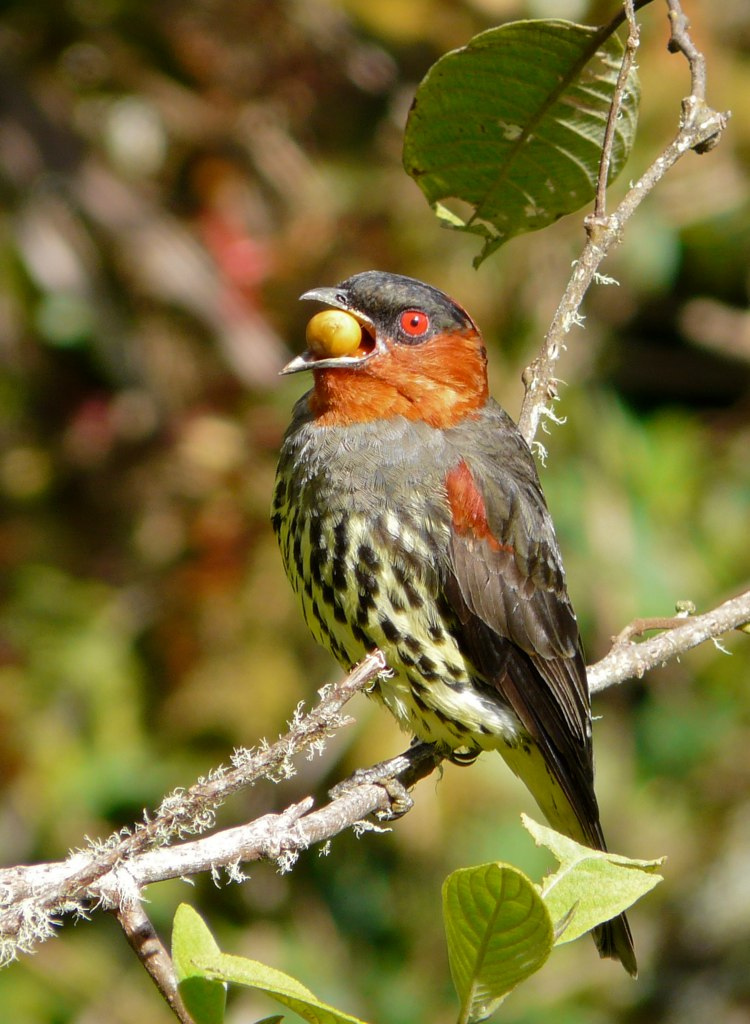
Banded Cotinga
Cotinga maculata
Order: Passeriformes / Family: Cotingidae

Wikimedia Commons
About the Banded Cotinga
The Banded Cotinga, known scientifically as Cotinga maculata, is a strikingly beautiful bird native to the Atlantic forests of eastern Brazil. This species is notable for its vibrant coloration and its role in the delicate ecosystem of these subtropical forests. The Banded Cotinga's plumage is a vivid mix of bright blues and purples, which serve as both a visual delight and a key aspect of its ecological interactions. As a member of the family Cotingidae, it plays a significant role in seed dispersal, thus contributing to the health and regeneration of its forest habitat. Found primarily in the states of Bahia and Espírito Santo, the Banded Cotinga's presence is an indicator of the health of these unique ecosystems.
This bird's ecological role extends beyond mere aesthetics. The Banded Cotinga participates in the complex web of life within the Atlantic Forest, a biodiversity hotspot that hosts a wide array of flora and fauna. The species' preference for fruit, particularly those of various fig and palm species, makes it an important agent of seed dispersal. By consuming fruits and subsequently excreting the seeds at different locations, this cotinga helps maintain plant diversity and promotes forest regeneration.
Seasonally, the Banded Cotinga exhibits subtle changes in behavior and distribution. During the breeding season, which typically occurs during the wetter months, males become more conspicuous as they engage in elaborate courtship displays to attract females. These displays not only enhance mating success but also highlight the species' reliance on intact forest habitats for successful breeding. Outside the breeding season, the Banded Cotinga may form loose associations with other frugivorous birds, taking advantage of seasonal fruiting events and the abundant resources they provide.
The Banded Cotinga belongs to the family Cotingidae, within the order Passeriformes. These birds typically live typically 7-9 years, with some living up to 10 years..
How to Identify a Banded Cotinga
The Banded Cotinga is a medium-sized passerine, measuring approximately 20 cm in length. Adult males are particularly striking, with their bright blue plumage contrasted by vivid purple bands across the throat and chest. The iridescence of their feathers makes them a standout in their forested environment. Females, while less colorful, are still distinctive, sporting a more subdued blue-gray plumage with faint streaks. Juveniles resemble females but have even less pronounced markings.
One of the key challenges in identifying the Banded Cotinga is distinguishing it from similar species within its range. The Spangled Cotinga, for instance, also exhibits blue plumage, but lacks the distinctive purple banding of the Banded Cotinga. Additionally, the Banded Cotinga's more uniformly colored wings and tail help differentiate it from the Spangled Cotinga's more variegated appearance.
In flight, the Banded Cotinga's silhouette is characterized by its broad wings and relatively short tail. When perched, the bird often adopts a slightly hunched posture, which, combined with its vivid coloration, makes for a striking presence against the green backdrop of the forest.
Having trouble telling birds apart? Upload a photo to our bird identification tool for an instant species match.
Banded Cotinga Habitat and Range
Preferred Habitat
The Banded Cotinga inhabits the tropical Atlantic Forest of eastern Brazil, favoring areas with dense canopy cover. This bird thrives in lowland and montane rainforests, typically at elevations ranging from sea level to about 1000 meters. Within these lush environments, it prefers regions with abundant fruiting trees, which provide its primary food source.
Seasonal changes in fruit availability can influence habitat use, with the Banded Cotinga sometimes moving to different areas in search of food. While it primarily resides in remote forested areas, the species occasionally ventures into forest edges or secondary growth. However, it is notably absent from urban environments, emphasizing the importance of intact natural habitats for its survival.
Geographic Range
The Banded Cotinga is endemic to Brazil, with its range restricted to the eastern part of the country. Primarily, it inhabits the Atlantic Forest biome, which stretches along the coastal regions of the states of Bahia and Espírito Santo. This range is relatively limited compared to other cotinga species, making the Banded Cotinga particularly vulnerable to habitat loss.
The species does not undertake long-distance migrations, but it may exhibit some local movements in response to changes in food availability. These movements are usually confined within its established range, influenced by seasonal fruiting patterns rather than climatic conditions. Within its range, certain areas such as protected reserves and national parks serve as population density hotspots, where conservation efforts have helped maintain suitable habitats.
Want to know which birds visit your area? Browse our backyard birds by location guides for region-specific species lists.
What Does the Banded Cotinga Eat?
The Banded Cotinga primarily consumes fruit, making it a frugivore by nature. Its diet consists of a variety of fruits, with a preference for those that are small to medium in size. Figs and palm fruits are particularly favored, and these are abundant in its natural habitat. During times of fruit scarcity, the Banded Cotinga may supplement its diet with insects, although this is not its primary food source.
Foraging typically occurs in the mid to upper canopy, where the bird can access ripe fruits without much competition from ground-dwelling species. The Banded Cotinga employs a sit-and-wait strategy, often perching quietly before darting out to snatch fruit from nearby branches. Feeding activity peaks during the early morning and late afternoon, coinciding with the cooler parts of the day when fruiting trees are most active.
Banded Cotinga Behavior and Social Structure
The Banded Cotinga exhibits a range of behaviors that reflect its adaptation to the forest canopy. It is generally a solitary bird, although small groups may form around abundant fruiting trees. Territorial behavior is most pronounced during the breeding season, when males defend their preferred display sites with vigor.
Courtship displays are a spectacle to behold, with males performing intricate aerial maneuvers and vocalizations to attract mates. These displays are typically conducted in open areas within the forest, where the male's vibrant plumage can be best appreciated by potential mates. Flocking behavior is rare, and the Banded Cotinga tends to maintain a low profile to avoid predators, such as raptors and larger arboreal mammals.
Daily activities follow a predictable pattern, with active periods in the early morning and late afternoon. During the heat of midday, the Banded Cotinga often retreats to shaded perches, conserving energy until conditions become more favorable for foraging and social interactions.
Banded Cotinga Nesting and Reproduction
The Banded Cotinga constructs cup-shaped nests made from twigs, moss, and leaves, typically located high in the forest canopy. Nest sites are carefully chosen to ensure safety from ground predators and a good vantage point for the incubating female. Generally, these nests are positioned on sturdy branches or in the fork of a tree, where they blend seamlessly with the surrounding foliage.
A typical clutch consists of 1 to 2 eggs, which are incubated exclusively by the female for about 18 to 20 days. During this period, the male plays a supportive role by providing food to the incubating female. Once hatched, the chicks remain in the nest for approximately 25 days before fledging. Both parents participate in feeding the young, ensuring a steady supply of fruit and occasional insects to meet the nutritional needs of the growing chicks.
The Banded Cotinga typically raises one brood per year, although in years of abundant food supply, a second brood is possible. The choice of nesting site and the level of parental investment reflect the species' strategy for maximizing reproductive success in a challenging environment.
Banded Cotinga Sounds and Vocalizations
The primary song of the Banded Cotinga is a series of clear, melodious whistles that vary in pitch and rhythm. These vocalizations are most commonly heard during the breeding season, when males use them to establish territories and attract mates. The song's quality is reminiscent of a flute, with a smooth, flowing cadence that carries well through the dense forest canopy.
In addition to its melodious song, the Banded Cotinga produces short, sharp call notes used for communication between individuals, particularly during foraging or when sensing potential threats. Alarm calls are more abrupt and higher in pitch, serving to alert other birds of danger. During the dawn chorus, the Banded Cotinga participates with enthusiasm, contributing to the symphony of bird calls that greet the new day.
Interesting Facts About the Banded Cotinga
- 1The Banded Cotinga's bright blue and purple plumage is a rare example of iridescence in bird feathers, caused by microscopic structures rather than pigments.
- 2Despite its vibrant colors, the Banded Cotinga is adept at camouflage among the forest canopy, using its coloration to blend with dappled sunlight.
- 3The Banded Cotinga plays a crucial role in its ecosystem as a seed disperser, helping maintain the biodiversity of the Atlantic Forest.
- 4Males perform elaborate courtship displays, including aerial acrobatics, to attract females during the breeding season.
- 5The Banded Cotinga's song is often compared to a flute, characterized by a series of melodious whistles that resonate through the forest.
- 6This species is endemic to Brazil's Atlantic Forest, one of the most biodiverse yet threatened ecosystems on the planet.
- 7The Banded Cotinga's diet changes seasonally, relying heavily on fruit availability, which influences its movement and behavior patterns.
Banded Cotinga Conservation Status
The Banded Cotinga is currently classified as Vulnerable by the IUCN, primarily due to habitat loss and fragmentation. The Atlantic Forest, where it resides, has experienced significant deforestation, reducing the extent of suitable habitat available to this species. Population trends indicate a decline, driven largely by the ongoing conversion of forest land for agriculture and urban development. Conservation efforts focus on habitat preservation and restoration, with several protected areas established to safeguard the remaining forest tracts. Initiatives to promote sustainable land use and reforestation are crucial to reversing the decline of the Banded Cotinga's population. Historical data suggest that the species was once more widespread, underscoring the need for continued conservation measures to prevent further losses.