Barred Becard
Pachyramphus versicolor
Order: Passeriformes / Family: Cotingidae

Wikimedia Commons
About the Barred Becard
The Barred Becard (Pachyramphus versicolor) is a captivating member of the diverse Cotingidae family, which inhabits the montane forests of South America. This bird is particularly adapted to the subtropical and tropical moist montane environments, where its specialized behaviors and ecological role become evident. Found primarily in the Andean regions, the Barred Becard can be observed across countries such as Colombia, Ecuador, Peru, and Bolivia. Its presence indicates the health of montane ecosystems, as it plays a role in both seed dispersal and insect population control. Typically, the Barred Becard frequents elevations ranging from 1,500 to 3,500 meters, showcasing its adaptability to varying altitudes within its preferred habitat.
Seasonally, the Barred Becard exhibits behaviors that align with the changing availability of food resources. During the wet seasons, these birds actively forage for insects, which are abundant and serve as a primary dietary component. Conversely, in drier months, when insect activity diminishes, the Barred Becard shifts its focus to fruit, relying on the fruiting cycles of local flora. This seasonal dietary flexibility highlights the bird's role in the ecosystem as both a predator and a seed disperser, contributing to the ecological balance of its environment.
The Barred Becard's significance extends beyond its ecological contributions. For bird enthusiasts and naturalists, its presence offers a unique opportunity to observe a species that exemplifies the biodiversity of montane forests. These birds are not merely indicators of environmental health but also represent the intricate relationships within their habitats, where each species, including the Barred Becard, plays a pivotal role in maintaining ecological harmony. As a subject of ornithological study, the Barred Becard provides insights into the complex dynamics of Andean ecosystems, prompting further research into habitat preservation and species interactions.
The Barred Becard belongs to the family Cotingidae, within the order Passeriformes. These birds typically live generally 4-6 years, with some individuals living up to 9 years..
How to Identify a Barred Becard
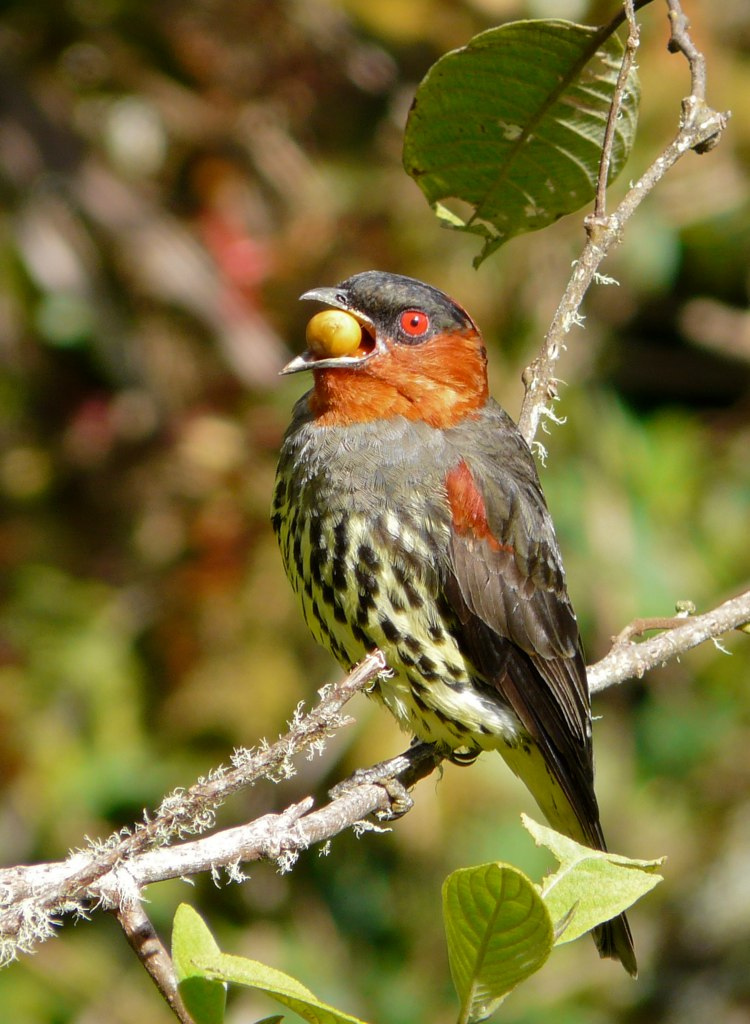
The Barred Becard presents a distinctive profile with its barred plumage, a feature that aids in its identification. Adult males typically exhibit a striking contrast between their black upperparts and the barred underparts, which consist of alternating black and white bars. This pattern provides effective camouflage against the dappled sunlight of the montane forest canopy. In contrast, females possess a more subdued coloration, with grayish-brown upperparts and less distinct barring on their underparts, aiding them in blending into their environment while nesting.
Juvenile Barred Becards resemble females but can be distinguished by their slightly duller plumage and less defined barring. Observers may mistake them for other becard species or even flycatchers due to their similar size and perching habits. However, the Barred Becard's characteristic head shape and stout bill, adaptations for its mixed diet, set it apart from these look-alikes.
In flight, the Barred Becard displays a silhouette marked by a short tail and broad wings, which facilitate agile maneuvering through dense foliage. When perched, it often assumes a slightly hunched posture, indicative of its becard family. Such postural nuances, alongside its vocalizations, can be crucial for field identification.
Having trouble telling birds apart? Upload a photo to our bird identification tool for an instant species match.
Barred Becard Habitat and Range
Preferred Habitat
The Barred Becard primarily inhabits subtropical and tropical moist montane forests. These forests, rich in biodiversity, provide the ideal conditions for the bird's feeding and nesting behaviors. In the Andes, this species occupies elevations from 1,500 to 3,500 meters, where cloud forests create a unique microclimate. Within these habitats, the Barred Becard often selects areas with dense canopy cover and abundant understory growth, which offer protection and ample foraging opportunities.
While the Barred Becard is largely associated with rural and forested areas, it occasionally ventures into semi-urban environments, especially where natural habitats intersect with human settlements. However, its presence in urban areas remains limited due to the species' reliance on undisturbed forest ecosystems. Seasonal shifts in habitat use are minimal, as the bird remains within its montane range year-round, adapting to seasonal fluctuations in food resources rather than relocating.
Geographic Range
The Barred Becard's range is primarily concentrated in the Andean regions of South America, where it is a resident breeder. This bird can be found in Colombia, Ecuador, Peru, and Bolivia, with its range extending along the Andean mountain chain. Within these countries, it prefers montane forest environments, which provide the necessary resources for its survival and reproduction.
Unlike many migratory species, the Barred Becard does not undertake long-distance migrations but instead exhibits local movements in response to food availability and climatic conditions. This limited range migration allows it to exploit varying elevations and microhabitats within its geographic confines.
Population density hotspots occur in areas with well-preserved montane forests, particularly in Ecuador and Peru, where conservation efforts have focused on preserving these critical habitats. The Barred Becard's distribution underscores its dependence on the conservation of Andean forest ecosystems, which continue to face pressures from deforestation and habitat fragmentation.
Want to know which birds visit your area? Browse our backyard birds by location guides for region-specific species lists.
What Does the Barred Becard Eat?
The Barred Becard maintains a varied diet that shifts seasonally between insects and fruits, reflecting its adaptability to changing food resources. During the wet season, insects become the primary focus, with the bird actively foraging for beetles, caterpillars, and other invertebrates. Utilizing its sharp bill and agile flight, the Barred Becard captures prey on the wing or gleans insects from foliage, exhibiting impressive aerial maneuvers.
As the seasons transition to drier periods, the availability of insects declines, prompting the Barred Becard to increase its consumption of fruits. It favors berries and small fruits from native plants, playing a role in seed dispersal across its montane habitat. The bird often forages alone or in small family groups, which allows it to efficiently exploit localized food sources without excessive competition.
While primarily diurnal in its feeding habits, the Barred Becard adjusts its foraging schedule based on food availability, often becoming more active during the cooler morning and late afternoon hours. This flexible feeding strategy ensures the bird's survival across varying seasonal conditions and resource distributions.
Barred Becard Behavior and Social Structure
The Barred Becard exhibits intriguing social and territorial behaviors. While generally solitary, it forms loose associations during the breeding season, with pairs establishing and defending territories within favored forest areas. Territorial displays often involve vocalizations and short chases, ensuring that rivals respect established boundaries.
Courtship rituals of the Barred Becard include vocal displays and synchronous flights, where males showcase their plumage and agility to attract females. These displays highlight the bird's adaptability and its reliance on vocal communication to establish pair bonds. Once paired, Barred Becards display a high degree of cooperation in nest building and raising their young.
Flocking behavior is rare outside of breeding groups, as the Barred Becard prefers solitary or paired foraging. Its response to predators involves remaining motionless and relying on its camouflaged plumage to avoid detection. When in flight, the bird's quick, darting movements and ability to navigate dense foliage aid in evading threats.
Daily activity patterns align with the availability of food, with foraging peaks occurring during cooler periods of the day. The Barred Becard's adaptability to its environment is further demonstrated by its ability to exploit a range of microhabitats within its montane forest home.
Barred Becard Nesting and Reproduction
Barred Becards construct intricate nests, using a variety of natural materials to form sturdy, cup-shaped structures. These nests are typically located in forked branches or among dense foliage, providing concealment from predators and environmental elements. The choice of nesting site often reflects the bird's need for security and proximity to food resources.
Clutch sizes for the Barred Becard range from two to three eggs, which exhibit a pale coloration with subtle speckling. Incubation duties are shared between both parents, highlighting the species' cooperative breeding strategy. Incubation lasts approximately 16 to 18 days, during which time the parents take turns maintaining optimal temperature and protection for the developing embryos.
Once hatched, the young remain in the nest for an additional 20 to 24 days, receiving both food and protection from the adults. Parental roles continue to be shared, with both males and females contributing to feeding and defense. The Barred Becard typically raises one brood per year, although favorable conditions may lead to occasional second broods. This reproductive strategy reflects the species' adaptation to the seasonal abundance of resources within its montane forest habitat.
Barred Becard Sounds and Vocalizations
The Barred Becard's vocalizations play a crucial role in communication and territory defense. Its primary song consists of a series of clear, melodious whistles, characterized by an ascending and descending pitch pattern. These songs resonate through the montane forest, serving as both a mating call and a territorial marker.
Call notes of the Barred Becard are brief and sharp, often used in coordination between mates or as alert signals. In the presence of potential threats, the bird emits a distinct alarm call, a rapid series of high-pitched notes that alert nearby individuals to danger.
During the dawn chorus, Barred Becards contribute to the symphony of forest sounds, their whistles adding to the acoustic complexity of the early morning hours. The bird's vocal repertoire, while not as varied as some other species, remains an essential tool for survival and social interaction in its montane environment.
Interesting Facts About the Barred Becard
- 1The Barred Becard can be found at elevations as high as 3,500 meters, making it one of the highest-dwelling members of the Cotingidae family.
- 2Unlike many birds, both male and female Barred Becards participate equally in nest building and chick rearing.
- 3The Barred Becard's song comprises clear whistles that can carry over long distances through the dense forest canopy.
- 4Its barred plumage serves as excellent camouflage against the dappled light of its montane forest habitat.
- 5Studies suggest that Barred Becards can adjust their diet based on seasonal availability, demonstrating remarkable ecological flexibility.
- 6The species' presence in a forest is often an indicator of the health and biodiversity of the montane ecosystem.
- 7Barred Becards are relatively sedentary, with most individuals spending their entire lives within a limited home range.
Barred Becard Conservation Status
Currently, the Barred Becard holds a status of Least Concern on the IUCN Red List, reflecting a stable population trend across its range. However, the species faces ongoing threats from habitat loss due to deforestation and land-use changes in the Andean regions. These activities can lead to fragmentation of montane forests, impacting the availability of suitable habitats for the Barred Becard. Conservation efforts focus on preserving and restoring critical montane forest ecosystems, emphasizing the importance of protecting entire habitats rather than isolated patches. Collaborative initiatives between local communities, conservation organizations, and governments aim to mitigate habitat destruction and promote sustainable land-use practices. Historically, the Barred Becard's population has remained relatively stable, bolstered by its adaptability to various montane environments. Continued monitoring and conservation actions are essential to ensure the species can thrive amidst increasing environmental pressures.