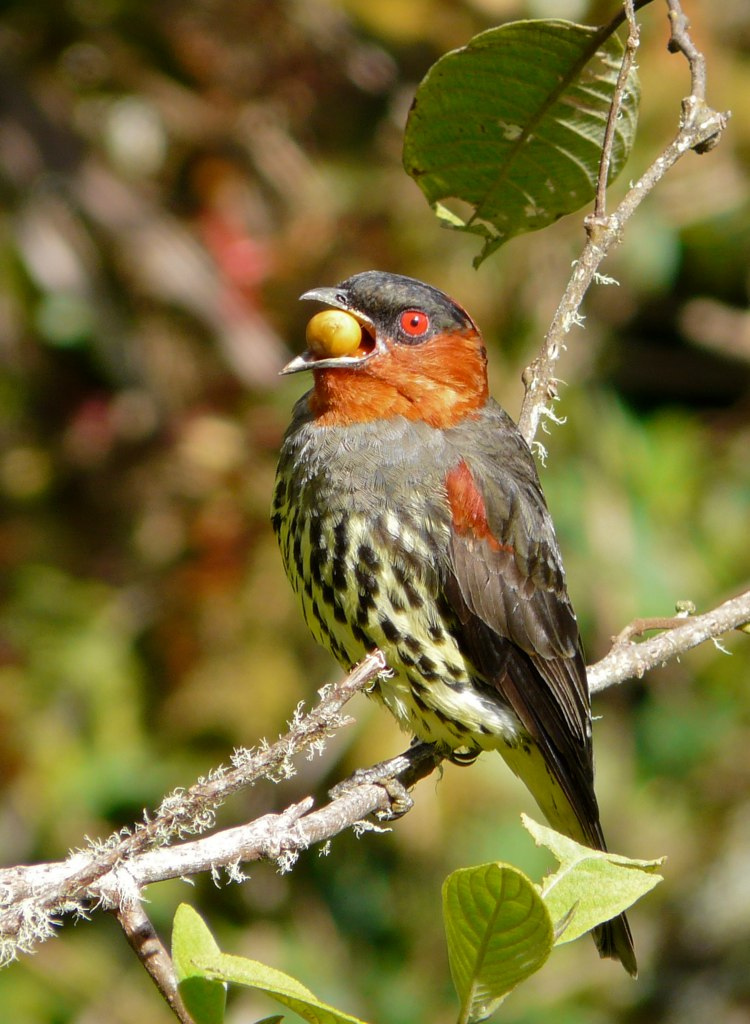
Barred Fruiteater
Pipreola arcuata
Order: Passeriformes / Family: Cotingidae

Wikimedia Commons
About the Barred Fruiteater
The Barred Fruiteater, scientifically known as Pipreola arcuata, is an intriguing member of the Cotingidae family, often found in the lush montane forests of the Andes. This bird is a compelling subject for ornithologists due to its distinct appearance and ecological role. The Barred Fruiteater typically inhabits elevations ranging from 1,800 to 3,500 meters, thriving in the humid cloud forests that stretch from Venezuela through Colombia, Ecuador, Peru, and Bolivia.
Pipreola arcuata plays a significant role in its ecosystem as a frugivore, primarily consuming a diverse array of fruits and berries. This diet not only sustains the bird but also aids in seed dispersal, thereby contributing to forest regeneration. Its presence in these ecosystems highlights the interconnectedness of species within the Andean montane regions.
The Barred Fruiteater's ecological significance extends beyond its immediate environment as it serves as a bioindicator for the health of montane forest ecosystems. Its reliance on undisturbed forest habitats makes it vulnerable to deforestation and habitat fragmentation. Consequently, ornithologists and conservationists often monitor its population trends to assess broader ecological impacts in the Andes.
During the breeding season, which typically occurs from October to March, the Barred Fruiteater engages in various vocalizations to attract mates and establish territories. Its melodious calls resonate through the forest, enhancing the biodiversity of this rich environment. In terms of conservation, while the species is currently not considered endangered, ongoing habitat destruction poses a threat that requires continuous monitoring. The Barred Fruiteater's presence within these montane forests underscores the necessity for comprehensive conservation strategies in the region.
The Barred Fruiteater belongs to the family Cotingidae, within the order Passeriformes. These birds typically live typically 6-8 years, with some individuals reaching up to 10 years..
How to Identify a Barred Fruiteater
The Barred Fruiteater is a medium-sized bird, measuring approximately 21 to 23 cm in length. It boasts a striking green plumage, which provides effective camouflage among the leafy canopy. The male typically has a brighter coloration compared to the female, with a more vivid green and a slightly more pronounced barring pattern on the underparts. These bars run horizontally across the chest and belly, giving the bird its common name.
Females tend to have a duller green hue, with less distinct barring, which can make field identification challenging when observing distant or obscured individuals. Juveniles resemble females but are even duller with less defined barring.
In flight, the Barred Fruiteater presents a compact silhouette with broad, rounded wings. Its flight is typically short and direct, as it moves from tree to tree within the dense forest. When perched, it often sits quietly among foliage, making use of its green plumage to remain inconspicuous. Observers may confuse it with other green birds in its range, but the unique barring pattern and habitat preferences help distinguish it from similar species.
Having trouble telling birds apart? Upload a photo to our bird identification tool for an instant species match.
Barred Fruiteater Habitat and Range
Preferred Habitat
The Barred Fruiteater thrives in the montane cloud forests of the Andes, preferring elevations between 1,800 and 3,500 meters. These forests, characterized by high humidity and frequent mist, provide an ideal environment with abundant fruiting trees and dense canopy cover. Within this habitat, the Barred Fruiteater shows a preference for undisturbed primary forests but can also be found in secondary growth areas, provided they offer sufficient cover and food resources.
Seasonal habitat shifts occur in response to fruit availability, with the bird occasionally descending to lower elevations during certain times of the year. However, it primarily remains within the montane regions. The Barred Fruiteater does not typically venture into urban areas, as it relies on the complex structure and microclimate of forested environments to thrive.
Geographic Range
The Barred Fruiteater's range spans the length of the Andes, from northern Venezuela through Colombia and Ecuador, down into Peru and Bolivia. It occupies a continuous corridor along the montane forest belt, making it a resident species throughout these regions. Unlike many other bird species, the Barred Fruiteater does not engage in long-distance migrations, instead opting for localized movements in response to seasonal changes in fruit availability.
Population density tends to be highest in areas with intact forest cover, particularly in protected reserves and national parks where habitat preservation efforts are strongest. Despite its relatively wide distribution, the Barred Fruiteater remains vulnerable to habitat loss, particularly in areas where deforestation and agricultural expansion threaten the integrity of montane ecosystems.
Want to know which birds visit your area? Browse our backyard birds by location guides for region-specific species lists.
What Does the Barred Fruiteater Eat?
The Barred Fruiteater primarily subsists on a diet of fruits and berries, reflecting its classification as a frugivore. Its diet includes a variety of native fruiting plants, with a preference for small to medium-sized fruits that it can easily handle with its strong beak. During certain seasons, when specific fruits are abundant, the Barred Fruiteater may exhibit a degree of dietary specialization, focusing on those particular food sources.
Foraging behavior is typically solitary or in pairs, although individuals may occasionally join mixed-species foraging flocks, especially when fruit is abundant. The Barred Fruiteater often employs a methodical approach to foraging, moving slowly through the canopy and carefully selecting ripe fruits. Its feeding schedule is largely diurnal, with peak activity in the early morning and late afternoon when fruit availability and environmental conditions are optimal.
Barred Fruiteater Behavior and Social Structure
The Barred Fruiteater exhibits a largely solitary lifestyle, although it may form loose associations with other frugivorous birds, particularly during times of abundant fruiting. This bird maintains a relatively small territory, defending it with vocal displays and occasional physical confrontations, especially during the breeding season.
Courtship displays involve a series of vocalizations and subtle plumage displays, with males often perching prominently to attract females. The Barred Fruiteater does not typically engage in elaborate courtship rituals, relying instead on its vocal prowess and territorial control to secure a mate.
Its response to predators includes remaining motionless and utilizing its camouflaged plumage to avoid detection. In instances of direct threat, the Barred Fruiteater may emit alarm calls and seek cover within dense vegetation. Daily activity patterns revolve around foraging and resting, with periods of increased vocal activity during dawn and dusk.
Barred Fruiteater Nesting and Reproduction
The Barred Fruiteater constructs its nest in the dense foliage of the mid to upper canopy, often selecting well-concealed sites to deter predators. The nest itself is a cup-shaped structure, intricately woven from twigs, moss, and other plant materials, providing both strength and camouflage.
Clutch size typically consists of two to three eggs, with both parents sharing incubation duties over a period of approximately 18 to 20 days. After hatching, the chicks remain in the nest for another 20 to 25 days, during which time both parents are actively involved in feeding and caring for the young.
The Barred Fruiteater generally raises one brood per year, although in areas with prolonged favorable conditions, a second brood may occasionally occur. Parental care extends beyond fledging, with adults continuing to provide food and guidance to juvenile birds as they learn to forage independently.
Barred Fruiteater Sounds and Vocalizations
The primary song of the Barred Fruiteater is a series of melodious, flutelike notes that rise and fall in pitch, creating a hauntingly beautiful melody that resonates through the forest. These vocalizations serve both to establish territory and attract mates, particularly during the breeding season.
In addition to its song, the Barred Fruiteater emits a variety of call notes, including soft chirps and more urgent alarm calls used to signal danger. During the dawn chorus, its contributions stand out for their clarity and musicality, often serving as a focal point for birdwatchers seeking to locate this elusive species.
Interesting Facts About the Barred Fruiteater
- 1The Barred Fruiteater's vibrant green plumage allows it to blend seamlessly into the dense foliage of the Andean cloud forests.
- 2Despite its name, the Barred Fruiteater is not closely related to true fruiteaters but belongs to the diverse Cotingidae family.
- 3This bird plays a crucial role in seed dispersal, aiding in the regeneration of its forest habitats by spreading seeds across its territory.
- 4The Barred Fruiteater's song can be heard echoing through the Andes, often marking the presence of fruiting trees in the area.
- 5While primarily a frugivore, the Barred Fruiteater occasionally consumes insects, especially during the breeding season to meet increased protein demands.
- 6The species exhibits little sexual dimorphism, though males typically display slightly brighter plumage than females.
- 7The Barred Fruiteater's reliance on pristine montane forests makes it a valuable indicator species for assessing ecosystem health.
Barred Fruiteater Conservation Status
Currently, the Barred Fruiteater is classified as Least Concern by the IUCN, with stable population trends across much of its range. However, habitat destruction due to deforestation and agricultural expansion presents ongoing threats, particularly in regions where forest clearing is prevalent. Conservation efforts focus primarily on habitat preservation, with many populations residing within protected areas and national parks. Ongoing research and monitoring are crucial to ensure the long-term survival of the Barred Fruiteater, as its reliance on specific montane habitats makes it vulnerable to environmental changes.