
Bay-vented Cotinga
Doliornis sclateri
Order: Passeriformes / Family: Cotingidae

Wikimedia Commons
About the Bay-vented Cotinga
The Bay-vented Cotinga, Doliornis sclateri, is an elusive and intriguing bird endemic to the Andean cloud forests of South America. This species primarily inhabits montane regions, specifically within the countries of Peru and Bolivia. The Bay-vented Cotinga is known for its vibrant reddish-brown undertail coverts, which contrast sharply with its otherwise muted plumage. This medium-sized bird typically measures about 20 cm in length, with a robust body and a short, stout bill adapted for its largely frugivorous diet. The ecological role of the Bay-vented Cotinga is significant within its habitat. As a frugivore, it plays a crucial part in seed dispersal, contributing to the vitality and regeneration of the cloud forest ecosystem. This bird often shares its habitat with other Andean avifauna, forming mixed-species flocks that enhance foraging efficiency and offer protection against predators. Seasonal behaviors of the Bay-vented Cotinga are tied closely to fruiting cycles within the cloud forest. During times of abundant fruit availability, these birds are more active and visible, often seen moving through the mid-canopy in search of ripe berries and other fruits. In contrast, when food is scarce, they may become more reclusive and difficult to spot. The Bay-vented Cotinga's presence is an indicator of healthy forest ecosystems, as they require pristine habitats to thrive. Conservation efforts for this species focus on preserving these vital habitats, which are increasingly threatened by deforestation and agricultural expansion. Despite these challenges, the Bay-vented Cotinga continues to be an object of fascination for ornithologists and bird enthusiasts alike, offering a window into the complex and interconnected world of the Andean cloud forest.
The Bay-vented Cotinga belongs to the family Cotingidae, within the order Passeriformes. These birds typically live averages 5-7 years, with a maximum recorded of 9 years..
How to Identify a Bay-vented Cotinga
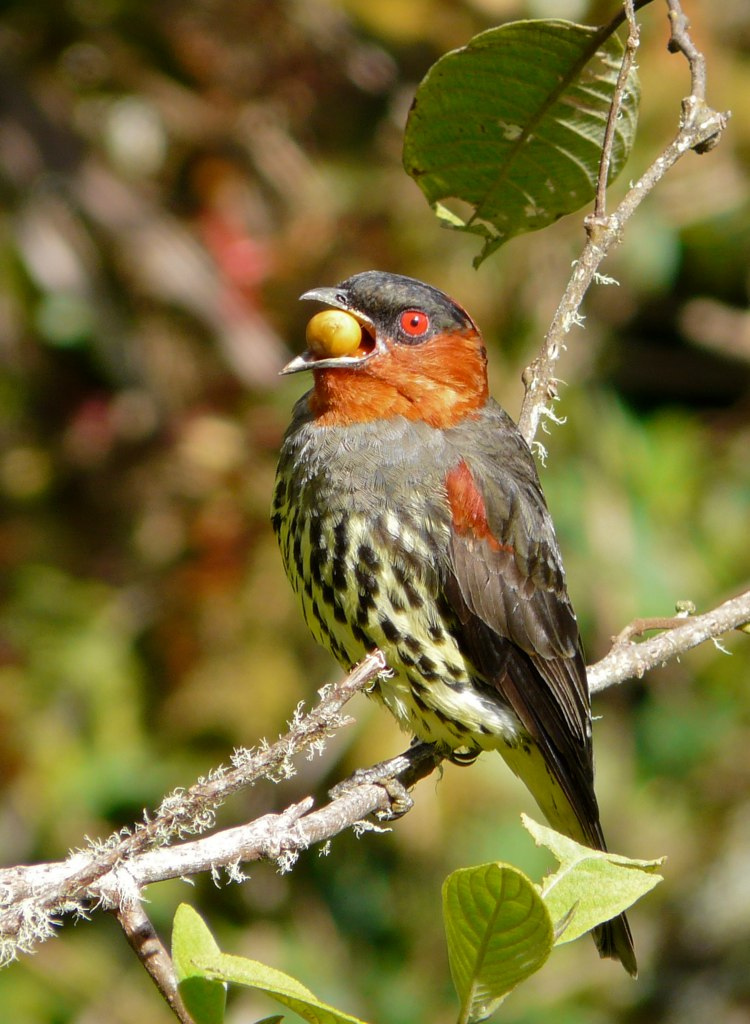
Identifying the Bay-vented Cotinga can be challenging due to its relatively drab appearance, but certain characteristics stand out. Adults display a subtle mix of grayish-brown plumage with a distinctive reddish-brown vent area, providing a key field mark. The head and upperparts are generally darker, while the underparts take on a paler shade. Juvenile Bay-vented Cotingas resemble adults but often exhibit a slightly duller coloration and less pronounced vent markings. Sexual dimorphism in this species is minimal, with males and females appearing similar, though careful observation may reveal males as marginally larger. In flight, the Bay-vented Cotinga's silhouette is compact, with broad wings and a short tail, aiding in maneuverability through dense forest canopies. Perched, the bird maintains an upright posture, often blending into the mossy branches of its environment. Confusion with similar species is possible, particularly with other cotingas and frugivorous birds of the Andes. However, the unique vent coloration and robust body size are reliable distinguishing features.
Having trouble telling birds apart? Upload a photo to our bird identification tool for an instant species match.
Bay-vented Cotinga Habitat and Range
Preferred Habitat
The Bay-vented Cotinga primarily inhabits the cloud forests of the Andes, thriving at elevations ranging from 2,500 to 3,200 meters. These forests, characterized by high humidity and frequent mist, provide an ideal environment rich in fruit-bearing trees and shrubs. Within this habitat, the Bay-vented Cotinga prefers areas with dense canopy cover and abundant epiphytes. As a non-migratory species, it shows little seasonal habitat shift, maintaining residence within its preferred montane environment year-round. While the Bay-vented Cotinga is not typically found in urban areas, it may occasionally venture into disturbed habitats adjacent to its primary forest home, especially if fruit resources are temporarily abundant. This bird is a quintessential resident of undisturbed montane forests, where it plays an integral role in the ecosystem.
Geographic Range
The Bay-vented Cotinga is a resident species confined to the Andean regions of Peru and Bolivia. It does not undertake long-distance migrations but instead remains within its specific range year-round. Within this range, the bird is most commonly observed in the central to southern Peruvian Andes, extending into northern Bolivia. While it occupies a relatively narrow elevational band, its presence is often patchy, concentrated in areas with optimal habitat conditions. Population densities are generally low, which, combined with its elusive nature, makes the Bay-vented Cotinga a rare sight even within its known range. It prefers the isolated cloud forests that line the eastern slopes of the Andes, an area increasingly under threat from human activities.
Want to know which birds visit your area? Browse our backyard birds by location guides for region-specific species lists.
What Does the Bay-vented Cotinga Eat?
The diet of the Bay-vented Cotinga primarily consists of fruit, making it an essential frugivore in its ecosystem. It consumes a variety of berries and small fruits, with a preference for those that are fleshy and rich in nutrients. Seasonal changes in fruit availability can influence its diet, with the bird displaying remarkable adaptability in its foraging strategies. During periods of fruit scarcity, the Bay-vented Cotinga may expand its diet to include insects and other invertebrates, although this is less common. Foraging typically occurs in the mid to upper canopy, where the bird uses its short, stout bill to pluck fruits from branches. The Bay-vented Cotinga often forages alone or in small groups, occasionally joining mixed-species flocks to maximize foraging success. Its feeding schedule is largely diurnal, with peak activity during the early morning and late afternoon when fruit is most abundant.
Bay-vented Cotinga Behavior and Social Structure
The Bay-vented Cotinga exhibits a range of intriguing behaviors. Socially, it is often seen foraging alone or in loose associations with other frugivores. It displays territorial tendencies, especially during the breeding season, when males may become more vocal and aggressive in defending fruit-rich areas. Courtship displays are subtle but include aerial chases and vocal exchanges. This species is generally quiet but will emit soft calls to maintain contact with mates and other flock members. Flocking patterns vary, with individuals joining mixed-species flocks, particularly during non-breeding seasons, to improve foraging success and reduce predation risk. The Bay-vented Cotinga is diurnal, engaging in most of its activities from dawn until late afternoon. When faced with predators, such as raptors, it relies on its cryptic plumage and evasive flight to avoid detection, often retreating to dense foliage for cover.
Bay-vented Cotinga Nesting and Reproduction
The nesting habits of the Bay-vented Cotinga are adapted to its montane forest environment. This species constructs a cup-shaped nest, typically using a mix of twigs, moss, and lichen, which it places on a horizontal branch in the mid-canopy. Preferred nesting sites are often secluded, providing cover from potential predators. The female lays a clutch of two to three eggs, which she incubates for approximately 18 to 20 days. During this period, the male may assist by bringing food to the nesting site. Once hatched, the chicks are altricial, requiring constant care and feeding from both parents. The fledgling period lasts around 20 to 25 days, after which the young birds gradually gain independence. The Bay-vented Cotinga typically raises one brood per year, timed to coincide with peak fruit availability, ensuring ample food resources for the growing chicks.
Bay-vented Cotinga Sounds and Vocalizations
The Bay-vented Cotinga is not a particularly vocal bird, but it has a distinctive repertoire of sounds. Its primary song consists of a series of soft, melodious whistles, often delivered in a slow, deliberate rhythm. These whistles can be described as having a clear, flute-like quality. Besides its song, the Bay-vented Cotinga emits low-pitched call notes, often used for communication between mates or within flocks. Alarm calls are more abrupt and harsh, serving as alerts to potential threats. While not prominent in dawn chorus, its song can occasionally be heard at daybreak, mingling with those of other forest dwellers. Its vocalizations, though understated, are a charming aspect of its behavior, contributing to its enigmatic presence in the cloud forest.
Interesting Facts About the Bay-vented Cotinga
- 1The Bay-vented Cotinga was first described in the late 19th century, yet it remains one of the less-studied cotingas due to its elusive nature.
- 2Despite its striking vent coloration, the Bay-vented Cotinga is often difficult to spot due to its preference for dense forest cover.
- 3The Bay-vented Cotinga shares its habitat with several rare and endemic bird species, making its conservation critical for biodiversity.
- 4This cotinga is part of the Cotingidae family, which includes some of the most colorful and diverse birds in the Neotropics.
- 5The Bay-vented Cotinga's fruit-centric diet helps in seed dispersal, playing a vital role in the health of its forest ecosystem.
- 6Cloud forests like those inhabited by the Bay-vented Cotinga are unique ecosystems, characterized by high biodiversity and endemism.
- 7While not migratory, the Bay-vented Cotinga's movements within its home range are closely linked to seasonal fruit availability.
Bay-vented Cotinga Conservation Status
Currently, the International Union for Conservation of Nature (IUCN) classifies the Bay-vented Cotinga as Near Threatened. Although its population appears stable, the primary threats include habitat destruction due to deforestation and agricultural expansion. Conservation efforts are underway to preserve the cloud forest habitats vital for its survival. These efforts include establishing protected areas and promoting sustainable land use practices. Historically, the Bay-vented Cotinga's range has contracted due to forest fragmentation, but recent conservation initiatives offer hope for maintaining its population. Continued monitoring and habitat protection are essential to ensure the long-term survival of this unique species.
Other Cotingidae Species



Birds Similar to the Bay-vented Cotinga
These species are often confused with the Bay-vented Cotinga due to similar appearance or overlapping range.
