Black-bellied Storm-Petrel
Fregetta tropica
Order: Procellariiformes / Family: Hydrobatidae

Wikimedia Commons
About the Black-bellied Storm-Petrel
The Black-bellied Storm-Petrel, scientifically named Fregetta tropica, is a small seabird that captures the attention of birders and researchers alike due to its distinctive appearance and behavior. This bird is predominantly found in the Southern Hemisphere, particularly in the open ocean waters surrounding Antarctica, the southern parts of Africa, South America, and Oceania. Its presence in these remote and often harsh environments underscores its adaptability and resilience. The Black-bellied Storm-Petrel plays a critical role in the marine ecosystem, acting as both predator and prey. It primarily feeds on planktonic crustaceans and small fish, thus helping to control these populations and maintain the balance within the oceanic food web. During breeding season, it returns to specific islands, such as those in the Scotia Sea and the South Shetland Islands, where it nests in crevices and burrows, safe from many terrestrial predators. The bird's life cycle is closely tied to the seasonal dynamics of its environment. It breeds during the austral summer when food resources are more plentiful and ocean conditions more favorable. This seasonal behavior ensures that its chicks have the best chance of survival. Throughout the rest of the year, the Black-bellied Storm-Petrel is largely pelagic, roaming vast stretches of ocean, which has implications for its conservation, as it crosses international waters and is subject to varying degrees of protection. The Black-bellied Storm-Petrel's ecological significance extends beyond its immediate environment. As a species that traverses large areas of the Southern Ocean, it is an indicator of ocean health, with its population trends reflecting broader changes in marine ecosystems. Its presence or absence can signal shifts in ocean conditions, such as changes in sea surface temperature and prey abundance, which are often linked to climate change. Observations of the Black-bellied Storm-Petrel thus contribute valuable data to the global understanding of marine biodiversity and the impacts of environmental change.
The Black-bellied Storm-Petrel belongs to the family Hydrobatidae, within the order Procellariiformes. These birds typically live average 10 years with max recorded 18 years..
How to Identify a Black-bellied Storm-Petrel
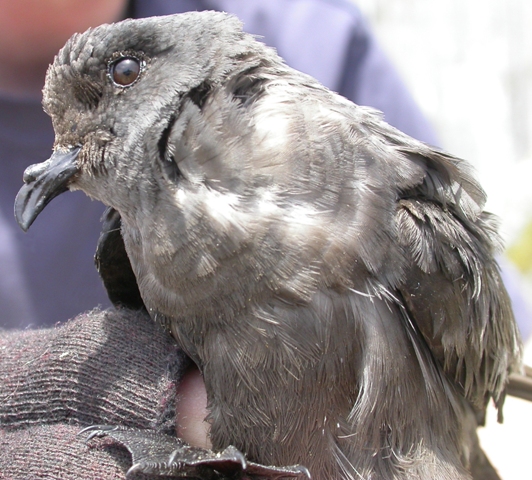
The Black-bellied Storm-Petrel is a small bird, measuring about 20 to 23 centimeters in length with a wingspan of approximately 46 to 48 centimeters. Its most distinguishing feature is its striking black belly, which contrasts sharply with its otherwise white underparts. The upperparts are predominantly dark, while the face and throat are white, giving it a unique appearance among storm-petrels. Juveniles resemble adults but have slightly duller plumage. Unlike many bird species, there is little sexual dimorphism in Black-bellied Storm-Petrels, with males and females appearing similar. In flight, the bird's silhouette is characterized by its long wings and short, square tail. It exhibits a fluttering flight pattern, often skimming just above the ocean surface, making sharp turns as it navigates the air currents. This flight style, combined with its plumage, aids in identification when observing the bird at sea. The Black-bellied Storm-Petrel can be confused with similar species like the White-bellied Storm-Petrel, especially at a distance. However, the black belly of Fregetta tropica is a clear distinguishing feature. When perched, it typically adopts a low, crouched posture, often on rocky islands or floating debris, where it rests between long flights.
Having trouble telling birds apart? Upload a photo to our bird identification tool for an instant species match.
Black-bellied Storm-Petrel Habitat and Range
Preferred Habitat
The Black-bellied Storm-Petrel predominantly inhabits open ocean environments, particularly in the Southern Hemisphere. It thrives in pelagic zones far from land, where it spends the majority of its life. During the breeding season, it frequents subantarctic and antarctic islands, where it nests in rocky crevices and burrows. Notable breeding sites include the islands of the Scotia Sea, the South Shetland Islands, and the southern coast of New Zealand. These regions offer the isolation and protection needed for successful reproduction. Outside the breeding season, the Black-bellied Storm-Petrel is highly pelagic, rarely coming close to coastal areas, instead favoring the vast expanses of the Southern Ocean. Unlike many birds, it does not exhibit significant elevation range shifts, remaining at sea level throughout its life. It has little interaction with urban or rural environments, as its life is closely tied to the marine habitat, far removed from human activities.
Geographic Range
The Black-bellied Storm-Petrel has a circumpolar distribution, primarily within the Southern Ocean. During the breeding season, it is found on isolated islands such as those in the Scotia Sea, South Shetland Islands, and the coasts of New Zealand's subantarctic regions. After breeding, it disperses widely across the Southern Ocean, ranging between the latitudes of approximately 40°S and 60°S, although it has been recorded as far north as the southern coasts of South America and Africa. This wide-ranging behavior makes it a true oceanic wanderer. Population densities are highest around breeding colonies, but during the non-breeding season, the birds are widely scattered, making them less concentrated and harder to observe. The Black-bellied Storm-Petrel's presence in these areas is influenced by oceanographic conditions such as sea surface temperature and food availability, which also affect their migration corridors. Despite its extensive range, sightings outside the Southern Hemisphere are rare, emphasizing its preference for the colder waters of the south.
Want to know which birds visit your area? Browse our backyard birds by location guides for region-specific species lists.
What Does the Black-bellied Storm-Petrel Eat?
The Black-bellied Storm-Petrel primarily feeds on planktonic crustaceans and small fish, which it captures at the ocean surface. It employs a technique known as surface seizing, where it hovers just above the water, picking off prey items with precision. This foraging method allows it to exploit the rich feeding grounds created by ocean currents and upwellings. Its diet varies seasonally, with an increased reliance on fish during the breeding season to meet the heightened energy demands of chick-rearing. Prey items are typically small, ranging from 1 to 3 centimeters in size, which suits the bird's small bill and agile hunting style. The Black-bellied Storm-Petrel forages throughout the day, although it may adjust its timing based on prey availability and ocean conditions. At night, it is less active, resting on the water or in flight. This diurnal foraging schedule aligns with the daily vertical migrations of many marine organisms, ensuring a consistent food supply.
Black-bellied Storm-Petrel Behavior and Social Structure
The Black-bellied Storm-Petrel exhibits a range of behaviors that reflect its adaptation to life at sea. It is generally solitary or found in small groups, particularly when foraging. However, during the breeding season, it becomes more social, nesting in loose colonies where pairs engage in cooperative activities such as nest building and chick rearing. Courtship displays involve synchronized flight patterns and vocalizations, which strengthen pair bonds. The Black-bellied Storm-Petrel is not particularly territorial, as its vast oceanic range provides ample space for all individuals. Its response to predators is primarily evasive; it relies on its agility in flight to avoid threats. When threatened on land, it retreats into its burrow or crevice. Daily activity patterns are largely dictated by the availability of food. It spends most of its time in flight, skimming the ocean surface in search of prey. This species is primarily active during daylight hours, though it can be observed flying at night, especially when returning to breeding sites.
Black-bellied Storm-Petrel Nesting and Reproduction
The nesting habits of the Black-bellied Storm-Petrel are adapted to its remote island environments. It nests in burrows or crevices on rocky subantarctic islands, where it is shielded from many predators. The nest is usually a simple scrape in the ground, occasionally lined with pebbles or vegetation. Clutch size is typically one egg, reflecting the species' investment in quality over quantity. The incubation period lasts around 40 to 50 days, with both parents sharing incubation duties. Once hatched, the chick is fed regurgitated food by both parents and remains in the nest for approximately 60 to 70 days until fledging. Parental roles are balanced, with both adults participating equally in feeding and protection. The Black-bellied Storm-Petrel typically raises one brood per year, although in years of abundant food, some pairs may attempt a second brood. The remote and harsh breeding conditions require precise timing and coordination to ensure the survival of the offspring.
Black-bellied Storm-Petrel Sounds and Vocalizations
The vocalizations of the Black-bellied Storm-Petrel are characterized by a series of high-pitched, twittering calls often heard during flight or at breeding colonies. These calls have a rhythmic quality, typically consisting of rapid sequences of short notes. The primary call serves as both a contact call and a means of reinforcing pair bonds. Alarm calls are sharper and more urgent, designed to alert mates to potential threats. During the breeding season, a chorus of calls can be heard at dawn and dusk as birds return to their nests, creating a distinctive soundscape that echoes across their island habitats. While not as melodious as songbirds, the Black-bellied Storm-Petrel's vocalizations are essential for communication and coordination within the species.
Interesting Facts About the Black-bellied Storm-Petrel
- 1The Black-bellied Storm-Petrel spends most of its life at sea, only coming to land to breed.
- 2Despite their small size, Black-bellied Storm-Petrels can travel thousands of kilometers during migration.
- 3These birds use a technique called 'surface seizing' to catch their prey, hovering just above the water.
- 4Black-bellied Storm-Petrels have a unique fluttering flight pattern that allows them to skim the ocean's surface.
- 5The species exhibits little sexual dimorphism, making males and females difficult to distinguish visually.
- 6They are one of the few bird species that can drink seawater, thanks to specialized glands that excrete salt.
- 7Black-bellied Storm-Petrels are rarely seen by humans due to their remote oceanic habitat.
Black-bellied Storm-Petrel Conservation Status
The Black-bellied Storm-Petrel is currently listed as Least Concern by the IUCN, with populations considered stable. However, it faces threats from climate change, which affects its marine habitat and food sources. Predation by introduced species on breeding islands and pollution also pose risks. Conservation efforts focus on habitat protection and monitoring population trends. Historical data suggest fluctuations in population sizes, often linked to broader environmental changes. While not immediate, ongoing threats necessitate vigilance to ensure the species' continued survival.