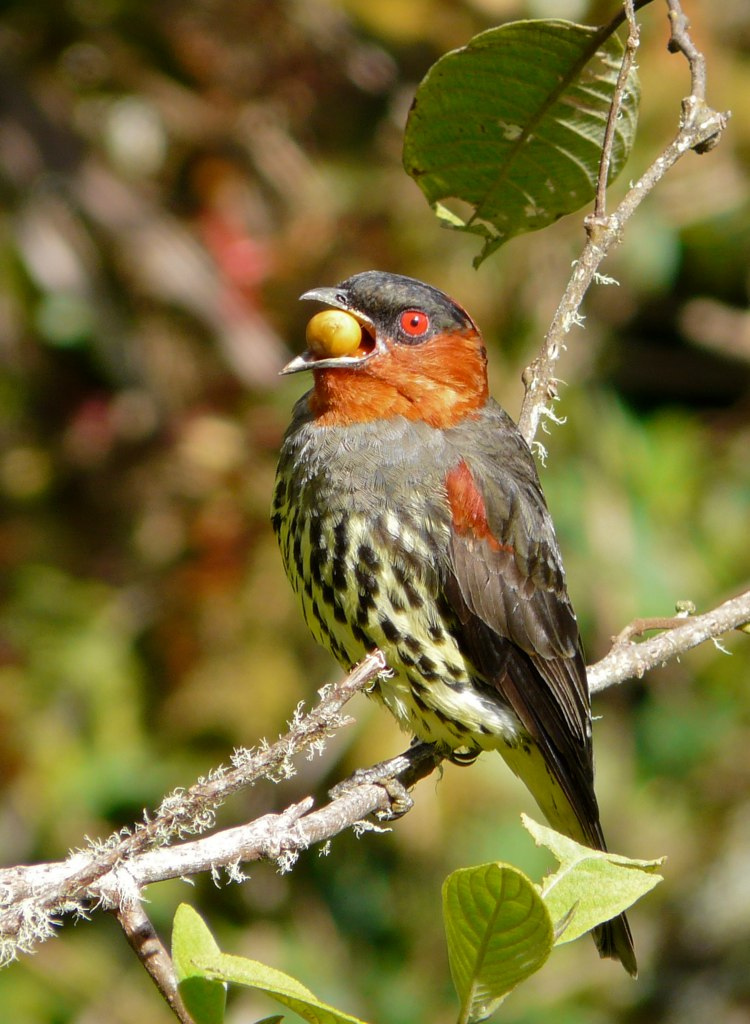
Black-chested Fruiteater
Pipreola lubomirskii
Order: Passeriformes / Family: Cotingidae

Wikimedia Commons
About the Black-chested Fruiteater
The Black-chested Fruiteater (Pipreola lubomirskii) is a remarkable member of the cotingidae family, known for its vibrant plumage and distinctive vocalizations. This bird is endemic to the cloud forests of the northern Andes, primarily found in Colombia and Ecuador. The Black-chested Fruiteater's striking appearance contributes to its allure; the male displays a vivid combination of green and black with a contrasting bright orange belly, while the female is more subdued with olive tones. Though not considered a large bird, it commands attention with its dynamic coloration and active behavior.
Ecologically, the Black-chested Fruiteater plays a crucial role as a frugivore, aiding in seed dispersal for many fruiting plants within its habitat. This interaction fosters forest regeneration and sustains the intricate ecosystem of the Andean cloud forests. These birds tend to inhabit altitudes ranging from 1,500 to 2,800 meters, favoring areas with dense vegetation that provide ample food sources and protection from predators.
Seasonally, the Black-chested Fruiteater exhibits specific behavior changes. During the breeding season, typically from May to July, males become more vocal and display their colorful plumage with increased frequency. The species is generally sedentary, with minimal altitudinal migration, relying on the evergreen nature of the cloud forest to provide consistent food availability throughout the year.
The Black-chested Fruiteater holds particular significance as an indicator species for the health of its high-altitude forest environment. Its presence signifies a thriving, biodiverse habitat, while any decline may suggest environmental degradation. Conservationists often monitor this bird to assess the ecosystem's status and implement preservation strategies, ensuring these unique forests continue to flourish.
The Black-chested Fruiteater belongs to the family Cotingidae, within the order Passeriformes. These birds typically live typically around 8-10 years, with some individuals living longer in optimal conditions.
How to Identify a Black-chested Fruiteater
Identifying the Black-chested Fruiteater involves observing several key physical characteristics. Adult males boast a vibrant green upper body with a prominent black chest band, contrasting sharply with their bright orange underparts. Females, in contrast, display a more muted olive-green color with less conspicuous markings, lacking the black chest band. Juveniles resemble females but may exhibit even duller plumage with a less defined belly color.
In flight, the Black-chested Fruiteater presents a compact silhouette with broad wings and a relatively short tail. This silhouette can help distinguish it from similar species, such as the Green-and-black Fruiteater, which lacks the distinct black chest band and orange belly. When perched, the Black-chested Fruiteater often adopts an upright posture, showcasing its colorful underparts prominently.
These visual cues are particularly useful in dense forest environments where direct observation may be brief. The bird's unique vocalizations can also assist in identification when visibility is limited. By focusing on these distinctive field marks, birders can accurately identify the Black-chested Fruiteater in its natural habitat.
Having trouble telling birds apart? Upload a photo to our bird identification tool for an instant species match.
Black-chested Fruiteater Habitat and Range
Preferred Habitat
The Black-chested Fruiteater predominantly inhabits the montane cloud forests of the northern Andes. These forests are characterized by high humidity, frequent cloud cover, and dense vegetation, providing an ideal environment for this frugivorous species. Typically, the bird resides at elevations between 1,500 and 2,800 meters, where the mix of tree and shrub species offers abundant fruiting opportunities.
Within these cloud forests, the Black-chested Fruiteater prefers areas with rich undergrowth and a high density of fruit-bearing plants. This habitat choice supports its diet and provides essential cover from predators. Unlike many other birds, the Black-chested Fruiteater does not exhibit significant seasonal habitat shifts, as the cloud forest’s evergreen nature ensures a consistent food supply year-round.
The species is rarely found in urban or heavily disturbed areas, reflecting its reliance on undisturbed, mature forest environments. Conservation of these habitats is crucial for the survival of the Black-chested Fruiteater, emphasizing the importance of preserving intact forest ecosystems in the Andes.
Geographic Range
The Black-chested Fruiteater's range is primarily confined to the Andean regions of Colombia and Ecuador. It is a non-migratory species, residing year-round in the cloud forests that span these countries. Within Colombia, the bird is found in the central and eastern Andes, while in Ecuador, it inhabits similar altitudinal zones in the northern parts of the country.
The bird's population density is higher in protected areas and national parks where habitat conditions remain optimal and human disturbance is minimal. Notable hotspots for observing the Black-chested Fruiteater include Colombia's Los Nevados National Natural Park and Ecuador's Mindo Valley, where diverse avifauna attracts birdwatchers from around the globe.
Despite its relatively limited geographical range, the Black-chested Fruiteater benefits from these conservation areas that safeguard its preferred habitat. While its range does not extend to far-reaching migratory corridors, the species' localized presence underscores the importance of regional conservation efforts in maintaining viable populations.
Want to know which birds visit your area? Browse our backyard birds by location guides for region-specific species lists.
What Does the Black-chested Fruiteater Eat?
The Black-chested Fruiteater primarily consumes a diet of fruit, making it an integral part of the Andean cloud forest ecosystem. It favors small to medium-sized fruits, including berries from a variety of native plant species. The bird's foraging technique involves moving agilely through the forest canopy, plucking ripe fruits directly from branches.
Seasonal changes in fruit availability influence the bird's diet, although the evergreen nature of its habitat ensures a relatively constant food source. During peak fruiting seasons, the Black-chested Fruiteater may exhibit increased feeding activity, taking advantage of abundant resources to fuel its energetic lifestyle.
In addition to fruit, the bird occasionally supplements its diet with insects, providing essential proteins and nutrients. This dietary flexibility supports the Black-chested Fruiteater's survival during leaner periods when fruit is less available. By dispersing seeds through its frugivorous habits, the bird plays a vital role in maintaining the biodiversity and health of the cloud forest ecosystem.
Black-chested Fruiteater Behavior and Social Structure
The Black-chested Fruiteater exhibits a range of behaviors that reflect its adaptation to the cloud forest environment. Generally solitary or found in pairs, this bird is not known for forming large flocks. Instead, it maintains a relatively small home range, focusing its activities within a familiar territory rich in fruiting plants.
During the breeding season, males engage in elaborate courtship displays, showcasing their vibrant plumage to attract mates. These displays often involve a combination of vocalizations and physical posturing, drawing attention to their striking black chest and orange belly. Once paired, both sexes remain attentive to their nesting duties, coordinating efforts to raise their young.
The Black-chested Fruiteater's daily activity patterns are largely diurnal, with peak foraging occurring in the morning and late afternoon. The bird's response to predators includes remaining motionless among foliage or executing rapid, evasive flights. These strategies, along with its cryptic coloration, help minimize predation risks in its dense forest habitat.
Black-chested Fruiteater Nesting and Reproduction
The nesting behavior of the Black-chested Fruiteater is adapted to the challenges of the cloud forest environment. Nests are typically constructed in dense foliage, often within the lower to mid-canopy levels of trees. The nest itself consists of a shallow cup made from twigs, moss, and leaves, providing a secure structure for raising young.
Clutch sizes generally consist of two to three eggs, with both parents sharing incubation responsibilities over a period of about 17 to 19 days. After hatching, the fledging period lasts an additional 18 to 20 days, during which time the nestlings receive constant care and feeding from both parents. This cooperative approach ensures the young receive adequate nourishment and protection during their vulnerable early life stages.
The Black-chested Fruiteater typically raises one brood per year, with breeding timed to coincide with peak fruit availability. This strategy maximizes the chances of offspring survival, aligning reproductive efforts with periods of abundant resources.
Black-chested Fruiteater Sounds and Vocalizations
The vocalizations of the Black-chested Fruiteater are notable for their rhythmic and melodious quality, often described as a series of clear, flute-like notes. These primary songs serve both as territorial calls and courtship signals, with males frequently singing from prominent perches to advertise their presence.
In addition to their songs, these birds produce various call notes, including soft whistles and chirps used for communication between mates or signaling alarm. When threatened, the Black-chested Fruiteater may emit harsher, more urgent sounds to warn others of approaching danger.
The species is most vocal during the dawn chorus, with males contributing to the symphony of sounds that fill the cloud forest at first light. These vocal displays are key to understanding the bird's behavior and are often the first clue to its presence in otherwise visually concealed settings.
Interesting Facts About the Black-chested Fruiteater
- 1The Black-chested Fruiteater, despite its name, exhibits a wide range of plumage colors, making it a visually striking species.
- 2This bird plays a crucial role in seed dispersal, helping maintain the biodiversity of the cloud forests it inhabits.
- 3The Black-chested Fruiteater is often heard before it is seen, thanks to its distinctive flute-like calls that resonate through the forest.
- 4Unlike many of its relatives, the Black-chested Fruiteater is sedentary, remaining in its Andean habitat year-round.
- 5Its diet primarily consists of fruit, but it will occasionally eat insects, showcasing its dietary adaptability.
- 6The species is known to participate in mixed-species flocks, benefiting from the protection and foraging opportunities these groups provide.
- 7The Black-chested Fruiteater's nesting success is closely tied to the availability of fruit, highlighting the importance of forest conservation.
Black-chested Fruiteater Conservation Status
The Black-chested Fruiteater is currently listed as Least Concern by the IUCN, indicating a relatively stable population. However, habitat loss due to deforestation poses a significant threat to its long-term survival. The cloud forests it inhabits are increasingly fragmented by agricultural expansion and logging, leading to potential declines in suitable habitat. Conservation efforts focus on protecting large tracts of intact forest within its range, with several national parks and reserves providing critical refuges for the species. Additionally, initiatives to promote sustainable land-use practices aim to mitigate habitat destruction and ensure the preservation of these vital ecosystems. Monitoring population trends remains a priority for conservationists, as changes in forest health directly impact the Black-chested Fruiteater's habitat availability. Continued attention to these factors is necessary to maintain the species' conservation status and support the broader ecological integrity of the Andean cloud forests.