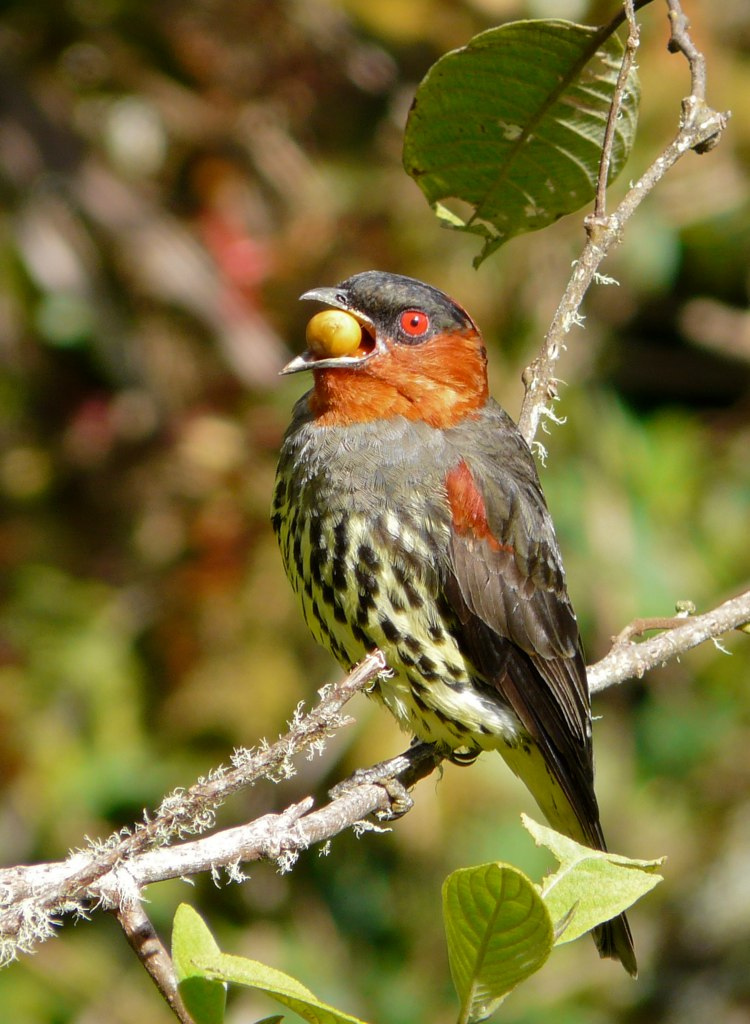
Black-headed Berryeater
Carpornis melanocephala
Order: Passeriformes / Family: Cotingidae

Wikimedia Commons
About the Black-headed Berryeater
The Black-headed Berryeater (Carpornis melanocephala) is a captivating species belonging to the Cotingidae family. It inhabits the lush Atlantic Forest of southeastern Brazil, particularly in the states of Rio de Janeiro, Espírito Santo, and Minas Gerais. This bird plays a vital role in the ecosystem by assisting in seed dispersal, as it primarily feeds on a variety of fruits and berries. Its presence indicates a healthy forest ecosystem, as it relies on large tracts of undisturbed habitat. The Black-headed Berryeater has a particular affinity for the high-canopy areas of the forest, where it can easily access its preferred food sources. These birds are generally sedentary, but they may exhibit local movements in response to food availability, traveling short distances to areas with abundant fruiting trees. During the breeding season, which typically coincides with the rainy months, these berryeaters become more vocal and active, establishing territories and engaging in courtship displays. The ecological role of the Black-headed Berryeater extends beyond just fruit consumption. Its foraging habits contribute to the balance and regeneration of the forest. As it consumes and later excretes seeds, it aids in the propagation of various plant species, supporting forest diversity. The Black-headed Berryeater's habitat choice often reflects its need for specific microhabitats within the forest, such as areas with dense foliage and fruiting plants. By maintaining a preference for undisturbed, mature forests, this bird inadvertently acts as a biological indicator of forest health. Conservationists pay close attention to this bird, for its population trends provide insights into the overall state of the Atlantic Forest. The Black-headed Berryeater's significance extends to its cultural impact as well. Birdwatchers and nature enthusiasts from around the world are drawn to Brazil's Atlantic Forest to catch a glimpse of this striking bird. Its presence adds an element of allure to the already biodiverse region, making it a valuable component of ecotourism efforts. The bird's reliance on the forest emphasizes the importance of protecting these habitats not only for the berryeater but also for the myriad of species that share its environment.
The Black-headed Berryeater belongs to the family Cotingidae, within the order Passeriformes. These birds typically live average 10 years, with a maximum recorded lifespan of 15 years..
How to Identify a Black-headed Berryeater
The Black-headed Berryeater is easily recognizable by its striking black head, which contrasts sharply with its olive-green body. Adult birds display a sleek, black plumage on the head and neck, creating a distinctive appearance against a backdrop of vibrant greenery. Juveniles, however, exhibit a more subdued coloration, with a grayish head that eventually darkens as they mature. Sexual dimorphism is not pronounced in this species, as both males and females share similar plumage characteristics. When perched, the Black-headed Berryeater maintains an upright posture, often seen sitting quietly in the high canopy, surveying its surroundings for potential food sources. Its silhouette in flight can be described as compact, with rounded wings and a relatively short tail, making it well-suited for maneuvering through dense forest canopies. The Black-headed Berryeater might occasionally be confused with similar species, such as the Cinnamon-vented Piha, but the latter lacks the distinctive black head. Observers should note the berryeater's unique coloration and listen for its distinctive calls to aid in proper identification.
Having trouble telling birds apart? Upload a photo to our bird identification tool for an instant species match.
Black-headed Berryeater Habitat and Range
Preferred Habitat
The Black-headed Berryeater thrives in the dense, humid environments of Brazil's Atlantic Forest, a biodiversity hotspot known for its rich flora and fauna. It predominantly inhabits lowland and montane forests, preferring altitudes ranging from 200 to 1,200 meters. This species favors areas with thick canopy cover and abundant fruiting trees, which provide both nourishment and shelter. Seasonal movements are minimal, as these birds are largely resident. However, they may shift slightly in response to the availability of fruits, moving to different elevations or forest patches as necessary. The Black-headed Berryeater is typically absent from urban areas, preferring the tranquility and resources of rural forest settings. Unlike some bird species that adapt well to human-altered landscapes, this berryeater's dependence on pristine forest environments underscores the need for conservation efforts focused on habitat preservation.
Geographic Range
The Black-headed Berryeater is endemic to southeastern Brazil, with its range primarily confined to the Atlantic Forest. This region spans several states, including Rio de Janeiro, Espírito Santo, and Minas Gerais. Unlike migratory species, the Black-headed Berryeater remains within its range year-round, although it may undertake short, local movements in search of food. The population is most dense in areas with extensive forest cover, where human disturbance is minimal. While the bird's distribution is limited to Brazil, it is relatively widespread within its preferred habitat. Conservation areas such as the Serra dos Órgãos National Park and the Itatiaia National Park provide crucial refuges for this species, supporting stable populations. However, ongoing deforestation and habitat fragmentation pose significant threats to the Black-headed Berryeater's long-term survival, emphasizing the need for continued habitat protection.
Want to know which birds visit your area? Browse our backyard birds by location guides for region-specific species lists.
What Does the Black-headed Berryeater Eat?
The Black-headed Berryeater's diet consists predominantly of fruits and berries, making it an essential frugivore within its ecosystem. It shows a preference for a variety of native fruits, including those from the Myrtaceae and Melastomataceae families. During the wet season, when fruit availability peaks, the berryeater's diet diversifies, incorporating a broader range of species. In the dry season, it relies more heavily on the fruits of certain evergreen trees, which maintain their bounty year-round. Foraging typically occurs in the upper canopy, where the bird adeptly plucks ripe berries using its robust bill. While fruits constitute the majority of its diet, the Black-headed Berryeater may occasionally consume small insects, providing additional protein. This dietary flexibility helps it navigate periods of scarcity, although its reliance on fruiting trees makes it vulnerable to habitat loss. Feeding primarily during the early morning and late afternoon, it takes advantage of cooler temperatures and reduced competition.
Black-headed Berryeater Behavior and Social Structure
The Black-headed Berryeater exhibits a solitary or loosely social behavior pattern, typically seen foraging alone or in pairs. It is a territorial species, with individuals or pairs defending their feeding areas from intruding conspecifics. During the breeding season, males become particularly vocal, engaging in elaborate displays to attract females. This often involves a combination of vocalizations and physical displays, such as wing fluttering and tail fanning. Despite their somewhat solitary nature, these birds may join mixed-species flocks, especially when food is abundant. Such associations offer safety in numbers and increased foraging efficiency. In response to predators, the Black-headed Berryeater relies on its agility and forest cover, often retreating deeper into the foliage. Its daily activity pattern follows a bimodal schedule, with peak activity in the early morning and late afternoon, coinciding with prime feeding times. This behavior allows it to avoid the midday heat while optimizing foraging success.
Black-headed Berryeater Nesting and Reproduction
The Black-headed Berryeater constructs cup-shaped nests, typically located high in the forest canopy. These nests are woven from twigs, leaves, and other plant materials, providing a well-camouflaged and secure environment for raising young. Preferred nesting sites are in robust, fruit-bearing trees that offer both protection from predators and proximity to food sources. Clutch size generally consists of one to two eggs, which both parents incubate over a period of approximately 18 to 20 days. After hatching, the young remain in the nest for an additional 20 to 25 days, during which both parents continue to provide food and protection. The fledglings are dependent on parental care for several weeks post-fledging, learning essential skills such as foraging and predator avoidance. The Black-headed Berryeater typically raises one brood per year, although in favorable conditions, a second brood may be attempted.
Black-headed Berryeater Sounds and Vocalizations
The Black-headed Berryeater's vocal repertoire includes a series of melodious whistles and trills, often described as flute-like in quality. The primary song is a series of clear, ascending notes that create a rhythmic and uplifting tune, often heard during the early morning hours. Call notes are sharp and piercing, serving as contact calls between individuals or as alarm signals in the presence of predators. During the dawn chorus, the Black-headed Berryeater's song stands out for its clarity and musicality, contributing to the rich tapestry of sounds within the Atlantic Forest. These vocalizations not only facilitate communication but also play a vital role in territory establishment and mate attraction.
Interesting Facts About the Black-headed Berryeater
- 1The Black-headed Berryeater plays a crucial role in seed dispersal, aiding the regeneration of Brazil's Atlantic Forest.
- 2Despite its striking appearance, the Black-headed Berryeater is often heard before it is seen, thanks to its distinctive flute-like song.
- 3The Black-headed Berryeater's reliance on fruiting trees makes it an important indicator species for forest health.
- 4This bird is a member of the Cotingidae family, which includes some of the most vibrantly colored birds in the world.
- 5The Black-headed Berryeater's range is limited to the Atlantic Forest, a biodiversity hotspot with many endemic species.
- 6During the breeding season, the male Black-headed Berryeater engages in elaborate vocal displays to attract a mate.
- 7Although primarily frugivorous, the Black-headed Berryeater occasionally supplements its diet with small insects.
Black-headed Berryeater Conservation Status
The Black-headed Berryeater is currently classified as Near Threatened by the IUCN, with its population trend showing signs of decline. The primary threat to this species is habitat loss due to deforestation and fragmentation of the Atlantic Forest, driven by agricultural expansion and urban development. Conservation efforts focus on protecting remaining forest habitats through the establishment of protected areas and environmental legislation. Initiatives aimed at reforestation and forest connectivity are also crucial in mitigating the impacts of habitat fragmentation. Historical population changes reflect the dramatic reduction of the Atlantic Forest, highlighting the urgent need for ongoing conservation actions to ensure the survival of this emblematic species.