
Black Manakin
Xenopipo atronitens
Order: Passeriformes / Family: Pipridae

Wikimedia Commons
About the Black Manakin
The Black Manakin (Xenopipo atronitens) is a small passerine bird belonging to the Pipridae family, renowned for its striking appearance and complex social behaviors. Its presence in the diverse ecosystems of the Amazon Basin underscores its ecological significance as both a pollinator and seed disperser. This bird thrives in the lush, humid rainforests stretching across several South American countries, including Brazil, Peru, Ecuador, and Colombia. The Black Manakin's role in these ecosystems is vital, as it contributes to the maintenance of plant diversity through its feeding habits.
In terms of behavior, the Black Manakin is a fascinating study of avian social structure. During the breeding season, males engage in elaborate courtship displays, which involve coordinated movements and vocalizations to attract females. These displays often take place in leks, communal areas where males vie for attention. Such behaviors not only highlight the bird's complex social interactions but also serve as a mechanism for sexual selection, ensuring the propagation of the species' most vigorous individuals.
Aside from their breeding rituals, Black Manakins also participate in mixed-species flocks, a behavior that reduces predation risk and increases foraging efficiency. Their presence in such flocks indicates their adaptability and social intelligence, allowing them to navigate the dense jungle environment effectively. The Black Manakin's adaptation to its environment is evident in its seasonal behaviors, as it may shift its foraging patterns and locations in response to the availability of food resources. This bird's resilience and adaptability underscore its importance to the ecological fabric of its habitat, making it a species of interest for ornithologists and conservationists alike.
The Black Manakin belongs to the family Pipridae, within the order Passeriformes. These birds typically live average 6-7 years, with the oldest known individuals reaching 10 years..
How to Identify a Black Manakin
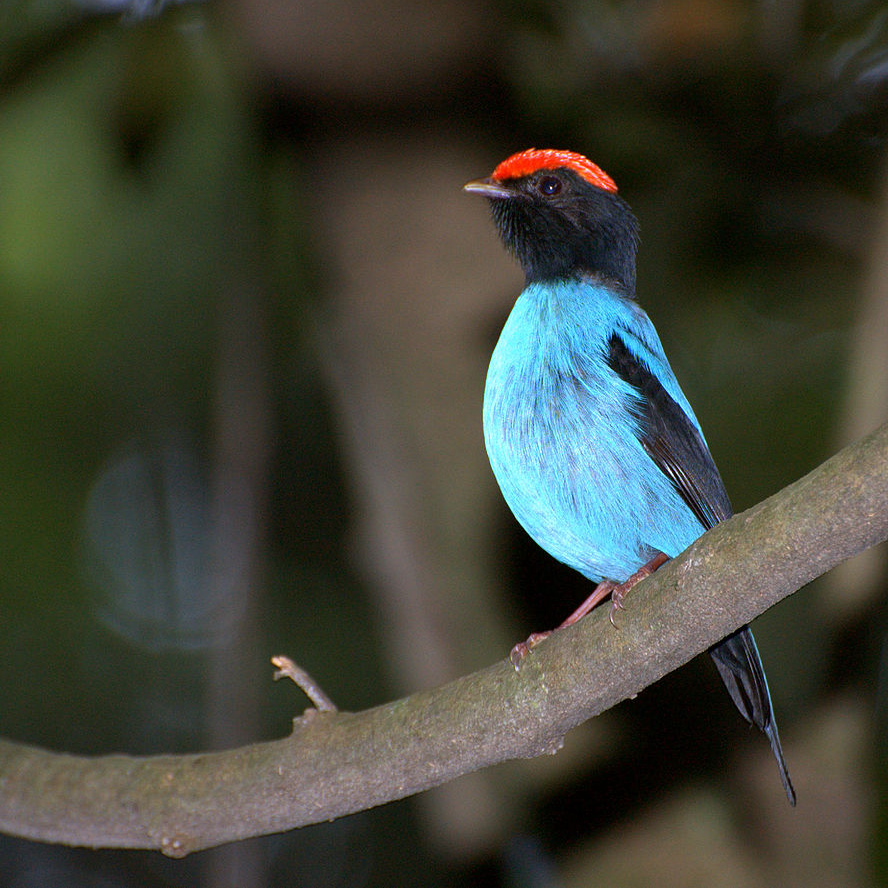
The Black Manakin is easily recognizable by its entirely glossy black plumage, which distinguishes it from other similar-sized birds in its habitat. Adult males and females exhibit little sexual dimorphism, both sporting the same sleek black feathers. Juveniles, however, have a more subdued appearance, often displaying duller black or brownish tones until they reach maturity. This monochromatic plumage reduces the likelihood of confusion with other manakin species that often have more colorful or varied feathers.
In terms of size, the Black Manakin is a small bird, typically measuring around 11 to 12 centimeters in length. Its compact body and short tail aid in swift, agile movements through the underbrush. When perched, the Black Manakin maintains an upright posture, often with its head held slightly elevated, giving it a vigilant appearance. This posture, combined with its distinctive color, provides a clear silhouette against the green backdrop of the rainforest.
Flight patterns of the Black Manakin are characterized by short, direct flights interspersed with rapid wing beats. This bird's flight silhouette is compact, with slightly rounded wings and a short tail, allowing it to navigate effectively through dense foliage. Unlike some of its more colorful relatives, the Black Manakin's simple yet striking appearance is a key identifier in the field.
Having trouble telling birds apart? Upload a photo to our bird identification tool for an instant species match.
Black Manakin Habitat and Range
Preferred Habitat
The Black Manakin thrives in tropical rainforest environments, particularly in lowland regions where dense vegetation prevails. It is commonly found in the understory and mid-story layers of the forest, where it forages for food and engages in social interactions. These forests, rich in biodiversity, provide both the shelter and resources necessary for the bird's survival.
The bird's elevation range typically extends from sea level to about 1,200 meters, although it is most prevalent in the lower elevations where humidity and vegetation density remain high. Unlike some bird species that adapt to urban environments, the Black Manakin remains largely within forested areas, avoiding heavily populated or developed regions.
Seasonally, the Black Manakin may exhibit slight shifts in habitat preference, moving towards areas with greater food availability during specific times of the year. However, it predominantly remains within its preferred rainforest habitat, thriving in the complex and resource-rich ecosystems that define its range.
Geographic Range
The Black Manakin's range is centered in the Amazon Basin, covering a vast expanse of tropical rainforest across northern South America. This bird's distribution includes several countries: Brazil, Peru, Ecuador, Colombia, and Venezuela. Within these regions, the Black Manakin is a resident species, meaning it does not undertake long-distance migrations like some other avian species.
In terms of population density, the Black Manakin is often found in significant numbers where the forest remains intact and undisturbed. It favors areas with dense vegetation and abundant food resources, such as fruiting plants and flowering trees, which provide sustenance throughout the year.
While the Black Manakin does not migrate, it may move locally within its range to track seasonal changes in food availability. This local movement ensures that it can capitalize on varying resources without leaving its primary habitat. As a result, the Black Manakin maintains a stable presence throughout its range, contributing to the ecological dynamics of the Amazon rainforest.
Want to know which birds visit your area? Browse our backyard birds by location guides for region-specific species lists.
What Does the Black Manakin Eat?
The diet of the Black Manakin primarily consists of fruits and insects, making it an important frugivore and insectivore within its ecosystem. It tends to favor small fruits and berries, which it plucks directly from branches or catches in mid-air during agile flights. This diet not only provides essential nutrients but also aids in seed dispersal, contributing to plant regeneration in its habitat.
In addition to fruit, the Black Manakin consumes a variety of insects, which it gleans from leaves and bark. This insectivorous aspect of its diet offers a crucial protein source, especially during the breeding season when energy demands increase. The bird employs a technique known as 'sallying,' where it briefly launches from a perch to catch flying insects before returning to its vantage point.
Seasonally, the Black Manakin's diet may shift slightly depending on the availability of specific fruits and insects. During periods when fruit is scarce, it may rely more heavily on insects and vice versa. This dietary flexibility ensures the bird's survival across different seasonal conditions, highlighting its adaptability within the rainforest ecosystem.
Black Manakin Behavior and Social Structure
The Black Manakin exhibits a rich array of behaviors that highlight its social nature and ecological adaptability. It is a diurnal bird, most active during the early morning and late afternoon when it forages and engages in social interactions. Outside of the breeding season, Black Manakins often join mixed-species flocks, which offer increased protection from predators and enhance foraging success.
During the breeding season, the Black Manakin's behavior becomes particularly fascinating. Males gather in leks to perform elaborate courtship displays, which involve coordinated dances and vocalizations. These displays serve to attract females and also to establish social hierarchies among males. The lekking behavior emphasizes the bird’s complex social structure, where dominant males usually have greater mating success.
Territoriality is another important aspect of the Black Manakin's behavior. Males defend their display sites within the lek, often engaging in aggressive interactions with rivals to maintain their position. Despite their competitive nature during breeding, outside of this period, Black Manakins exhibit more cooperative behaviors, particularly when feeding in flocks. This dual nature of competitive and cooperative behavior underscores their adaptability and social intelligence.
Black Manakin Nesting and Reproduction
The Black Manakin constructs its nests in the dense foliage of the rainforest understory. These nests, typically located close to the ground, are cup-shaped structures woven from fine plant fibers, leaves, and rootlets, providing a secure environment for the eggs.
A typical clutch size for the Black Manakin consists of two eggs. These eggs are incubated primarily by the female, with an incubation period lasting approximately 18 to 20 days. During this time, the female remains closely bonded to the nest, ensuring the safety and warmth of the developing embryos.
After hatching, the chicks remain in the nest for about 15 to 20 days before fledging. Both parents participate in feeding the young, bringing a variety of fruits and insects to support their rapid growth. The cooperative parental care observed in the Black Manakin ensures high survival rates for the offspring, contributing to the species' stability within its habitat.
Black Manakin Sounds and Vocalizations
The Black Manakin's vocalizations form an integral part of its communication repertoire. Its primary song consists of a series of sharp, high-pitched whistles often described as 'tsee-tsee-tsee,' repeated in quick succession. This song serves both to attract mates and establish territory during the breeding season.
In addition to its song, the Black Manakin produces a variety of call notes, including short clicks and chirps, used to maintain contact with other flock members. These calls are crucial for coordinating movements within mixed-species flocks and avoiding potential predators.
Alarm calls are more abrupt and urgent, signaling the presence of a threat. During the dawn and dusk hours, Black Manakins often participate in the rainforest's chorus, adding their distinctive notes to the symphony of jungle sounds. These vocalizations, though not as melodious as some other birds, are an essential aspect of the Black Manakin's life in the forest.
Interesting Facts About the Black Manakin
- 1The Black Manakin is often found in mixed-species flocks, which can include up to 30 different bird species.
- 2Male Black Manakins engage in complex courtship dances that can last several minutes, showcasing their stamina and agility.
- 3Despite its glossy black plumage, the Black Manakin is often difficult to spot in the dense shadows of the rainforest undergrowth.
- 4The Black Manakin's diet of fruits and insects helps control insect populations and aids in rainforest seed dispersal.
- 5Each lek of Black Manakins can contain up to 10 males, all competing to impress visiting females with their displays.
- 6The species has a wide range across the Amazon but remains elusive due to its preference for dense forest habitats.
- 7Black Manakins are non-migratory, but they may move locally within their range to optimize food resource availability.
Black Manakin Conservation Status
The International Union for Conservation of Nature (IUCN) currently lists the Black Manakin as a species of Least Concern, reflecting its stable population trend across its extensive range. However, ongoing deforestation and habitat degradation in the Amazon Basin pose significant threats to its long-term survival. Primary threats include logging, agricultural expansion, and infrastructure development, which result in habitat loss and fragmentation. These activities reduce the availability of suitable nesting and foraging sites, potentially lowering reproductive success and population density over time. Conservation efforts are crucial to safeguard the Black Manakin's habitat. These efforts include establishing protected areas, promoting sustainable land use practices, and engaging local communities in conservation initiatives. By addressing these threats, conservationists aim to ensure that the Black Manakin continues to thrive in the rich ecosystems of the Amazon.
Other Pipridae Species


Birds Similar to the Black Manakin
These species are often confused with the Black Manakin due to similar appearance or overlapping range.
