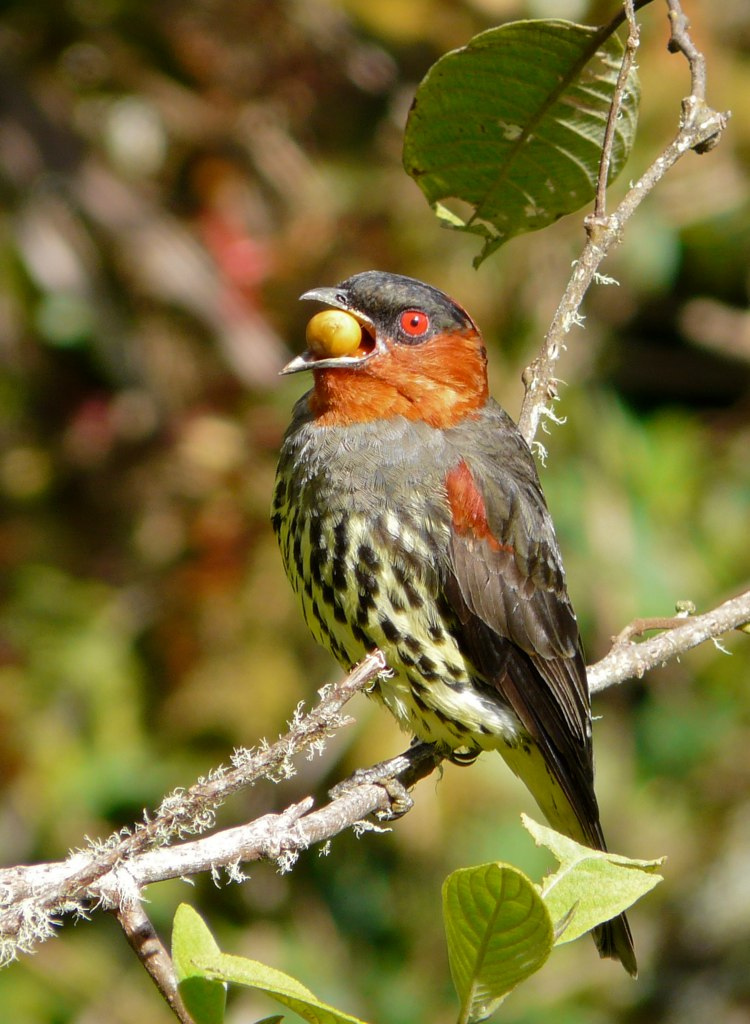
Black-necked Red-Cotinga
Phoenicircus nigricollis
Order: Passeriformes / Family: Cotingidae

Wikimedia Commons
About the Black-necked Red-Cotinga
The Black-necked Red-Cotinga (Phoenicircus nigricollis) is a remarkable bird species native to the dense tropical forests of the Amazon basin. Its vibrant red body and distinctive black neck create a striking appearance that captivates birdwatchers and naturalists alike. This bird thrives in the lowland rainforests, primarily in countries such as Brazil, Peru, and Colombia, where the dense canopy provides ample resources and shelter.
As a member of the Cotingidae family, the Black-necked Red-Cotinga plays a critical role in its ecosystem. It contributes to the seed dispersal of various plant species, aiding in forest regeneration. The bird's diet primarily consists of fruit, and its foraging habits help in spreading seeds across large areas.
Seasonally, the Black-necked Red-Cotinga may exhibit slight shifts in behavior and habitat use, though it predominantly remains in its Amazonian stronghold year-round. During the breeding season, which generally coincides with the rainy season, these birds become more vocal and active, establishing territories and engaging in courtship displays.
The ecological significance of the Black-necked Red-Cotinga extends beyond its immediate environment, influencing the broader biodiversity of the region. Its presence indicates a healthy forest ecosystem, as it relies on a rich array of fruiting trees and other flora. As such, the conservation of this species aligns closely with broader efforts to preserve the Amazon rainforest, one of the world's most vital ecological treasures.
The Black-necked Red-Cotinga belongs to the family Cotingidae, within the order Passeriformes. These birds typically live average 8 years, with a maximum recorded of 10 years..
How to Identify a Black-necked Red-Cotinga
The Black-necked Red-Cotinga is easily identified by its vivid red plumage, which covers the majority of its body. The bird's head, however, is adorned with a contrasting black patch that extends down its neck, providing the species with its common name. Adult males and females are similar in coloration, though males may exhibit slightly more vibrant hues.
Juvenile Black-necked Red-Cotingas are less vividly colored, often displaying a duller red with less defined black markings. This difference in plumage helps them remain less conspicuous to predators as they develop.
In flight, the Black-necked Red-Cotinga presents a compact silhouette with broad wings and a relatively short tail. When perched, it maintains an upright posture, often remaining still for extended periods, which can make it challenging to spot among the dense foliage.
The bird can be confused with other red-plumaged cotingas, but its distinctive black neck patch serves as a reliable field mark. Additionally, its size, being medium for a cotinga, and the specific shade of red it exhibits differentiate it from similar species within its range.
Having trouble telling birds apart? Upload a photo to our bird identification tool for an instant species match.
Black-necked Red-Cotinga Habitat and Range
Preferred Habitat
The Black-necked Red-Cotinga primarily inhabits the lowland tropical rainforests of the Amazon basin, thriving in areas with dense tree cover and abundant fruiting plants. It prefers regions with high humidity and stable temperatures, typically found at elevations below 1,000 meters.
Within its habitat, the Black-necked Red-Cotinga favors areas near water bodies, such as rivers and oxbow lakes, where the diversity of plant life is richest. These locations provide both food and nesting opportunities, as well as cover from potential predators.
While the species is primarily associated with pristine forest environments, it can also be found in secondary forests and regenerating clearings, provided that sufficient resources are available. However, it is notably absent from urban areas and heavily disturbed habitats.
Seasonal shifts in habitat are minimal for the Black-necked Red-Cotinga, as it tends to remain within the same general areas throughout the year. This consistency in habitat usage underscores the importance of conserving its native forest environments to ensure the species' continued survival.
Geographic Range
The Black-necked Red-Cotinga is endemic to the Amazon basin, with its range extending across several South American countries. It is primarily found in Brazil, particularly in the states of Amazonas, Acre, and Rondônia, as well as in eastern Peru and southern Colombia.
Within this region, the Black-necked Red-Cotinga's distribution is patchy, often concentrated in areas where forest cover is dense and food resources plentiful. The species does not migrate, maintaining relatively stable populations within its range year-round.
Population density hotspots are typically associated with large tracts of undisturbed rainforest, where the ecological conditions are most favorable for the bird's survival. However, pockets of the population can sometimes be found in secondary growth areas, indicating a level of adaptability to changing environments.
Despite its relatively limited range, the Black-necked Red-Cotinga's presence is an important indicator of forest health, and conservation efforts focused on preserving its habitat are critical for the long-term stability of its populations.
Want to know which birds visit your area? Browse our backyard birds by location guides for region-specific species lists.
What Does the Black-necked Red-Cotinga Eat?
The Black-necked Red-Cotinga primarily feeds on a diet of fruit, relying heavily on the rich diversity of fruiting trees found in the Amazon rainforest. Its foraging strategy involves perching quietly and scanning for ripe fruits, which it plucks with precision from branches and vines.
Seasonally, the availability of different fruit species can alter the bird's diet, as it opportunistically feeds on what is most abundant. In times of fruit scarcity, the Black-necked Red-Cotinga may supplement its diet with insects and other small invertebrates, providing a source of protein.
The bird typically feeds during the early morning and late afternoon when temperatures are cooler and predation risks are lower. Its feeding schedule aligns with the activity patterns of many fruiting plants, which tend to produce their ripest offerings during these times.
Prey size varies depending on the available fruit, but the Black-necked Red-Cotinga shows a preference for medium to large fruits, which provide ample sustenance. Its role as a seed disperser underscores its ecological importance, as it contributes to the propagation of numerous plant species within its habitat.
Black-necked Red-Cotinga Behavior and Social Structure
The Black-necked Red-Cotinga exhibits interesting social and territorial behaviors, often seen in pairs or small family groups. While generally not considered highly social, these birds maintain loose affiliations that are most evident during the breeding season.
Territorial behavior is pronounced during this period, with males defending their chosen areas through vocalizations and displays. Courtship involves a series of visual displays, where the male showcases his vibrant plumage to attract a mate.
The species demonstrates a distinct daily activity pattern, with most movement and foraging occurring during the cooler hours of the morning and late afternoon. During the hottest part of the day, the Black-necked Red-Cotinga tends to remain inactive, seeking shade within the canopy.
In response to predators, such as raptors or snakes, the Black-necked Red-Cotinga relies on its cryptic coloration and stillness to evade detection. This strategy, coupled with its preference for dense foliage, provides effective protection.
Flocking patterns are less common, with the species typically leading a solitary or paired existence, particularly outside the breeding season. This behavior reflects its specialized dietary needs and the requirement for specific habitat conditions.
Black-necked Red-Cotinga Nesting and Reproduction
The nesting habits of the Black-necked Red-Cotinga are intricately tied to the dense Amazonian forest environment. The bird typically selects a well-concealed location high in the canopy to construct its nest, using a variety of materials such as twigs, leaves, and moss to create a sturdy platform.
The female is primarily responsible for nest construction, although the male may assist by gathering materials. Once the nest is completed, the female lays a clutch of one to two eggs, which she incubates for approximately 20 days.
During the incubation period, the male plays a crucial role in providing food for the female, ensuring she remains nourished while she tends to the eggs. Upon hatching, both parents share the responsibility of feeding the chicks, which fledge after about three weeks.
The Black-necked Red-Cotinga typically produces one brood per year, although in particularly fruitful years, a second brood is possible. Parental care extends beyond fledging, with the young often remaining with their parents for several weeks as they learn essential survival skills.
Black-necked Red-Cotinga Sounds and Vocalizations
The vocalizations of the Black-necked Red-Cotinga are a distinctive feature of its presence in the rainforest. The primary song consists of a series of melodious whistles and fluting notes, delivered in a rhythmic pattern that echoes through the forest.
Call notes are shorter and more abrupt, often used in communication between mates or to signal alarm. These calls can be sharp and piercing, serving as an effective deterrent to potential predators.
During the dawn chorus, the Black-necked Red-Cotinga contributes its voice to the cacophony of the rainforest, adding to the vibrant soundscape that characterizes its habitat. Its song is often compared to the clear, resonant tones of a flute, standing out against the backdrop of other avian calls.
The bird's vocal repertoire is an essential tool for maintaining social bonds and territorial boundaries, particularly during the breeding season when competition for mates and resources intensifies.
Interesting Facts About the Black-necked Red-Cotinga
- 1The Black-necked Red-Cotinga is one of the most vividly colored birds in the Amazon, with its red plumage acting as a beacon in the dense forest.
- 2Despite their striking appearance, Black-necked Red-Cotingas are rarely seen due to their preference for high, dense canopy habitats.
- 3The species plays a pivotal role in seed dispersal, helping maintain the diversity of the Amazon's vast plant life.
- 4Black-necked Red-Cotingas have a relatively small clutch size, with usually only one or two eggs laid per breeding season.
- 5These birds are non-migratory, choosing to remain in their Amazonian habitats year-round, regardless of seasonal changes.
- 6The courtship display of the Black-necked Red-Cotinga is a visual spectacle, with males showcasing their vibrant plumage to potential mates.
- 7The song of the Black-necked Red-Cotinga is often likened to a flute, its melodious notes resonating through the rainforest canopy.
Black-necked Red-Cotinga Conservation Status
The Black-necked Red-Cotinga is currently listed as Least Concern by the IUCN, though its population trend is not well-documented due to its remote habitat. Deforestation and habitat degradation pose the most significant threats to its continued survival, as these activities lead to the fragmentation of its rainforest home. Conservation efforts focused on preserving the Amazon rainforest are crucial for the future of the Black-necked Red-Cotinga. Protected areas and sustainable land management practices can help mitigate the impact of deforestation and ensure the bird's habitat remains intact. Historically, the Black-necked Red-Cotinga has benefitted from the relative inaccessibility of its range, but increasing human activity in the Amazon threatens to alter this balance. Continued research and monitoring are needed to better understand its population dynamics and inform conservation strategies. Efforts to engage local communities in conservation can also play a role in safeguarding the Black-necked Red-Cotinga, by promoting the value of biodiversity and sustainable resource use.