Black-throated Laughingthrush
Garrulax chinensis
Order: Passeriformes / Family: Leiothrichidae

Wikimedia Commons
About the Black-throated Laughingthrush
The Black-throated Laughingthrush (Garrulax chinensis) is a captivating species belonging to the family Leiothrichidae, known for its striking appearance and distinctive vocalizations. Found primarily in Southeast Asia, this bird thrives in the dense tropical and subtropical forests of countries such as Thailand, Vietnam, and southern China. Its presence is particularly notable in the evergreen forests and bamboo thickets, where the species often moves in small, noisy flocks. This bird plays a significant role in its ecosystem as both a seed disperser and insect predator, contributing to the ecological balance of its habitat. The Black-throated Laughingthrush is a social bird, often observed in groups that communicate through a series of complex and melodious calls. These vocalizations serve various purposes, from maintaining group cohesion to signaling alarm. During the breeding season, which typically occurs from April to July, their calls become even more pronounced as pairs establish territories and engage in courtship activities. The species is non-migratory, remaining within its range year-round. However, they may exhibit some altitudinal movement in response to seasonal changes, particularly in areas where food availability fluctuates. Despite its relatively stable population, habitat destruction poses a significant threat to the Black-throated Laughingthrush, especially as deforestation continues to encroach on its native environments. Conservation efforts are crucial to ensuring the long-term survival of this species, emphasizing the importance of preserving Southeast Asia's rich forest habitats.
The Black-throated Laughingthrush belongs to the family Leiothrichidae, within the order Passeriformes. These birds typically live average 5-7 years with max recorded up to 12 years.
How to Identify a Black-throated Laughingthrush
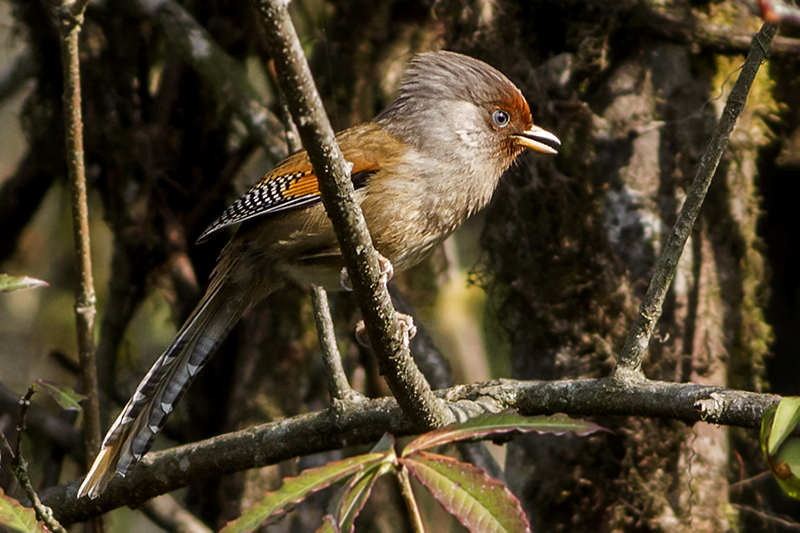
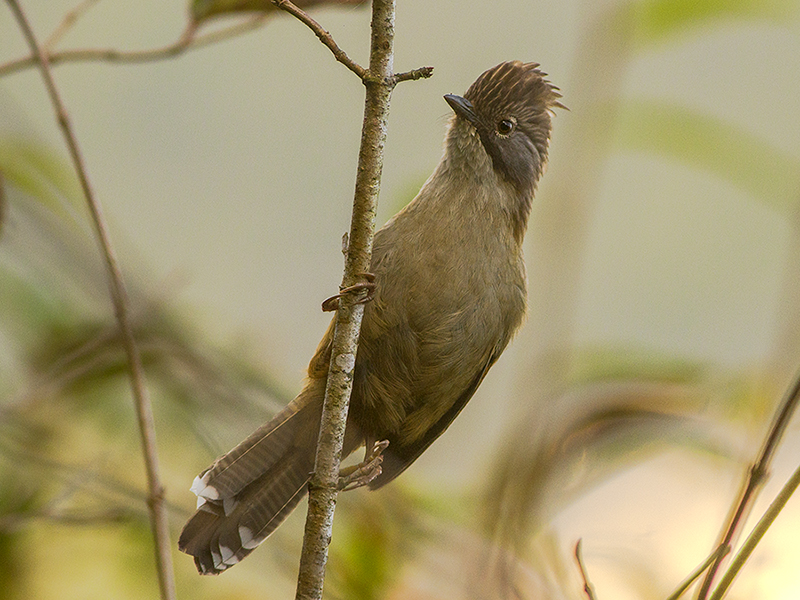
The Black-throated Laughingthrush can be easily recognized by its striking plumage and distinct vocalizations. Adult birds have a predominantly grayish-brown body with a stark black throat and a white patch on the side of the head, which contrasts sharply with their dark eyes. The wings and tail exhibit a more pronounced brown hue, with some individuals displaying slight rufous tinges. Juveniles resemble adults but have a slightly duller appearance with less defined coloration, lacking the crisp contrast seen in mature birds. Male and female Black-throated Laughingthrushes are similar in appearance, making sex differentiation challenging without close observation of behavior during the breeding season. In terms of size, this species is medium, with a length of about 25 centimeters. Its silhouette in flight is characterized by broad, rounded wings and a long tail, which aid in maneuvering through dense foliage. When perched, they often maintain an upright posture, showcasing their contrasting throat and head markings. While similar in appearance to other laughingthrush species, the Black-throated Laughingthrush's distinct throat coloration and vocal patterns help distinguish it from potential lookalikes.
Having trouble telling birds apart? Upload a photo to our bird identification tool for an instant species match.
Black-throated Laughingthrush Habitat and Range
Preferred Habitat
The preferred habitat of the Black-throated Laughingthrush includes dense, humid environments such as tropical and subtropical forests, particularly evergreen forests and bamboo thickets. These habitats provide ample cover and abundant food resources. The species is typically found at elevations ranging from lowlands up to 2,000 meters, although it tends to be more common at mid-elevation zones where vegetation is lush and varied. While primarily a forest dweller, the Black-throated Laughingthrush can occasionally be observed in secondary growth areas and plantations, indicating some adaptability to human-altered landscapes. However, it is less commonly found in urban settings, as it prefers the cover and protection afforded by forested environments. Seasonal shifts in habitat use are minimal, with any movement primarily related to local food availability rather than long-distance migration.
Geographic Range
The Black-throated Laughingthrush is native to Southeast Asia, with its range extending through southern China, Laos, Vietnam, Thailand, and parts of Myanmar. Within this region, it occupies a variety of forested habitats, though it is most abundant in areas with dense undergrowth and ample tree cover. The species does not undertake long migrations, instead remaining resident throughout the year within its established range. However, some populations may engage in altitudinal migration, moving to lower elevations during colder months when food becomes scarce at higher altitudes. In terms of population density, the bird is commonly found in large, contiguous forest tracts where it can form flocks and communicate through its characteristic vocalizations. While generally considered a common species within its range, localized declines have been noted in regions facing significant deforestation.
Want to know which birds visit your area? Browse our backyard birds by location guides for region-specific species lists.
What Does the Black-throated Laughingthrush Eat?
The Black-throated Laughingthrush's diet is diverse, consisting primarily of insects and other small invertebrates, which it actively forages for among leaf litter and low vegetation. This foraging behavior involves hopping along the forest floor and using its bill to probe and investigate potential prey hiding in the undergrowth. In addition to insects, the species also consumes a variety of plant matter, including seeds, berries, and fruits, which provide essential nutrients and energy. Seasonal variations in diet are influenced by the availability of different food sources, with a greater reliance on fruits and seeds during periods when insect prey is less abundant. The bird's feeding schedule is generally diurnal, with peak activity occurring during the cooler hours of the morning and late afternoon. By maintaining a varied diet, the Black-throated Laughingthrush plays a vital role in both seed dispersal and pest control within its ecosystem.
Black-throated Laughingthrush Behavior and Social Structure
The Black-throated Laughingthrush exhibits a highly social and cooperative behavior, often found in small groups or larger flocks that move through the forest together. These groups are characterized by constant vocal communication, using a variety of calls to maintain contact and coordinate movements. Territorial disputes are relatively uncommon, as the species tends to prioritize group cohesion over solitary territorial defense. Courtship displays involve elaborate vocal duets between mated pairs, accompanied by mutual preening and feeding, which strengthen pair bonds. Flocking behavior provides a degree of protection against predators, as the presence of multiple individuals increases vigilance and reduces individual predation risk. In response to threats, the birds typically issue alarm calls, alerting other flock members to potential danger. Daily activities are largely influenced by the availability of food, with foraging taking precedence during early morning and late afternoon. The Black-throated Laughingthrush's social nature ensures a dynamic and cooperative life within its forest home.
Black-throated Laughingthrush Nesting and Reproduction
Nesting for the Black-throated Laughingthrush begins with the construction of a cup-shaped nest, typically situated in dense foliage or among bamboo stems. The nest is constructed from twigs, leaves, and grasses, providing a secure environment for the developing eggs and chicks. Preferred nest locations include low shrubs or small trees, often at a height of 1 to 3 meters above the ground. Clutch size generally ranges from two to four eggs, with both parents sharing incubation duties over a period of approximately 14 to 16 days. After hatching, the chicks remain in the nest for about 12 to 14 days before fledging, during which time they are fed and cared for by both parents. The species is capable of producing multiple broods per year, particularly in regions with extended breeding seasons. Parental care is attentive, with both adults actively involved in feeding and protecting the young until they are independent.
Black-throated Laughingthrush Sounds and Vocalizations
The Black-throated Laughingthrush is renowned for its complex and varied vocalizations, which include a primary song characterized by a series of melodious, flute-like notes often delivered in a rhythmic sequence. These songs play a crucial role in communication, particularly during the breeding season when they are used to establish and defend territories. In addition to the primary song, the species produces a range of call notes, including sharp, metallic clicks and whistles that serve as contact calls between flock members. Alarm calls are distinct and urgent, alerting others to potential threats in the vicinity. The Black-throated Laughingthrush's vocal repertoire contributes to the vibrant soundscape of the forests it inhabits, with dawn and dusk being particularly active periods for vocal activity.
Interesting Facts About the Black-throated Laughingthrush
- 1The Black-throated Laughingthrush is known to form 'chattering' flocks, with up to 20 individuals communicating simultaneously.
- 2This species often engages in 'anting,' a behavior where birds allow ants to crawl on their feathers, possibly to deter parasites.
- 3Despite their melodious calls, Black-throated Laughingthrushes are primarily insectivorous, playing a crucial role in controlling pest populations.
- 4The bird's name stems from its cheerful, laughing-like calls that echo through the dense forests they inhabit.
- 5In some cultures, the Black-throated Laughingthrush is kept as a pet, appreciated for its lively song and sociable nature.
- 6During courtship, males may present food items to females as part of their bonding and display behavior.
- 7The species is sometimes confused with the White-crested Laughingthrush, but the latter lacks the distinctive black throat.
Black-throated Laughingthrush Conservation Status
The current IUCN status of the Black-throated Laughingthrush is listed as Least Concern, reflecting its relatively stable population across its range. However, ongoing habitat loss due to deforestation and land conversion poses a significant threat to the species, particularly in areas where forested habitats are rapidly declining. Conservation efforts focus on preserving intact forest ecosystems and promoting sustainable land use practices to mitigate habitat destruction. Historical data indicate that while the species has maintained stable numbers in protected areas, unprotected regions face increasing pressure from human activities. Continued monitoring and habitat preservation are essential to ensure the long-term survival of the Black-throated Laughingthrush and the rich biodiversity of its forest home.