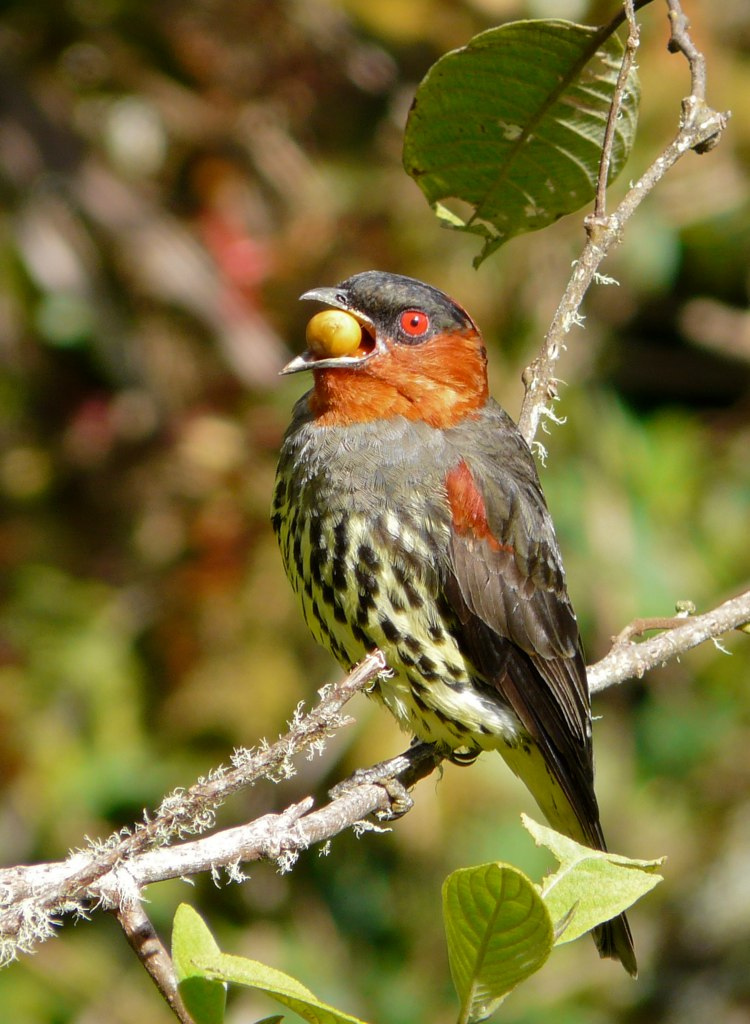
Blue Cotinga
Cotinga nattererii
Order: Passeriformes / Family: Cotingidae

Wikimedia Commons
About the Blue Cotinga
The Blue Cotinga, scientifically known as Cotinga nattererii, is one of the most stunningly colored birds of the neotropical rainforests. Found primarily in the lowland and foothill forests of Central America, this species is a visual emblem of biodiversity. The Blue Cotinga's habitat extends from eastern Honduras through Nicaragua, Costa Rica, and western Panama. These regions offer the dense, humid forest canopies that the Blue Cotinga prefers, providing ample cover and an abundance of food resources. Throughout the year, the Blue Cotinga plays a crucial ecological role as a frugivore, contributing to seed dispersal across its habitat. By consuming a wide variety of fruits, the bird aids in the regeneration of forest plant species, ensuring the sustainability of its ecosystem. During the breeding season, which typically peaks in the rainy months, the Blue Cotinga becomes more vocal and conspicuous, though it remains a challenging bird to spot due to its preference for the higher strata of the forest. In ecological terms, the presence of the Blue Cotinga is a marker of forest health, as it thrives only in well-preserved environments. Seasonal behaviors include slight altitudinal migrations in response to food availability, where some populations may descend from montane regions to lower altitudes during periods of fruit scarcity. The Blue Cotinga's presence in protected areas such as Costa Rica's La Selva Biological Station emphasizes the importance of conservation efforts in maintaining its habitat. As a species within the Cotingidae family, the Blue Cotinga shares familial traits of bright coloration and frugivory, contributing to the rich avian diversity of Central America's tropical forests.
The Blue Cotinga belongs to the family Cotingidae, within the order Passeriformes. These birds typically live typically 8-10 years, with some individuals living up to 13 years..
How to Identify a Blue Cotinga
The Blue Cotinga is a medium-sized bird, easily distinguished by the male's brilliant, iridescent blue plumage, which reflects sunlight with a metallic sheen. Males also feature a contrasting violet throat patch, which becomes more prominent during display behaviors. In contrast, females exhibit a more subdued coloration with shades of brown and gray, providing camouflage against the forest backdrop. Juvenile Blue Cotingas resemble females but can be distinguished by their less intricate patterning. While the male's vivid blue stands out, the female's cryptic plumage is an essential adaptation for nesting. The Blue Cotinga is often confused with other cotingas, such as the Lovely Cotinga, yet it can be distinguished by its more uniform blue coloration and lack of black on the wings. In flight, the Blue Cotinga presents a short, rounded silhouette with rapid wingbeats, differing from the longer-winged appearance of some sympatric species. When perched, it maintains an upright posture on high branches, often remaining still for extended periods, which can make detection challenging.
Having trouble telling birds apart? Upload a photo to our bird identification tool for an instant species match.
Blue Cotinga Habitat and Range
Preferred Habitat
The Blue Cotinga inhabits the tropical and subtropical moist lowland forests and foothills of Central America. It thrives in areas such as the Caribbean slopes of Costa Rica and extends into the Pacific lowland forests of Panama. Preferring elevations up to 1,200 meters, it occupies the middle to upper canopy layers, where it finds an abundant supply of fruits. Seasonal shifts in habitat are minimal, although slight altitudinal movements can occur in response to food availability. In terms of human-altered landscapes, the Blue Cotinga is rarely found in urban environments, as it requires large tracts of undisturbed forest to thrive. Its presence is more common in national parks and biological reserves, where conservation efforts have preserved large sections of its natural habitat.
Geographic Range
The Blue Cotinga's range spans the lowland tropical forests of Central America. Its breeding range extends from eastern Honduras through the Caribbean slopes of Nicaragua and Costa Rica, reaching western Panama. This bird is a year-round resident within its range and does not exhibit long-distance migratory behavior. However, it may engage in localized movements in search of fruiting trees, especially in the non-breeding season. Population density is highest in regions like Costa Rica's Braulio Carrillo National Park, where the combination of preserved forest and ample food resources supports a stable population. While the Blue Cotinga is not considered migratory, its presence in contiguous forest corridors is critical for maintaining genetic diversity and population stability.
Want to know which birds visit your area? Browse our backyard birds by location guides for region-specific species lists.
What Does the Blue Cotinga Eat?
The Blue Cotinga primarily feeds on a diet rich in fruits and berries, making it an important frugivore in its ecosystem. It shows a particular preference for the fruits of fig trees, which are abundant in its habitat. Additionally, it consumes small fruits from plant families such as Lauraceae and Melastomataceae. Seasonal diet shifts occur as different fruits become available, ensuring a varied intake throughout the year. The Blue Cotinga forages by moving methodically through the forest canopy, using its strong, slightly curved bill to pluck ripe fruits. It tends to forage alone or in small groups, often visiting the same fruiting trees repeatedly. While primarily frugivorous, it occasionally supplements its diet with insects, especially during the breeding season when protein demands increase. This dietary flexibility allows the Blue Cotinga to thrive even when preferred fruit sources are scarce.
Blue Cotinga Behavior and Social Structure
The Blue Cotinga exhibits a solitary lifestyle, often observed alone or in pairs rather than large flocks. During the breeding season, males become territorial, performing courtship displays to attract females. These displays involve fluttering flights and vocalizations to highlight their vibrant plumage. Males may defend territories that encompass valuable fruiting trees, which serve as both a food source and an attraction for potential mates. Outside of the breeding season, the Blue Cotinga is less conspicuous, spending much of its time foraging quietly in the canopy. It responds to predators with alarm calls and may join mixed-species flocks for added vigilance. Daily activities peak in the early morning and late afternoon, with periods of rest during the hottest midday hours.
Blue Cotinga Nesting and Reproduction
The Blue Cotinga constructs its nest high in the forest canopy, typically choosing a sturdy branch or forked limb. Nests are shallow cups made from twigs, vines, and leaves, providing a secure platform for eggs. The female is primarily responsible for nest building and incubation, laying one to two eggs per clutch. Incubation lasts about 16 to 18 days, after which both parents participate in feeding the chicks. The fledging period is approximately 20 to 25 days, during which time the young are cared for and taught to forage. The Blue Cotinga usually breeds once per year, but favorable conditions can lead to a second brood. Parental roles are well-defined, with the male defending the territory while the female focuses on nurturing the young.
Blue Cotinga Sounds and Vocalizations
The Blue Cotinga's primary song consists of a series of soft, melodious whistles that rise and fall in pitch, creating a soothing, flute-like quality. These vocalizations serve both territorial and mate-attraction purposes. Call notes are typically short, sharp chirps used for maintaining contact between individuals. Alarm calls are more abrupt and harsh, designed to alert others of potential threats. During the dawn chorus, males become particularly vocal, filling the forest with their musical phrases. The Blue Cotinga's song can be reminiscent of a distant flute, adding a serene soundtrack to its tropical habitat.
Interesting Facts About the Blue Cotinga
- 1The Blue Cotinga's name honors Austrian naturalist Johann Natterer, who made significant contributions to ornithology.
- 2Despite its vivid color, the Blue Cotinga's blue plumage is not due to pigment but the microscopic structure of its feathers.
- 3Cotinga species, including the Blue Cotinga, have evolved to specialize in fruit diets, unlike many other passerines.
- 4The Blue Cotinga can be difficult to spot as it often remains motionless in the canopy, relying on its plumage for camouflage.
- 5Males perform elaborate courtship displays, which can include a variety of aerial maneuvers to showcase their brilliant feathers.
- 6The Blue Cotinga's diet of figs and other fruits aids in maintaining the diversity of tropical forests by dispersing seeds.
- 7Blue Cotingas, like many tropical birds, have a relatively stable, non-migratory lifestyle, staying within their range year-round.
Blue Cotinga Conservation Status
The Blue Cotinga is currently classified as Least Concern by the IUCN, though its population trend shows signs of decline due to habitat loss. Deforestation for agriculture and urban expansion poses the primary threat to its habitat. Conservation efforts focus on protecting its forested environments, with successful programs in several national parks across its range. Historical population changes reflect the broader challenges facing neotropical avifauna, with localized extinctions occurring in areas of severe habitat degradation. Continued conservation actions are essential to preserve the Blue Cotinga and its role in forest ecosystems.