Blue-crowned Laughingthrush
Ianthocincla courtoisi
Order: Passeriformes / Family: Leiothrichidae

Wikimedia Commons
About the Blue-crowned Laughingthrush
The Blue-crowned Laughingthrush (Ianthocincla courtoisi) is a captivating bird species belonging to the family Leiothrichidae, known for its striking appearance and remarkable vocal abilities. This bird is endemic to the Jiangxi province in southeastern China, where it inhabits subtropical or tropical moist lowland forests. Historically, the Blue-crowned Laughingthrush was also found in other regions such as Fujian and Zhejiang, but habitat destruction has limited its range significantly. The bird's striking blue crown and expressive calls make it a focal point of interest for ornithologists and bird enthusiasts alike, contributing to its significance in both ecological and cultural contexts.
Playing a crucial role in the ecosystem, the Blue-crowned Laughingthrush acts as a seed disperser, aiding in the propagation of various plant species within its habitat. Its diet, composed largely of insects and fruits, influences the populations of these food sources, reflecting the bird's integral place in its ecological community. During the breeding season, which typically occurs between April and July, the Blue-crowned Laughingthrush becomes more vocal and conspicuous as it establishes territories and attracts mates. The bird is often observed in pairs or small family groups, a behavior that shifts to larger flock formations during the non-breeding season as they forage collectively and communicate through their complex vocalizations.
Conservation efforts have intensified in response to the alarming decline in the population of the Blue-crowned Laughingthrush, primarily due to habitat loss and fragmentation. The species is currently classified as Critically Endangered by the International Union for Conservation of Nature (IUCN), with fewer than 250 mature individuals remaining in the wild. Conservation programs focus on habitat restoration, legal protection, and the establishment of captive breeding programs to prevent extinction. Despite these challenges, the Blue-crowned Laughingthrush continues to symbolize resilience in the face of adversity, capturing the imagination of conservationists and bird lovers around the world.
The Blue-crowned Laughingthrush belongs to the family Leiothrichidae, within the order Passeriformes. These birds typically live typically 5-7 years, though some individuals have been known to live longer in favorable conditions..
How to Identify a Blue-crowned Laughingthrush
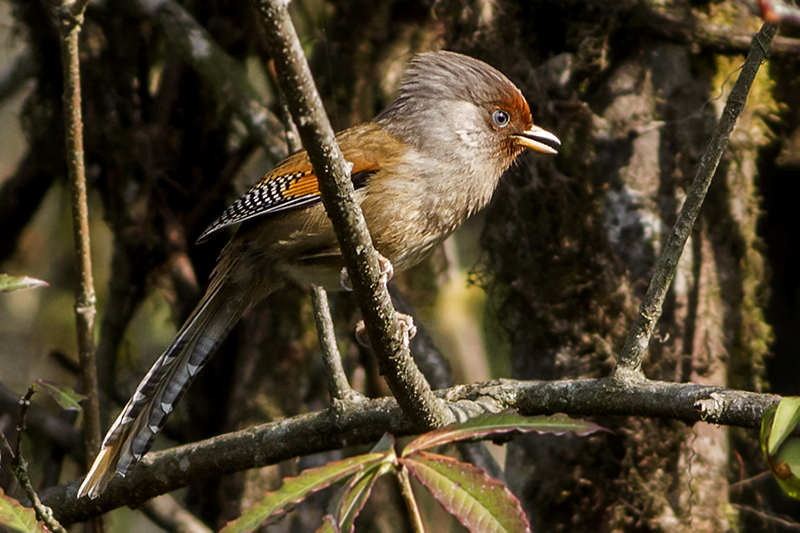
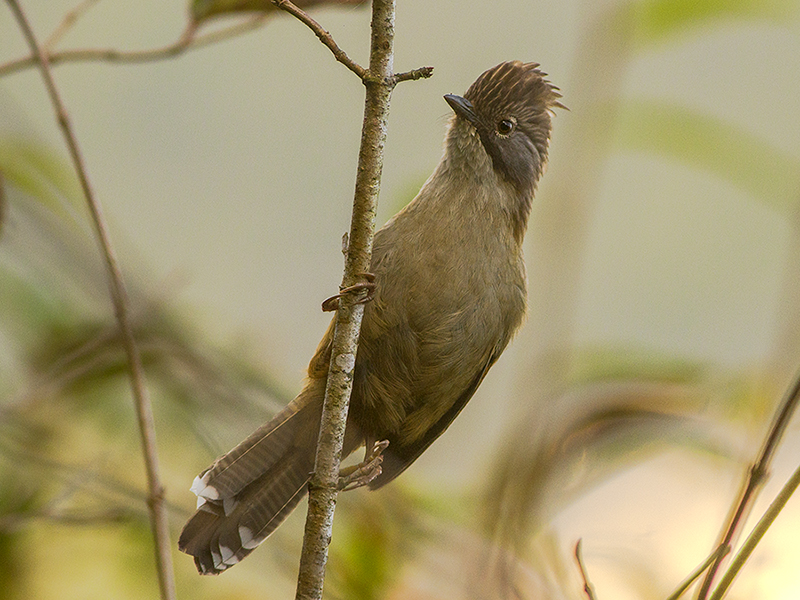
The Blue-crowned Laughingthrush features a distinctive blue crown that immediately draws attention, contrasting with its otherwise olive-brown upperparts and white underparts. Adults possess a black face mask that extends to the nape, enhancing their striking appearance. Juveniles, while similar in overall structure, display a duller coloration with less pronounced blue and black markings, making them slightly less conspicuous in the wild.
Sexual dimorphism in the Blue-crowned Laughingthrush is subtle, with males and females looking remarkably similar. However, males may exhibit slightly more vivid coloration during the breeding season, a trait that aids in courtship displays. The bird's robust body, medium-sized stature, and strong legs are characteristic of the Leiothrichidae family, aiding in its agile movements through dense vegetation. In flight, the Blue-crowned Laughingthrush displays a rounded wing shape and a relatively short tail, which can help differentiate it from other sympatric species.
Confusion with similar species is possible, particularly with other laughingthrushes inhabiting overlapping ranges. However, the combination of the blue crown, black face mask, and unique vocalizations typically distinguishes the Blue-crowned Laughingthrush from its congeners. Observers should also note its perching behavior, often seen in the mid to lower canopy levels, where it remains alert and active, frequently engaging in social interactions with conspecifics.
Having trouble telling birds apart? Upload a photo to our bird identification tool for an instant species match.
Blue-crowned Laughingthrush Habitat and Range
Preferred Habitat
The Blue-crowned Laughingthrush primarily inhabits subtropical or tropical moist lowland forests in southeastern China, particularly within the Jiangxi province. These forests provide the dense foliage and abundant food resources essential for their survival. The bird favors areas with thick understory vegetation, which offers both protection from predators and an ample supply of insects and fruits.
Elevations where the Blue-crowned Laughingthrush is commonly found range from 200 to 800 meters, although specific habitat preferences may vary slightly across its limited range. Seasonal habitat shifts are minimal due to the bird's non-migratory nature, but slight movements may occur in search of food or as a response to habitat disturbances.
While the Blue-crowned Laughingthrush is predominantly found in rural and forested areas, it occasionally ventures into semi-urban environments, particularly where forest patches remain intact. However, urbanization and agricultural expansion have significantly impacted its natural habitat, underscoring the need for effective conservation strategies to preserve the existing forested areas that support this critically endangered species.
Geographic Range
The Blue-crowned Laughingthrush has an extremely limited range, confined primarily to the Jiangxi province in southeastern China. Historical records suggest a broader range that once included parts of Fujian and Zhejiang provinces, but habitat degradation has drastically reduced its distribution. The bird is now predominantly found in the Wuyuan County, where isolated populations inhabit scattered forest fragments.
As a non-migratory species, the Blue-crowned Laughingthrush does not undertake long-distance migrations. Instead, it exhibits local movements within its restricted range, primarily driven by food availability and habitat conditions. Due to its limited range and small population size, the species experiences high vulnerability to environmental changes and human activities, making conservation of its current habitats a critical priority.
Population density hotspots are concentrated in areas where conservation efforts have been implemented, such as protected forest reserves. These areas provide a refuge for the Blue-crowned Laughingthrush, supporting the small existing populations and serving as focal points for ongoing research and conservation activities aimed at understanding and preserving this critically endangered species.
Want to know which birds visit your area? Browse our backyard birds by location guides for region-specific species lists.
What Does the Blue-crowned Laughingthrush Eat?
The Blue-crowned Laughingthrush has an omnivorous diet, feeding on a diverse array of food sources that include insects, fruits, and small invertebrates. Insects form a crucial component of its diet, particularly during the breeding season when the demand for protein-rich food is heightened to support the growth of chicks. The bird actively forages in the understory and middle layers of the forest, using its beak to probe into crevices and foliage.
Fruits, such as berries and small drupes, provide essential energy and nutrients, especially during periods when insects are less abundant. The Blue-crowned Laughingthrush exhibits seasonal variations in its diet, with a greater reliance on fruits during the late summer and autumn months when they are more plentiful.
Foraging typically occurs in pairs or small family groups, aligning with the bird's social nature. Observers often note the bird's methodical approach to foraging, characterized by a combination of visual and auditory cues to locate prey. The Laughingthrush's feeding schedule aligns with its daily activity patterns, with peak foraging times occurring in the early morning and late afternoon. This schedule allows the bird to maximize food intake while avoiding the midday heat.
Blue-crowned Laughingthrush Behavior and Social Structure
Blue-crowned Laughingthrushes exhibit complex social structures, often forming small family groups or larger flocks outside the breeding season. These social formations facilitate cooperative behaviors, such as group foraging and communal roosting, which enhance survival in their fragmented habitats. Territorial behavior is prominent during the breeding season, with pairs establishing and defending territories through vocalizations and displays.
Courtship displays are subtle yet significant, involving both visual and auditory components. Males may sing more frequently and perform short flights or hops to attract the attention of females. Once paired, the birds engage in mutual preening and other bonding behaviors to strengthen their partnership.
In response to predators, the Blue-crowned Laughingthrush employs a mix of alarm calls and evasive maneuvers. The bird's vocal repertoire includes specific alarm calls that alert conspecifics to potential threats, allowing the group to take collective action. Daily activity patterns are diurnal, with periods of intense activity during dawn and dusk, when the birds are most vocal and engaged in foraging and social interactions.
Blue-crowned Laughingthrush Nesting and Reproduction
The nesting habits of the Blue-crowned Laughingthrush are characterized by their preference for dense vegetation, where they construct well-camouflaged nests. Nests are typically built in shrubs or low trees, often at heights ranging from 1.5 to 3 meters. The structure is a cup-shaped nest made from twigs, grass, and leaves, lined with softer materials like feathers and moss to provide insulation and comfort for the eggs and chicks.
A typical clutch consists of two to four eggs, which are incubated primarily by the female. The incubation period lasts approximately 14 to 16 days, during which the male provides food and protection for the nesting female. Both parents share responsibilities in feeding and caring for the chicks once they hatch. Fledging occurs about 14 to 18 days after hatching, with juveniles remaining dependent on their parents for several weeks post-fledging.
The Blue-crowned Laughingthrush generally produces one brood per year, although under favorable conditions, a second brood may be attempted. Parental roles are well-defined, with both sexes actively participating in the rearing and protection of their offspring, ensuring that the young birds receive adequate nourishment and care until they are fully independent.
Blue-crowned Laughingthrush Sounds and Vocalizations
The vocalizations of the Blue-crowned Laughingthrush are both distinctive and melodious, characterized by a series of varied, gurgling notes that comprise their primary song. This song often contains a combination of rising and falling pitches, with a rhythm that is both fluid and somewhat unpredictable. Call notes are typically shorter and more abrupt, serving functions such as maintaining group cohesion and signaling alerts.
Alarm calls are sharper and more urgent, designed to warn conspecifics of potential dangers in the vicinity. These calls are integral to the bird's communication network, allowing for coordinated responses to threats. During the dawn chorus, the Blue-crowned Laughingthrush becomes particularly vocal, using this time to assert territorial presence and strengthen social bonds within the group.
The bird's vocalizations bear a resemblance to the sounds of running water or bubbling brooks, offering a pleasant auditory experience for those fortunate enough to hear them in their natural habitat. These sounds not only facilitate intraspecific communication but also enhance the bird's allure as a target for avian enthusiasts.
Interesting Facts About the Blue-crowned Laughingthrush
- 1The Blue-crowned Laughingthrush is known to have less than 250 mature individuals remaining in the wild, making it one of the rarest birds globally.
- 2Unlike many birds, the Blue-crowned Laughingthrush does not migrate, instead staying within its limited range year-round.
- 3The bird's vocalizations are complex and melodious, often compared to the sound of a bubbling brook or running water.
- 4Conservation efforts for the Blue-crowned Laughingthrush include captive breeding programs that aim to bolster its population.
- 5The Blue-crowned Laughingthrush plays a crucial ecological role as a seed disperser, aiding in the regeneration of its forest habitat.
- 6Historically, the bird's range extended across multiple Chinese provinces, but habitat loss has confined it to a much smaller area.
- 7The Blue-crowned Laughingthrush's striking appearance and unique calls have made it a focal point for ornithologists and birdwatchers.
Blue-crowned Laughingthrush Conservation Status
The Blue-crowned Laughingthrush is currently classified as Critically Endangered according to the IUCN Red List, with a population trend that remains in decline. The principal threats to its survival include extensive habitat loss due to deforestation, agricultural expansion, and urban development, which have severely fragmented its already limited range. Conservation efforts are focused on habitat protection and restoration, with initiatives aimed at preserving the remaining forest patches in the Jiangxi province. Legal protection measures, coupled with community-based conservation programs, aim to mitigate human impacts and enhance the sustainability of these habitats. Captive breeding programs have also been established to increase population numbers and provide a genetic reservoir for future reintroductions. Historically, the population of the Blue-crowned Laughingthrush was more widespread, but anthropogenic pressures have significantly reduced its numbers. Conservation strategies require ongoing collaboration between local communities, governmental agencies, and international organizations to ensure the survival of this iconic species.