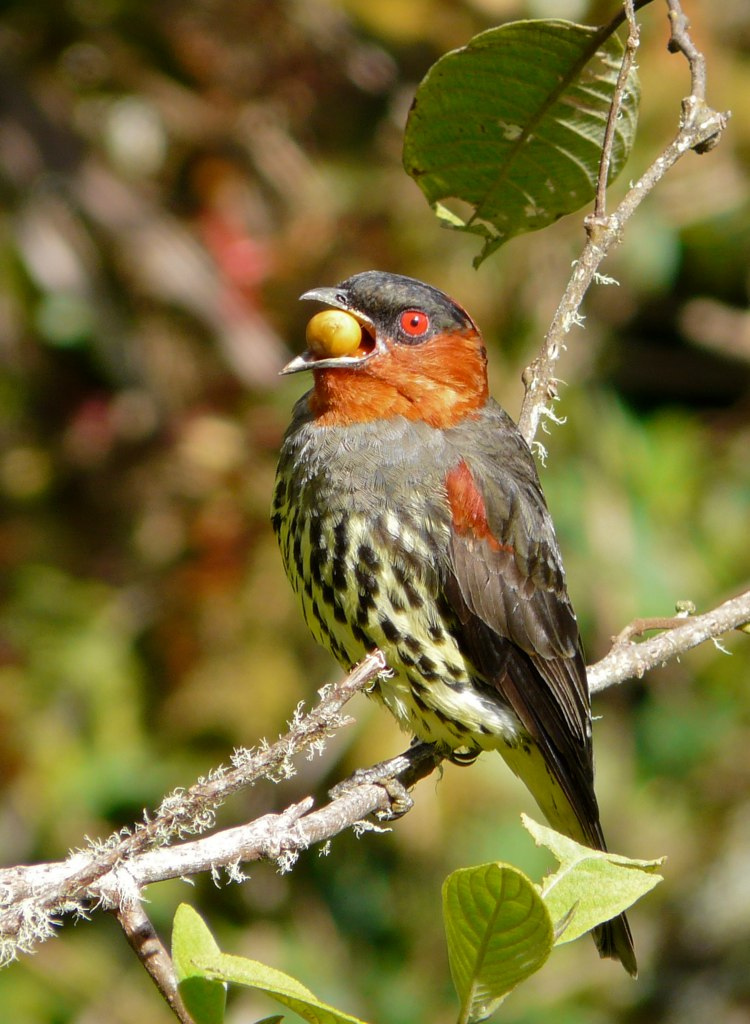
Buff-throated Purpletuft
Iodopleura pipra
Order: Passeriformes / Family: Cotingidae

Wikimedia Commons
About the Buff-throated Purpletuft
The Buff-throated Purpletuft (Iodopleura pipra) is a small and remarkable bird belonging to the family Cotingidae. Endemic to South America, it thrives in the lush tropical forests of Brazil, particularly in the Atlantic Forest, which stretches along the eastern coast. This region, known for its rich biodiversity, provides the ideal environment for the Buff-throated Purpletuft's survival and ecological role. The bird plays a crucial part in seed dispersal, contributing to the health of its forest habitat.
In terms of ecological significance, the Buff-throated Purpletuft serves as both predator and prey within its ecosystem. By consuming a variety of fruits and insects, it helps control insect populations and aids in the proliferation of plant species through seed dispersal. Its presence indicates a healthy, functioning ecosystem, as it requires an abundance of food resources and suitable nesting sites.
This species exhibits fascinating seasonal behaviors, particularly during the breeding season. During these months, typically from September to December, the Buff-throated Purpletuft becomes more vocal and active, with males engaging in elaborate courtship displays to attract mates. These displays involve fluttering flights combined with vocalizations that are both a spectacle for observers and a vital component of their reproductive success.
While the Buff-throated Purpletuft may not be as widely recognized as some of its avian counterparts, its role in the delicate balance of the forest ecosystem cannot be understated. Conservation efforts are crucial to ensure the preservation of its habitat, as deforestation poses a significant threat to its survival. The bird's dependency on undisturbed forest areas highlights the importance of protecting these environments for the continued existence of species like the Buff-throated Purpletuft and many others.
The Buff-throated Purpletuft belongs to the family Cotingidae, within the order Passeriformes. These birds typically live average 5 years with a maximum recorded of 8 years.
How to Identify a Buff-throated Purpletuft
Adult Buff-throated Purpletufts are easily recognized by their small size, measuring about 12 cm in length. The most striking feature is the buff-colored throat that contrasts with the purple hue of the upperparts. The rest of the body is a mix of gray and white, with the underparts being predominantly white. Males and females exhibit similar plumage, although females tend to have slightly duller colors.
Juveniles differ from adults in having less vivid coloring, with a more muted buff throat and grayer overall appearance. Despite these differences, the basic plumage patterns remain consistent across ages, aiding in identification. The Buff-throated Purpletuft can be confused with similar species like the Purple-breasted Cotinga, but the latter lacks the distinctive buff throat.
In flight, the Buff-throated Purpletuft displays a rapid, fluttering wingbeat. When perching, it often adopts an upright posture, making it easier to spot among the foliage. Observers should note the bird's preference for high perches in the canopy, where it can be spotted searching for food.
Having trouble telling birds apart? Upload a photo to our bird identification tool for an instant species match.
Buff-throated Purpletuft Habitat and Range
Preferred Habitat
The Buff-throated Purpletuft resides primarily in the Atlantic Forest of Brazil. This habitat consists of dense, humid tropical forests rich in biodiversity. It favors primary and secondary growth forests, particularly those with an abundant supply of fruiting trees. These birds are typically found at elevations ranging from sea level up to 1,500 meters.
During different seasons, the Buff-throated Purpletuft may shift its habitat preferences slightly, moving to areas with higher fruit availability during non-breeding months. Unlike some other species, it tends to avoid urban areas, preferring the tranquility and resources of forest environments.
Though primarily a forest dweller, the Buff-throated Purpletuft can occasionally be found in edge habitats where forest meets open land, especially when these areas are rich in fruit-bearing vegetation. The ongoing change in forest landscapes due to human activity poses challenges, making habitat preservation crucial for their continued existence.
Geographic Range
The Buff-throated Purpletuft's range is relatively restricted to eastern Brazil, specifically within the Atlantic Forest biome. It does not undertake long migrations, instead remaining within its range year-round, though it may make small movements locally in search of food.
Key regions include the states of Bahia, Espírito Santo, and Rio de Janeiro, with population densities varying across these areas. The bird's presence is closely tied to the health and extent of forest cover, so areas with intact habitats support higher populations.
Though not migratory, the Buff-throated Purpletuft's movements are influenced by seasonal fruiting patterns, leading to shifts in local distribution. Conservation of its forest range is vital due to its limited geographical extent and the ongoing threats from deforestation.
Want to know which birds visit your area? Browse our backyard birds by location guides for region-specific species lists.
What Does the Buff-throated Purpletuft Eat?
The Buff-throated Purpletuft primarily feeds on a diet of fruits, particularly small berries and figs, which it plucks deftly from the canopy. Fruits from trees like Miconia and Cecropia form a significant part of its diet, especially during the breeding season when energy demands are higher.
In addition to fruit, the Buff-throated Purpletuft consumes insects, providing a source of protein and other nutrients. Its agile flight and foraging techniques allow it to catch insects mid-air or glean them from foliage.
The diet shifts seasonally, with a higher reliance on insects when fruit is less abundant. It typically forages during the early morning and late afternoon, taking advantage of cooler temperatures and reduced competition from other frugivores. Its role in seed dispersal is critical, as it helps maintain the diversity and regeneration of its forest habitat.
Buff-throated Purpletuft Behavior and Social Structure
The Buff-throated Purpletuft is generally a solitary or loosely social bird, often seen alone or in small groups. During the breeding season, it becomes more territorial, with males establishing and defending small territories through vocalizations and displays.
Courtship involves males performing fluttering flights and singing to attract females. These displays are crucial for mate selection and occur primarily in the early morning. Once paired, both sexes contribute to nesting and rearing young, although the male's role is more focused on territory defense.
The Buff-throated Purpletuft is diurnal, with peak activity during the cooler parts of the day. Its response to predators includes quick, agile flights, using its small size and rapid maneuvers to evade capture. These behaviors, along with its vocal alerts, help protect it from avian predators.
Buff-throated Purpletuft Nesting and Reproduction
Nesting for the Buff-throated Purpletuft occurs primarily from September to December. The nest is a small cup constructed from fine twigs, moss, and leaves bound together with spider silk. Typically, these are placed high in the canopy, often 10-15 meters above the ground, providing safety from ground predators.
Clutch size is usually two eggs, which are incubated by the female for approximately 14 days. During this period, the male remains nearby, defending the nesting territory and assisting with feeding once the chicks hatch.
Fledging occurs about 20 days after hatching, with young birds remaining near the nest for a short period as they learn to forage independently. The Buff-throated Purpletuft typically raises one brood per year, although favorable conditions may occasionally allow for a second brood.
Buff-throated Purpletuft Sounds and Vocalizations
The Buff-throated Purpletuft's song is a series of high-pitched, melodious notes delivered in rapid succession. This song is most often heard during the breeding season at dawn and is used by males to establish territory and attract mates.
Call notes are short and sharp, serving as contact calls between individuals or a warning of nearby predators. Alarm calls are faster and more repetitive, alerting others to immediate danger.
Compared to other forest birds, the Buff-throated Purpletuft's vocalizations are less complex but distinct, aiding in identification by experienced birders. The dawn chorus, though less varied, resonates through its forest home, signaling the start of a new day.
Interesting Facts About the Buff-throated Purpletuft
- 1The Buff-throated Purpletuft is one of the few birds whose plumage combines both buff and purple, making it a unique visual spectacle.
- 2Despite its small size, the Buff-throated Purpletuft plays a significant role in seed dispersal, aiding forest regeneration.
- 3This species is known to travel short distances daily, showcasing impressive agility as it moves through dense forest canopies.
- 4The Buff-throated Purpletuft's diet shifts seasonally, with a higher insect intake when fruits are scarce, demonstrating its adaptability.
- 5Its ability to use spider silk for nest construction shows a fascinating use of natural materials for structural integrity.
- 6The species' limited range to the Atlantic Forest makes it a priority for conservation, highlighting its ecological importance.
- 7The Buff-throated Purpletuft's song, though simple, is essential for territory establishment and mate attraction during breeding seasons.
Buff-throated Purpletuft Conservation Status
The Buff-throated Purpletuft currently holds a vulnerable status according to the IUCN Red List, primarily due to habitat loss. The Atlantic Forest, its primary habitat, faces significant deforestation and fragmentation, threatening its population. Despite these challenges, conservation efforts aimed at protecting and restoring forest areas show promise. Initiatives include reforestation projects and the establishment of protected areas to safeguard remaining habitats. Population trends indicate a decline over recent decades, correlated with increased human activity and land-use change. Ongoing conservation work focuses on mitigating these impacts and ensuring the survival of the Buff-throated Purpletuft and the broader ecosystem it supports.