
Buffy-crowned Wood-Partridge
Dendrortyx leucophrys
Order: Galliformes / Family: Odontophoridae

Wikimedia Commons
About the Buffy-crowned Wood-Partridge
The Buffy-crowned Wood-Partridge (Dendrortyx leucophrys) is an intriguing member of the Odontophoridae family, primarily found in the montane forests of Central America. It inhabits countries such as Mexico, Guatemala, El Salvador, Honduras, and Nicaragua. This partridge prefers subtropical or tropical moist montane forests, making its home between elevations of 1,000 to 2,500 meters. Its presence in these regions plays a critical role in the ecosystem, as it aids in seed dispersal through its foraging behaviors.
The Buffy-crowned Wood-Partridge is significant not only for its ecological contributions but also for its cultural importance in many of the regions it inhabits. Locally, it is often associated with the dense undergrowth of forests, where its calls are part of the soundscape. Its seasonal behaviors include shifts in altitude; during the wet season, it may venture higher into the cloud forests, while it descends to lower elevations in drier times. This movement allows the bird to exploit various food resources as they become seasonally available.
Ecologically, the Buffy-crowned Wood-Partridge serves as both a prey and a predator. It feeds on a variety of seeds, fruits, and small invertebrates, which helps in controlling insect populations. In turn, it serves as prey for larger raptors and terrestrial predators. The bird’s elusive nature makes it a challenging yet rewarding sight for birdwatchers and researchers alike, who often rely on its vocalizations to locate it in the dense forest canopy.
The Buffy-crowned Wood-Partridge belongs to the family Odontophoridae, within the order Galliformes. These birds typically live average 6-8 years with a maximum recorded of 12 years..
How to Identify a Buffy-crowned Wood-Partridge
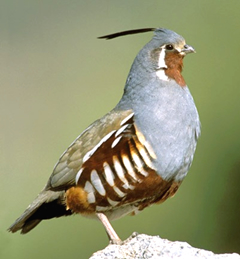
The Buffy-crowned Wood-Partridge can be recognized by its striking buffy crown, which provides a stark contrast to its otherwise dark plumage. Adult plumage consists of a rich brown body with speckled flanks and a paler underside. The juvenile plumage is generally duller, with less distinct marking, aiding in camouflage within its dense understory habitat. Males and females are similar in appearance, although males tend to be slightly larger and exhibit bolder crown coloration.
One of the key identifying features of the Buffy-crowned Wood-Partridge is its robust, rounded body shape, a characteristic common to the Odontophoridae family. This bird's short, rounded wings and strong legs are adapted for life on the forest floor rather than for prolonged flight. When flushed, it takes to the air in a swift, direct manner with rapid wingbeats before quickly descending back into cover.
The Buffy-crowned Wood-Partridge is sometimes confused with the Long-tailed Wood-Partridge (Dendrortyx macroura), but the latter has a much longer tail and lacks the distinctive buffy crown. When perched, the Buffy-crowned Wood-Partridge maintains an upright posture, which can help in differentiating it from similar ground-dwelling birds like quails.
Having trouble telling birds apart? Upload a photo to our bird identification tool for an instant species match.
Buffy-crowned Wood-Partridge Habitat and Range
Preferred Habitat
The Buffy-crowned Wood-Partridge thrives in subtropical and tropical moist montane forests. These habitats are typically characterized by dense vegetation and a rich understory, which provides both food and protection. In these regions, it is often found at elevations ranging from 1,000 to 2,500 meters, where it can access a variety of food resources throughout the year.
Seasonal habitat shifts are common, with the bird moving to higher elevations during the wet season to exploit the bounty of fruits and seeds that become available. In the dry season, it tends to descend to lower, more sheltered areas where food remains accessible. While primarily a forest-dwelling species, the Buffy-crowned Wood-Partridge occasionally ventures into adjacent agricultural lands, particularly in fragmented forest landscapes.
The species shows a marked preference for undisturbed forest environments, and while it can sometimes be found in secondary growth areas, it is less common in heavily degraded habitats. Urban presence is rare, as the bird thrives on the complex structure of mature forests that urban environments cannot replicate.
Geographic Range
The Buffy-crowned Wood-Partridge's range is primarily confined to the montane regions of Central America. It breeds and resides in southern Mexico, particularly in the Sierra Madre del Sur, extending through Guatemala and into parts of Honduras, El Salvador, and Nicaragua. The bird is non-migratory, maintaining year-round presence within its range, although it exhibits altitudinal movements in response to seasonal changes in food availability.
Within its range, population densities can vary significantly, often correlated with habitat quality and human disturbance levels. Hotspots for this species include the cloud forests of Guatemala and the highland areas of Chiapas, Mexico, where conservation efforts are focused due to habitat loss from agricultural expansion and logging.
Despite its relatively limited range compared to some other bird species, the Buffy-crowned Wood-Partridge is considered widespread within suitable habitats. However, its reliance on montane forests makes it vulnerable to deforestation, which has led to localized population declines.
Want to know which birds visit your area? Browse our backyard birds by location guides for region-specific species lists.
What Does the Buffy-crowned Wood-Partridge Eat?
The diet of the Buffy-crowned Wood-Partridge consists primarily of seeds, berries, and fruits sourced from the forest floor. It also consumes a variety of small invertebrates, including insects and grubs, which provide essential protein. A shift in diet occurs with the seasons; during the wet season, fruits and berries form a larger part of their intake, while seeds become more prominent in the dry months.
Foraging behavior is typically solitary or in small family groups. The Buffy-crowned Wood-Partridge uses its strong legs to scratch at the leaf litter, uncovering hidden morsels. This method not only aids in feeding but also promotes seed dispersal, an essential ecological role. The bird is mostly active in the early morning and late afternoon, when it spends considerable time searching for food, often remaining close to dense cover to avoid predators. Prey size generally remains small, as the bird’s diet does not include large insects or vertebrates.
Buffy-crowned Wood-Partridge Behavior and Social Structure
The Buffy-crowned Wood-Partridge exhibits interesting social behaviors, often forming small family groups rather than large flocks. This structure aids in maintaining territories, which the birds defend with vocal calls and displays. These territories are essential for breeding and foraging, ensuring access to resources needed for survival.
During the breeding season, males perform courtship displays that include vocalizations and physical posturing to attract females. The pair bond is strong, with both parents involved in rearing the young. Outside of the breeding season, these birds are more solitary but may come together in small groups when foraging.
The Buffy-crowned Wood-Partridge is generally wary of predators, including large birds of prey and terrestrial hunters. It relies on its ability to remain still and blend into the forest floor to evade detection. If startled, it will quickly flush into dense cover. Daily activity patterns are crepuscular, with most foraging occurring during the cooler parts of the day.
Buffy-crowned Wood-Partridge Nesting and Reproduction
Nesting for the Buffy-crowned Wood-Partridge involves creating a simple scrape on the forest floor, often under the cover of dense vegetation or among tree roots. The nest is lined with leaves and other plant materials to provide some insulation and concealment.
The typical clutch size ranges from 5 to 8 eggs, which are incubated by both parents over a period of about 21 to 24 days. This shared responsibility extends to feeding and protecting the chicks once they hatch. The young are precocial, able to leave the nest shortly after hatching, although they remain under the watchful care of their parents for several weeks.
Fledging occurs relatively quickly, often within 2 to 3 weeks, after which the juveniles join the adults in foraging activities. The Buffy-crowned Wood-Partridge usually raises one brood per year; however, conditions that are particularly favorable may result in an additional brood.
Buffy-crowned Wood-Partridge Sounds and Vocalizations
The primary song of the Buffy-crowned Wood-Partridge is a series of clear, whistling notes that rise and fall in pitch, often described as musical and melodious. These calls serve to establish territory and communicate with family members. Alarm calls are sharper and more abrupt, used to alert others of potential threats.
During the dawn chorus, the Buffy-crowned Wood-Partridge is among the first to vocalize, its calls resonating through the forest. The sound is reminiscent of a flute, with a rhythm that can vary slightly depending on the individual's mood or context.
In comparison to other forest birds, its vocalizations are less complex but highly effective in maintaining contact with its group. These sounds are crucial in dense habitats, where visibility is limited.
Interesting Facts About the Buffy-crowned Wood-Partridge
- 1The Buffy-crowned Wood-Partridge's distinct call is often used by researchers to locate this elusive bird in dense forests.
- 2Unlike many ground-dwelling birds, both male and female Buffy-crowned Wood-Partridges share incubation duties equally.
- 3The species relies heavily on the dense undergrowth of montane forests, making it a key indicator of forest health.
- 4Buffy-crowned Wood-Partridges are known to participate in dawn choruses, adding to the rich soundscape of their habitat.
- 5Despite their shyness, these birds play a crucial role in seed dispersal, impacting forest regeneration.
- 6The Buffy-crowned Wood-Partridge has a surprisingly wide range of vocalizations, each serving a specific purpose.
- 7Juveniles resemble adults but have a duller plumage, which helps them blend into the forest floor for protection.
Buffy-crowned Wood-Partridge Conservation Status
The IUCN currently lists the Buffy-crowned Wood-Partridge as a species of Least Concern, but its population is suspected to be declining due to habitat loss. Deforestation for agriculture and logging constitutes the primary threat, particularly in areas where montane forests are being converted. Conservation efforts focus on habitat preservation and restoration, with some regions implementing protected areas to safeguard critical habitats. Historical data indicate that the species was once more abundant, but recent pressures have led to localized population decreases. Ongoing studies aim to better understand the ecological needs of the Buffy-crowned Wood-Partridge, with the goal of developing more targeted conservation strategies. These efforts are crucial to ensure the continued presence of this species within its native range.
Other Odontophoridae Species


Birds Similar to the Buffy-crowned Wood-Partridge
These species are often confused with the Buffy-crowned Wood-Partridge due to similar appearance or overlapping range.

