
Ocellated Quail
Cyrtonyx ocellatus
Order: Galliformes / Family: Odontophoridae

Wikimedia Commons
About the Ocellated Quail
The Ocellated Quail (Cyrtonyx ocellatus) is a striking bird native to the mountainous regions of Central America, specifically found in countries such as Guatemala, Honduras, and parts of southern Mexico. This quail thrives in oak-pine forests, where its presence signifies a healthy ecosystem due to its role in seed dispersal and as a prey species for larger predators. Notably elusive, the Ocellated Quail often remains hidden in dense underbrush, making it a challenging find for birdwatchers. However, its unique vocalizations and distinctive plumage make it a rewarding sighting. The intricate feather patterns of the Ocellated Quail, with its namesake ocellated spots, serve as both camouflage and a means of communication during courtship displays. Ecologically, this quail contributes to the control of insect populations and the dispersal of seeds, playing a critical role in the forest's understory dynamics. Seasonal behaviors of the Ocellated Quail include shifts in elevation to follow food availability and breeding requirements. During the wet season, they move to higher elevations while retreating to lower altitudes in the dry months. This altitudinal migration corresponds with their breeding cycle, as they seek optimal conditions for raising their young. Beyond mere survival, the Ocellated Quail is an indicator species, reflecting the health and changes within its habitat. Conservation efforts focus on preserving its natural habitat, as deforestation and land use changes pose significant threats. As a species with specialized habitat needs, the Ocellated Quail serves as a barometer for broader ecological shifts in Central America's montane regions.
The Ocellated Quail belongs to the family Odontophoridae, within the order Galliformes. These birds typically live average 3-5 years with a maximum recorded of 7 years..
How to Identify a Ocellated Quail
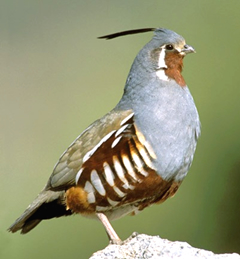
The Ocellated Quail showcases a distinct plumage that sets it apart from other quail species. Adult males display an intricate pattern of chestnut and gray with striking black and white spots, or ocelli, that give the species its name. Their heads feature a bold black-and-white facial pattern with a chestnut cap. Females, though similar in size, exhibit more subdued coloration, with browner tones and less pronounced spots, facilitating better camouflage. Juveniles resemble females but are generally duller, with more uniform brown plumage. This sexual dimorphism aids in identification but may also cause confusion with similar-sized quail like the Montezuma Quail. In flight, the Ocellated Quail presents a compact silhouette, with broad, rounded wings that enable quick, low flight through dense vegetation. When perched, they often sit low to the ground, relying on their cryptic plumage to remain undetected. Observers should note the bird's preference for remaining close to cover, which makes it a rare sight in open areas. While in their preferred habitat, the bird's distinctive calls often provide the best clue to their presence, as visual confirmation can be challenging.
Having trouble telling birds apart? Upload a photo to our bird identification tool for an instant species match.
Ocellated Quail Habitat and Range
Preferred Habitat
Ocellated Quails predominantly inhabit oak-pine forests in mountainous regions, thriving at elevations between 1,000 and 3,000 meters. These habitats, found in southern Mexico and Central American countries like Guatemala and Honduras, provide the dense underbrush needed for nesting and foraging. The presence of both coniferous and broadleaf trees supports a rich understory that the quail utilize for cover and food. During the wet season, Ocellated Quails may migrate to higher elevations where food is more plentiful, while in the dry season, they occupy lower areas where water sources remain accessible. Unlike many bird species, they show little adaptability to urban or suburban environments, highlighting their reliance on pristine or near-pristine forest conditions. Conservation of these habitats is crucial, as the Ocellated Quail's survival hinges on the availability of its specific ecological niche.
Geographic Range
The Ocellated Quail's range is relatively restricted to Central America's mountainous regions, particularly in southern Mexico, Guatemala, Honduras, and occasionally in El Salvador. These quail are not known to migrate long distances but may exhibit altitudinal movements in response to seasonal changes in food availability and breeding conditions. During the breeding season, they tend to remain within dense forests at higher elevations, while outside the breeding season, they descend to lower altitudes where food remains abundant. The population density of Ocellated Quails is highest in areas that provide a mix of open and dense forest habitats, allowing for both foraging and nesting opportunities. However, their populations are scattered and often localized, with specific hotspots in protected reserves and national parks where forest conservation measures are in place.
Want to know which birds visit your area? Browse our backyard birds by location guides for region-specific species lists.
What Does the Ocellated Quail Eat?
Ocellated Quails primarily feed on a diverse diet of seeds, fruits, and insects, which varies seasonally. In the wet season, when insects are abundant, they consume a higher proportion of protein-rich invertebrates, aiding in their nutritional needs during breeding. Common insect prey includes beetles, ants, and caterpillars. As the dry season progresses and insect availability decreases, their diet shifts towards seeds and fruits, such as acorns and berries, which they forage from the forest floor. The quails employ a scratching technique to unearth food hidden under leaf litter, using their strong legs and curved bills. This foraging behavior not only sustains them but also aids in seed dispersal for various plant species. Feeding typically occurs during the early morning and late afternoon when they are most active, avoiding the midday heat.
Ocellated Quail Behavior and Social Structure
Socially, Ocellated Quails are monogamous during the breeding season, forming pair bonds that last through the nesting period. Outside of breeding, they may gather in small coveys, primarily consisting of family groups. Territorial behavior intensifies during the breeding season, with males vocalizing to establish dominance and attract mates. Their courtship displays involve intricate dances and calls, showcasing their striking plumage. In response to predators, Ocellated Quails typically rely on their camouflage and quick, low flights to escape danger. They exhibit a crepuscular activity pattern, being most active during dawn and dusk. During these times, they engage in foraging and social interactions, while midday sees them retreat to cover for rest. This behavior helps them avoid the attention of diurnal raptors and other predators.
Ocellated Quail Nesting and Reproduction
Ocellated Quails construct their nests on the ground, hidden beneath dense vegetation or in the cover of low shrubs. The nest consists of a shallow depression lined with grass, leaves, and feathers, providing insulation and camouflage. Clutch sizes range from 6 to 12 eggs, with incubation lasting approximately 24 days. Both parents participate in incubation and chick-rearing, though the female often takes on the primary brooding role. Once hatched, chicks are precocial, leaving the nest shortly after, yet they remain under the watchful care of both parents. This dual parenting strategy increases chick survival rates in the challenging forest environment. Typically, the Ocellated Quail produces one brood per year, although favorable conditions may allow for a second.
Ocellated Quail Sounds and Vocalizations
The Ocellated Quail's vocalizations play a crucial role in their social interactions. Their primary song, a series of clear, whistled notes, is often described as melodic and carries through the dense forest understory. This song serves both to attract mates and establish territories. Alarm calls consist of sharp, repeated clucks, alerting nearby quails to the presence of potential threats. Additionally, the dawn chorus, a period of heightened vocal activity, marks the beginning of their daily activities. These vocalizations, while distinctive, may be confused with those of other sympatric quail species, yet the specific tonal quality and rhythm remain unique to the Ocellated Quail.
Interesting Facts About the Ocellated Quail
- 1The Ocellated Quail's name derives from the Latin 'ocellatus,' meaning 'spotted,' referencing its distinctive plumage pattern.
- 2These quails can be identified by their unique vocalizations, which are often heard before the birds are seen.
- 3Ocellated Quails have a preference for altitudinal migration, moving between 1,000 and 3,000 meters based on seasonal food availability.
- 4Unlike many quails, the Ocellated Quail relies heavily on forest environments, rarely venturing into open or urban areas.
- 5Their diet shifts significantly with the seasons, focusing on insects during the wet season and seeds in the dry season.
- 6Both male and female Ocellated Quails participate in incubation, a trait not commonly observed in other quail species.
- 7The species' dependence on specific habitats makes it an important indicator of forest ecosystem health in Central America.
Ocellated Quail Conservation Status
The IUCN currently lists the Ocellated Quail as Near Threatened, with populations experiencing a gradual decline due to habitat loss and fragmentation. Deforestation, driven by agricultural expansion and logging, poses the most significant threat. Conservation efforts focus on protecting remaining forest habitats and establishing reserves in areas where the quail populations are most concentrated. Historically, the Ocellated Quail's range has contracted as suitable habitats have diminished. However, recent initiatives aiming to engage local communities in conservation efforts offer hope for stabilizing and potentially increasing populations. Continued research and habitat protection are essential for the long-term survival of this unique species.
Other Odontophoridae Species


Birds Similar to the Ocellated Quail
These species are often confused with the Ocellated Quail due to similar appearance or overlapping range.

