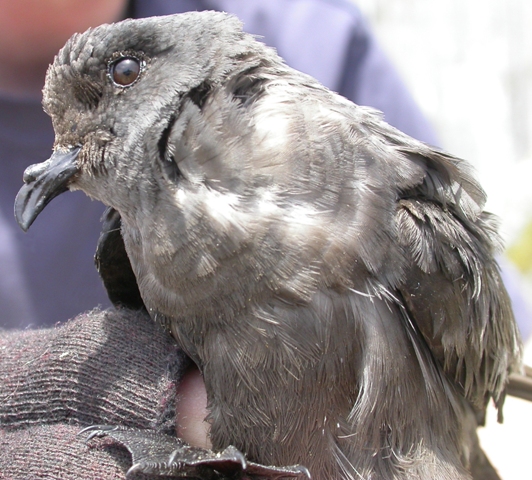
Cape Verde Storm-Petrel
Oceanodroma jabejabe
Order: Procellariiformes / Family: Hydrobatidae

Wikimedia Commons
About the Cape Verde Storm-Petrel
The Cape Verde Storm-Petrel, scientifically named Oceanodroma jabejabe, is a fascinating seabird belonging to the family Hydrobatidae. This species is endemic to the Cape Verde Islands, a tropical archipelago off the western coast of Africa. It thrives in the windy, open ocean environments surrounding these islands, making it a quintessential pelagic bird. The Cape Verde Storm-Petrel plays a crucial ecological role as a part of the marine food chain, where it acts as both predator and prey. The bird feeds primarily on small fish and invertebrates, which it catches through surface seizing, and in turn, it serves as a food source for larger marine predators such as gulls and raptors. This bird's presence indicates healthy marine ecosystems, as it relies on abundant food resources and undisturbed nesting sites. Cape Verde Storm-Petrels are highly migratory, dispersing widely across the Atlantic Ocean outside the breeding season. Their migratory behavior is driven by the search for food, and they are known to travel great distances, sometimes as far as the eastern coast of North and South America. During the breeding season, which typically spans from late spring to early summer, the Cape Verde Storm-Petrel returns to the archipelago, where it nests in colonies on remote, rocky islands. The bird's ability to navigate vast oceanic expanses and its reliance on specific breeding habitats underscore its ecological significance and the need for conservation measures to ensure its survival. Changes in ocean temperatures, the availability of prey, and human disturbances all influence the Cape Verde Storm-Petrel's seasonal patterns. Climate change and increasing human activity pose significant threats to their habitat, potentially impacting their foraging success and breeding success. Protecting the Cape Verde Storm-Petrel involves safeguarding its breeding and feeding habitats, monitoring population trends, and mitigating human-induced threats such as pollution and overfishing. Efforts to conserve this species not only help preserve a unique member of the global avian community but also contribute to the health of marine ecosystems at large.
The Cape Verde Storm-Petrel belongs to the family Hydrobatidae, within the order Procellariiformes. These birds typically live average 14 years with a max recorded of 19 years..
How to Identify a Cape Verde Storm-Petrel
Adult Cape Verde Storm-Petrels exhibit a predominantly dark plumage, with sooty black feathers covering the body and wings. Their upperparts are slightly lighter, giving a subtle contrast to their appearance. The wings are long and narrow, providing a distinctive fluttering flight pattern typical of storm-petrels. A key identification feature is the pale rump patch, a common characteristic among storm-petrels, though it can be challenging to spot from a distance. In flight, the Cape Verde Storm-Petrel can be mistaken for other storm-petrel species; however, its relatively larger size and specific flight style help distinguish it. Juveniles resemble adults but may have fresher plumage with more pronounced contrasting patterns. There are no significant differences between males and females in terms of plumage, making sex identification in the field difficult. The bird's perching posture is often described as upright when resting on the water, with wings held tightly against the body. This silhouette can aid in identification when observing the bird from afar.
Having trouble telling birds apart? Upload a photo to our bird identification tool for an instant species match.
Cape Verde Storm-Petrel Habitat and Range
Preferred Habitat
Cape Verde Storm-Petrels are quintessential pelagic birds, spending much of their lives over the open ocean. They are most commonly found in tropical and subtropical waters, particularly around the Cape Verde Islands. These birds prefer areas with consistent wind patterns, which aid their flight and foraging activities. During the breeding season, they inhabit rocky islets and cliffs that provide safe nesting sites. The islands of Raso and Branco in the Cape Verde archipelago are notable breeding locations. The species generally avoids urban areas and heavily populated regions, favoring remote, undisturbed habitats. There is little evidence of seasonal habitat shifts in this species, as they remain tied closely to the oceanic environment year-round. Elevation is not a significant factor in their habitat preference since they primarily breed at sea level near the coast.
Geographic Range
The Cape Verde Storm-Petrel breeds exclusively in the Cape Verde archipelago, making it an endemic species. During the non-breeding season, these birds disperse widely across the Atlantic Ocean, with some individuals reportedly reaching as far as the eastern coasts of North and South America. This wide-ranging dispersal indicates that the birds use extensive oceanic migration corridors. However, specific migratory patterns are not well-documented, partly due to the challenges of tracking such small seabirds over vast oceanic areas. Population density is highest around the breeding islands during the nesting season, particularly on the islands of Raso and Branco. Outside the breeding season, they become more dispersed, and sightings are less frequent, though they remain an integral part of the Atlantic marine avifauna.
Want to know which birds visit your area? Browse our backyard birds by location guides for region-specific species lists.
What Does the Cape Verde Storm-Petrel Eat?
The diet of the Cape Verde Storm-Petrel consists mainly of small fish and invertebrates, which they capture from the ocean's surface. Their primary prey includes species such as lanternfish and various crustaceans. The bird's foraging technique, known as surface seizing, involves skimming the water with their feet dangling down to snatch prey items. They often feed during the day, taking advantage of wind patterns to assist in their flight. The size of the prey usually ranges from 2 to 5 centimeters, small enough to be swallowed whole. Seasonal variations in diet are influenced by prey availability, with the birds adapting their foraging habits to the shifting abundance of different marine organisms. The Cape Verde Storm-Petrel does not exhibit a strict feeding schedule and feeds opportunistically, often alone or in small, loose flocks.
Cape Verde Storm-Petrel Behavior and Social Structure
Cape Verde Storm-Petrels are generally solitary or found in small groups when foraging, though they form dense breeding colonies during the nesting season. These birds do not exhibit strong territorial behavior, as their open ocean environment provides ample space for foraging. Courtship displays are subtle and primarily involve vocalizations and synchronized flight patterns near breeding sites. The species is nocturnal around the breeding colonies, likely to avoid predation by diurnal birds of prey. During the day, they spend time feeding at sea. In response to predators, Cape Verde Storm-Petrels are known to employ evasive flight maneuvers, taking advantage of their agile flight capabilities. Daily activity patterns revolve around feeding and breeding requirements, with migration periods characterized by increased travel to distant oceanic regions.
Cape Verde Storm-Petrel Nesting and Reproduction
Cape Verde Storm-Petrels nest in burrows or crevices on rocky islands, with a preference for sites that offer protection from the elements and predators. The nests are simple scrapes in the substrate or sheltered areas lined with a minimal amount of plant material and feathers. A typical clutch consists of a single egg, which both parents incubate for about 40 to 50 days. Once hatched, the chick is cared for by both parents, who take turns foraging and feeding the young. The fledging period lasts approximately 60 to 70 days, after which the juvenile is ready to take to the sea. Cape Verde Storm-Petrels usually produce one brood per year, with breeding success heavily dependent on food availability and environmental conditions.
Cape Verde Storm-Petrel Sounds and Vocalizations
The vocalizations of the Cape Verde Storm-Petrel are primarily heard near the breeding colonies. Their calls consist of a series of high-pitched, repetitive chirps and whistles, which facilitate communication between mates and within the colony. The rhythm is often fast, with a slightly musical quality, though not as melodious as songs of some land birds. Alarm calls are sharper and more abrupt, serving as warnings to other birds of potential danger. While the Cape Verde Storm-Petrel does not participate in a traditional dawn chorus, their nocturnal activity around breeding sites results in a chorus of calls at night, especially during peak breeding periods.
Interesting Facts About the Cape Verde Storm-Petrel
- 1The Cape Verde Storm-Petrel can travel over 1,000 kilometers in a single foraging trip while searching for food.
- 2Despite their name, storm-petrels are not deterred by stormy weather, often feeding in rough seas that many other birds avoid.
- 3The species' scientific name, Oceanodroma jabejabe, reflects its association with the ocean, with 'Oceanodroma' meaning 'sea runner'.
- 4Breeding sites of the Cape Verde Storm-Petrel are often found on inaccessible islets, making human contact infrequent.
- 5The Cape Verde Storm-Petrel was only recognized as a distinct species in the early 21st century, previously grouped with similar species.
- 6Their nocturnal habits at breeding sites help them avoid predation by larger diurnal birds.
- 7Cape Verde Storm-Petrels have a unique adaptation allowing them to excrete excess salt through specialized glandular structures.
Cape Verde Storm-Petrel Conservation Status
The Cape Verde Storm-Petrel is currently listed as Near Threatened by the IUCN, primarily due to its limited breeding range and potential threats from habitat disturbance. The population trend is uncertain, with evidence suggesting both stable and declining trends depending on specific colonies. Primary threats include habitat degradation from human activities, invasive species on breeding islands, and climate change affecting food availability. Conservation efforts focus on protecting breeding sites from human disturbance and managing invasive species. Historical population changes are not well-documented, but ongoing monitoring aims to better understand and protect this vulnerable species.