Capuchin Babbler
Phyllanthus atripennis
Order: Passeriformes / Family: Leiothrichidae

Wikimedia Commons
About the Capuchin Babbler
The Capuchin Babbler, scientifically known as Phyllanthus atripennis, is a fascinating bird belonging to the family Leiothrichidae. This bird is primarily found in the dense tropical forests of West Africa, with a range spanning from Sierra Leone to Nigeria. The Capuchin Babbler plays a crucial role in its ecosystem by aiding in seed dispersal and insect control. As an integral part of the understory bird community, it helps maintain the balance of insect populations, which can affect plant health and growth. The bird's presence is a good indicator of healthy forest ecosystems.
The Capuchin Babbler is significant not only for its ecological contributions but also for its cultural importance in certain regions. In local folklore, the bird is often associated with wisdom and is sometimes regarded as a symbol of good fortune. Its adaptation to the dense foliage and ability to thrive in various forest strata make it a resilient species in the face of habitat changes, although deforestation remains a concern.
Observing the Capuchin Babbler can be challenging due to its preference for dense, low-lying vegetation. However, its distinctive call often gives away its presence before it is seen. During the breeding season, which generally aligns with the rainy season in its habitat, the Capuchin Babbler becomes more vocal and active, engaging in elaborate courtship displays and territorial defense. Its ecological role underscores the importance of conserving tropical forests, which are vital for the survival of numerous species, including the Capuchin Babbler.
The Capuchin Babbler belongs to the family Leiothrichidae, within the order Passeriformes. These birds typically live average 5-8 years with max recorded around 10 years..
How to Identify a Capuchin Babbler
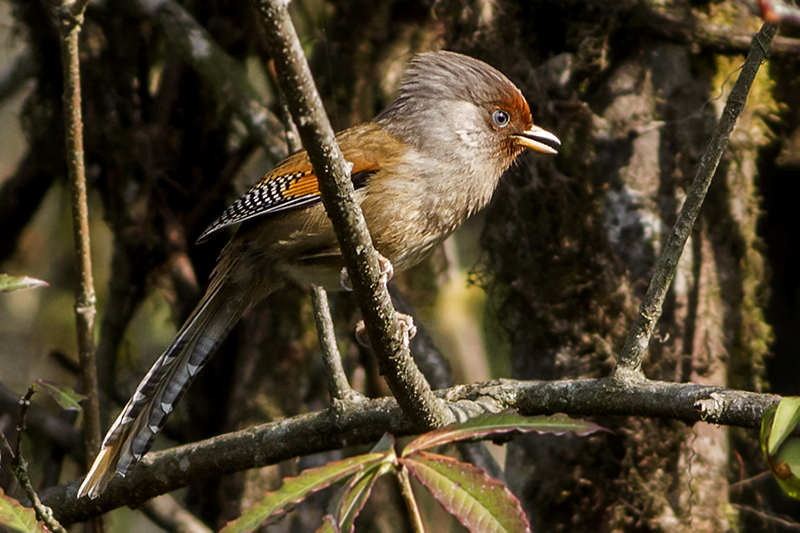
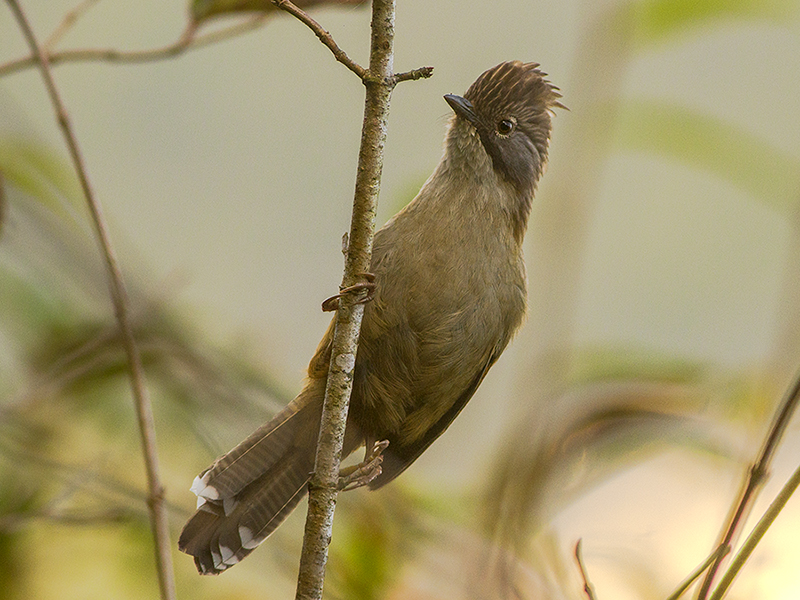
The Capuchin Babbler is a medium-sized bird, measuring approximately 23-25 cm in length. Its most distinctive feature is the striking white crown on its head, which contrasts sharply with its predominantly dark chestnut body. The bird's wings and tail are a darker brown, giving it a uniform appearance from a distance, but closer inspection reveals subtle barring on the wings and tail feathers.
Juvenile Capuchin Babblers resemble adults but have a slightly duller plumage, lacking the pronounced white crown found in mature birds. There are no significant differences between males and females, which can make them challenging to differentiate in the field. However, their behavior during the breeding season, when males tend to be more vocal and active, can aid identification.
In flight, the Capuchin Babbler presents a compact silhouette with relatively short, rounded wings and a long tail. Perched birds often sit with an upright posture, making them appear alert and poised. While it is unlikely to confuse the Capuchin Babbler with other species due to its unique coloration, birders should be cautious of other babblers with overlapping ranges, such as the Brown Babbler, which lacks the distinctive white crown.
Having trouble telling birds apart? Upload a photo to our bird identification tool for an instant species match.
Capuchin Babbler Habitat and Range
Preferred Habitat
The Capuchin Babbler inhabits dense tropical forests, often favoring the understory where it can forage and nest with relative safety. It thrives in lowland rainforests, but can also be found in secondary growth and forest edges, particularly where dense shrubbery or thickets provide ample cover. This adaptability allows the bird to persist in areas experiencing moderate levels of habitat disturbance.
While primarily a forest bird, the Capuchin Babbler can occasionally be spotted in plantations and agroforests, especially where native vegetation is preserved. It typically resides at elevations ranging from sea level to around 1,500 meters, although it shows a preference for lower elevations where forest density is higher.
The bird's habitat choice does not significantly change with the seasons, as it is a year-round resident of its range. However, localized movements may occur in response to food availability or breeding conditions. Unlike some forest species, the Capuchin Babbler rarely ventures into urban environments, remaining closely tied to its natural forested areas.
Geographic Range
The Capuchin Babbler's range is confined to the tropical regions of West Africa, where it is most commonly found in countries such as Sierra Leone, Liberia, Ivory Coast, Ghana, and Nigeria. The bird's distribution aligns closely with the moist lowland forest belt that stretches across this part of the continent. Within this range, population densities can vary depending on habitat quality and availability.
The Capuchin Babbler does not undertake long-distance migrations, but it may engage in local movements, particularly in response to seasonal food availability or breeding opportunities. These movements are typically limited to within its established range, as the bird is not known to venture outside the West African forest regions.
While it is considered a resident species, localized migrations can sometimes lead to temporary changes in population densities in certain areas. Despite its limited range, the Capuchin Babbler remains relatively common in suitable habitats, although deforestation poses a risk to its continued abundance.
Want to know which birds visit your area? Browse our backyard birds by location guides for region-specific species lists.
What Does the Capuchin Babbler Eat?
The Capuchin Babbler is primarily insectivorous, with a diet that consists of a wide variety of insects and other invertebrates. It forages on the forest floor and in the understory, using its strong bill to probe leaf litter and crevices for prey. Common food items include beetles, ants, termites, and caterpillars, which provide essential protein and nutrients.
During the rainy season, when insect populations surge, the Capuchin Babbler's diet becomes more diverse, incorporating a greater number of flying insects and small arthropods. Additionally, the bird occasionally supplements its diet with fruits and seeds, particularly when insect availability declines.
The Capuchin Babbler typically forages in small groups, employing a cooperative approach to locating and capturing prey. This social foraging strategy not only increases feeding efficiency but also provides added protection against predators. Feeding activity peaks in the early morning and late afternoon, coinciding with periods of increased insect activity.
Capuchin Babbler Behavior and Social Structure
The Capuchin Babbler exhibits a complex social structure, often forming small, cohesive groups of up to ten individuals. These groups maintain defined territories, which they defend through vocal displays and physical confrontations with rival groups. Such territorial behavior is most pronounced during the breeding season, when resources are in high demand.
Courtship displays among Capuchin Babblers are elaborate, involving synchronized movements and vocal duets between paired birds. These displays serve to strengthen pair bonds and signal territory ownership to potential rivals.
The Capuchin Babbler is generally active during daylight hours, with peaks in activity occurring in the cooler hours of the morning and late afternoon. In response to predators, the bird employs a combination of alarm calls and evasive maneuvers, often retreating to dense vegetation where it is less visible. Flocking behavior provides additional safety, as there are more eyes to spot potential threats.
Capuchin Babbler Nesting and Reproduction
The Capuchin Babbler constructs cup-shaped nests using a variety of materials, including twigs, leaves, and grass. These nests are typically located in dense shrubbery or low trees, providing concealment from predators. Preferred nest sites are often near the forest floor, although they can be found up to several meters above ground in thicker vegetation.
Breeding occurs during the rainy season, with a typical clutch size of two to three eggs. The incubation period lasts approximately 14 days, with both parents sharing the responsibility of keeping the eggs warm and protected.
After hatching, the chicks grow quickly and fledge within 14 to 18 days. Parental care continues for several weeks post-fledging, as young birds learn essential foraging and survival skills. The Capuchin Babbler usually raises one brood per year, although favorable conditions can sometimes lead to a second attempt.
Capuchin Babbler Sounds and Vocalizations
The Capuchin Babbler is known for its distinctive vocalizations, which include a series of rich, melodious whistles and chattering notes. Its primary song consists of a rhythmic sequence of whistles, varying in pitch and quality, often repeated in quick succession. The song is used for communication within groups and territory establishment.
In addition to its song, the Capuchin Babbler produces a range of call notes, including sharp, alarm calls that alert group members to potential threats. These alarm calls are often accompanied by noticeable agitation and increased movement within the group.
The dawn chorus of the Capuchin Babbler is a particularly lively affair, with multiple individuals contributing to a cacophony of sounds as they announce their presence and reinforce social bonds. The sounds are reminiscent of those made by other babblers, though the Capuchin Babbler's calls are more resonant and varied.
Interesting Facts About the Capuchin Babbler
- 1The Capuchin Babbler's name derives from its white crown, which resembles the hood of a Capuchin monk.
- 2Capuchin Babblers are often seen in mixed-species flocks, a strategy that provides increased protection from predators.
- 3These babblers are vocal year-round, but their calls become more frequent and complex during the breeding season.
- 4Capuchin Babblers use their strong bills to forage for insects in leaf litter, showcasing their adaptability to forest life.
- 5The bird's preference for dense understory makes it a key indicator species for forest health and biodiversity.
- 6Despite being non-migratory, Capuchin Babblers may move locally in search of food or suitable nesting sites.
- 7The Capuchin Babbler's melodious song can carry over considerable distances, aiding communication in dense forests.
Capuchin Babbler Conservation Status
The Capuchin Babbler is currently listed as Least Concern by the IUCN, thanks to its wide distribution within suitable habitats. However, its population trend is suspected to be decreasing due to ongoing habitat loss from deforestation and human encroachment. Primary threats include logging, agricultural expansion, and infrastructure development, all of which contribute to the fragmentation of its forest habitat. Conservation efforts focus on preserving remaining forest areas and promoting sustainable land use practices. Historically, the Capuchin Babbler has maintained a stable population across its range, but continued habitat degradation presents a significant challenge. Conservationists emphasize the importance of protecting forest ecosystems not only for the Capuchin Babbler but for the multitude of species that depend on these habitats.