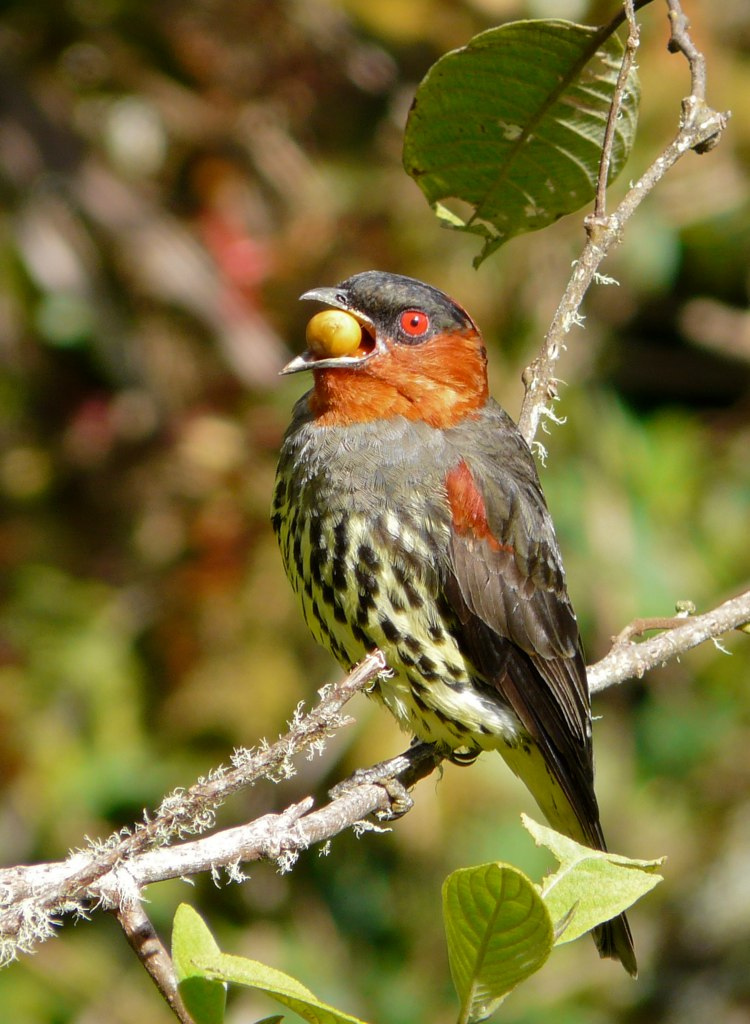
Capuchinbird
Perissocephalus tricolor
Order: Passeriformes / Family: Cotingidae

Wikimedia Commons
About the Capuchinbird
The Capuchinbird (Perissocephalus tricolor), a member of the Cotingidae family, is a remarkable bird inhabiting the neotropical rainforests of northern South America. This species is particularly notable for its distinctive appearance and unusual vocalizations, which have intrigued ornithologists and bird enthusiasts alike. The Capuchinbird's range includes countries such as Venezuela, Colombia, Brazil, and the Guianas, where it resides in dense, humid forests and lowland areas.
The ecological significance of the Capuchinbird is tied to its role as both predator and prey within its ecosystem. As a frugivore, it contributes to seed dispersal, thus aiding in forest regeneration and health. These birds are often observed in the middle to upper canopy, foraging for fruits and occasionally insects. Seasonal shifts in fruit availability may influence their diet and foraging behavior, although they remain largely sedentary throughout the year.
The Capuchinbird's role within its habitat extends beyond its dietary habits. It is a part of the complex web of interactions that sustain tropical forest ecosystems. During the breeding season, the males engage in dramatic lekking displays to attract mates, which can impact the social dynamics within bird communities. Such displays occur primarily during the wet season when food resources are abundant, ensuring sufficient nourishment for raising young. The Capuchinbird's presence and activities thus exemplify the intricate relationships that characterize tropical bird ecosystems.
The Capuchinbird belongs to the family Cotingidae, within the order Passeriformes. These birds typically live average 8-10 years with a max recorded of 12 years.
How to Identify a Capuchinbird
The Capuchinbird is easily recognizable due to its large size and striking plumage. Adults typically measure around 40 centimeters in length, with males being slightly larger than females. The most distinctive feature of this species is its bald head, which is covered in bare, reddish-orange skin, a trait that is reminiscent of a monk's tonsure, hence its name. The plumage is primarily a rich chestnut brown, with a contrasting black tail. Juveniles resemble adults but are generally duller in color, with less vibrant skin tones on the head.
In terms of sexual dimorphism, males and females appear similar, though males are often slightly larger and more robust. The Capuchinbird's flight silhouette is characterized by broad, rounded wings and a relatively short tail. When perching, these birds often adopt a hunched posture, which can make them appear smaller than they actually are. Despite their unique appearance, they can sometimes be confused with other large cotingas, though their bare head and vocalizations are reliable distinguishing features.
In the field, observers should pay attention to the Capuchinbird's behavior and habitat, as it is usually found in the mid to upper canopy of dense forests. The combination of its vocalizations and distinctive physical features makes it an unforgettable sight for birders lucky enough to encounter it.
Having trouble telling birds apart? Upload a photo to our bird identification tool for an instant species match.
Capuchinbird Habitat and Range
Preferred Habitat
Capuchinbirds primarily inhabit the tropical rainforests of northern South America. They are most commonly found in dense, humid forests, particularly in lowland regions and foothills. These birds thrive in areas where the canopy is diverse and provides a variety of fruiting trees. They are seldom found in open or fragmented habitats, preferring the shelter and resources offered by intact forest ecosystems.
The elevation range for the Capuchinbird typically extends from sea level up to about 1,200 meters. While they are not known for significant elevational migrations, they may move locally in response to seasonal fruit abundance. Urban presence is uncommon for this species, as they rely heavily on undisturbed forest environments for their survival.
Seasonal habitat shifts are minimal, as the Capuchinbird tends to remain within its preferred forested habitats year-round. Their dependence on primary forests makes them vulnerable to habitat loss and fragmentation, which underscores the importance of conservation efforts in maintaining their natural environments.
Geographic Range
The Capuchinbird's range is centered in the neotropical regions of northern South America. It is found in countries such as Venezuela, Colombia, Brazil, Guyana, Suriname, and French Guiana. Within these countries, the bird occupies a relatively narrow ecological niche, favoring the dense, humid forests that characterize much of this region.
The Capuchinbird does not typically undertake long-distance migrations. Instead, it remains a resident species throughout its range, maintaining a sedentary lifestyle that is closely tied to the availability of food resources within its habitat. This lack of migratory behavior means that the Capuchinbird's distribution is largely stable, although local movements may occur in response to changes in fruit abundance.
Population density hotspots for the Capuchinbird are often associated with areas of high fruit diversity and availability, particularly during the breeding season. These hotspots can provide critical insights into the species' ecological needs and are essential for targeted conservation efforts. Despite its relatively stable range, habitat destruction poses a significant threat to the Capuchinbird's long-term survival, emphasizing the importance of preserving the forests it calls home.
Want to know which birds visit your area? Browse our backyard birds by location guides for region-specific species lists.
What Does the Capuchinbird Eat?
The Capuchinbird primarily feeds on a variety of fruits, which constitute the bulk of its diet. Its frugivorous habits are facilitated by the abundance of fruiting trees in its rainforest habitat. Among its preferred food sources are figs, berries, and other fleshy fruits, which it plucks from the canopy with precision. The bird's strong bill is well adapted to extracting fruit, and its feeding technique involves deftly swallowing the fruit whole or cracking it open to access the pulp and seeds.
Seasonal changes in fruit availability can lead to shifts in the Capuchinbird's diet, though its preference for fruit remains constant. During times when fruits are less abundant, the Capuchinbird may supplement its diet with insects, although this is not a primary food source. The bird's foraging activity is typically concentrated in the early morning and late afternoon, coinciding with cooler temperatures and reduced competition from other fruit-eating species.
The size of prey items is generally small, with insects serving as occasional sources of protein. The Capuchinbird's reliance on a fruit-based diet underscores its role as a seed disperser within its ecosystem, facilitating forest regeneration by spreading seeds across its range. This dietary specialization, while beneficial for forest dynamics, also makes the Capuchinbird vulnerable to fluctuations in fruit availability and highlights the importance of its forested habitat.
Capuchinbird Behavior and Social Structure
The Capuchinbird exhibits intriguing behavioral patterns, particularly during the breeding season when males engage in lekking displays to attract females. These displays are characterized by the males gathering in small groups, known as leks, where they perform visually and vocally to impress potential mates. The Capuchinbird's vocalizations during these displays are distinctive and can be heard over long distances, serving as a key component of the courtship ritual.
Socially, the Capuchinbird tends to be a solitary or loosely social species outside the breeding season. It does not form large flocks, although individuals may be seen foraging in proximity to one another when fruit is abundant. Territorial behavior is most pronounced during the breeding season, with males defending their lekking sites from rivals to maximize their chances of mating success.
In response to predators, the Capuchinbird relies on its cryptic plumage and the dense forest canopy for protection. It exhibits a high degree of vigilance, often pausing its activities to scan for potential threats. Daily activity patterns are largely diurnal, with peak activity occurring during the cooler parts of the day. The Capuchinbird's behavior reflects its adaptation to the challenges and opportunities presented by its rainforest environment.
Capuchinbird Nesting and Reproduction
Capuchinbirds build their nests high in the canopy, favoring locations that offer both protection from predators and proximity to abundant food resources. The nests are typically cup-shaped and constructed from a combination of twigs, leaves, and other plant materials. Female Capuchinbirds usually select the nesting site and take the lead in building the nest, although males may assist in gathering materials.
The typical clutch size for a Capuchinbird ranges from one to two eggs. These eggs are incubated primarily by the female, with the incubation period lasting approximately 18 to 20 days. During this time, the male may help by providing food to the female, ensuring she can remain on the nest for extended periods.
Once the chicks hatch, they are altricial, requiring significant parental care before they are ready to fledge. The fledging period lasts about 25 to 30 days, during which both parents contribute to feeding and protecting the young. Capuchinbirds generally produce one brood per year, timed to coincide with periods of peak fruit availability to maximize the chances of chick survival and successful fledging.
Capuchinbird Sounds and Vocalizations
The Capuchinbird is renowned for its unique vocalizations, which play a crucial role in its courtship displays. The primary song is a deep, resonant humming sound, reminiscent of a distant cow mooing. This low-pitched, rhythmic call can carry over long distances, making it effective for attracting females to the males' lekking sites.
In addition to its primary song, the Capuchinbird produces a variety of call notes, including grunts and softer cooing sounds that may serve as communication between individuals or as part of its mating ritual. Alarm calls are less frequently documented but are believed to consist of sharp, abrupt notes that alert other birds to the presence of predators.
During the dawn chorus, the Capuchinbird's calls are particularly prominent, as males compete to establish their presence and attract mates. The distinctive quality of the Capuchinbird's vocalizations makes it an acoustic highlight of the neotropical forest soundscape.
Interesting Facts About the Capuchinbird
- 1The Capuchinbird's bald head, resembling a monk's tonsure, is unique among the cotingas.
- 2Capuchinbird vocalizations are often compared to the low mooing of a cow, an unusual trait for a bird.
- 3The species' name, Perissocephalus tricolor, reflects its striking three-color plumage.
- 4Capuchinbirds participate in lekking, a rare behavior among birds where males display communally.
- 5Despite their large size, Capuchinbirds are more often heard than seen due to their secretive nature.
- 6The Capuchinbird plays a vital role in seed dispersal, contributing to rainforest regeneration.
- 7Its range is limited to northern South America, where it occupies a specific ecological niche.
Capuchinbird Conservation Status
The Capuchinbird is currently classified as Least Concern by the IUCN, though its population trend is decreasing. The primary threat to this species is habitat loss due to deforestation, primarily driven by agriculture and logging activities. As forests are cleared, the Capuchinbird loses both its foraging grounds and breeding sites, which can lead to local population declines. Conservation efforts focus on preserving the intact rainforest habitats that the Capuchinbird depends upon. Protected areas and reserves in countries like Brazil and Guyana play a crucial role in providing refuge for this and other forest-dependent species. Additionally, reforestation initiatives and sustainable land-use practices can contribute to stabilizing and potentially increasing Capuchinbird populations. Historically, the Capuchinbird has maintained stable populations across its range, but ongoing habitat destruction poses a significant challenge to its long-term survival. Continued conservation efforts are essential to ensure that this unique bird remains a part of the neotropical biodiversity.