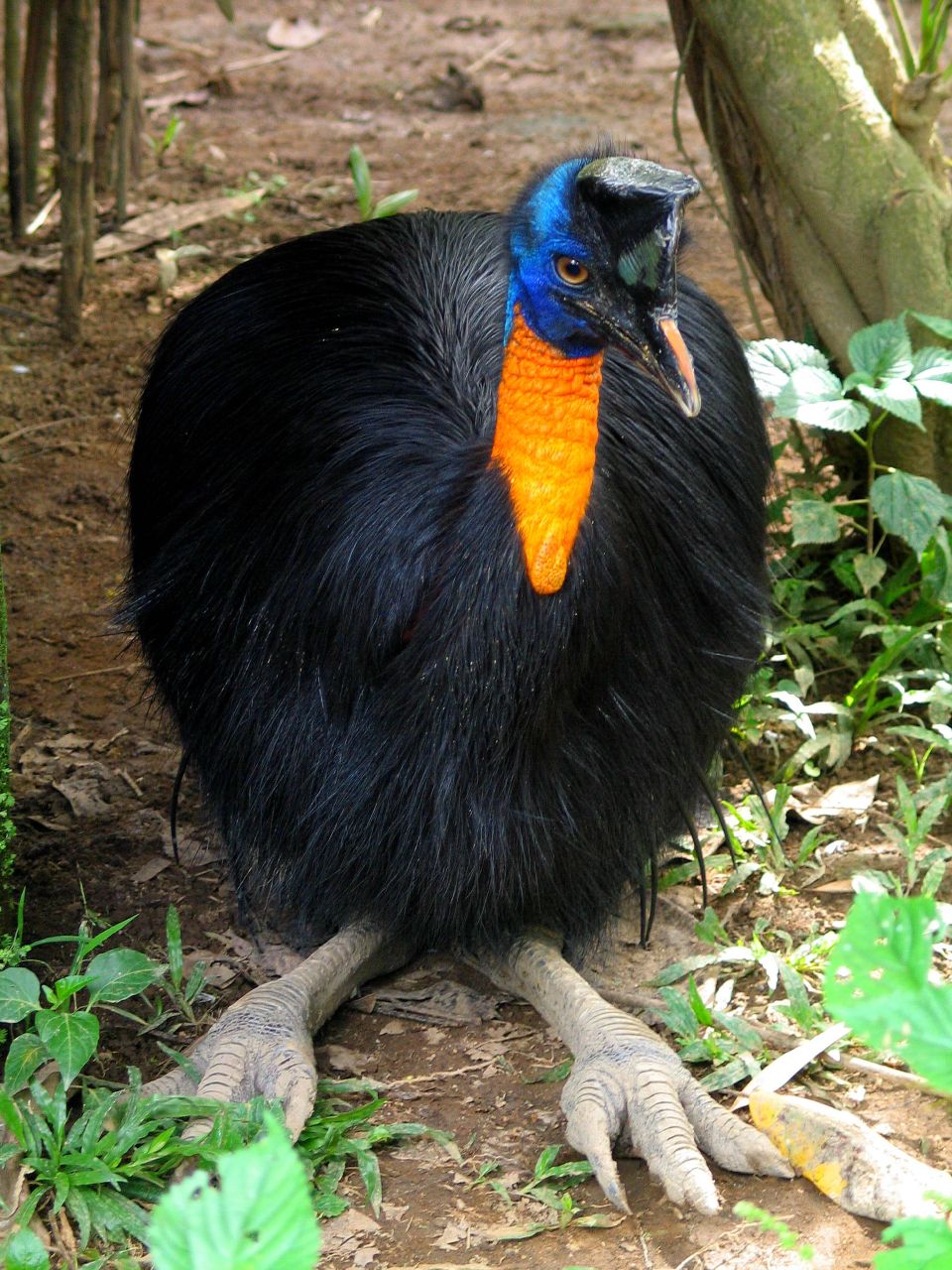
Southern Cassowary
Casuarius diemenianus
Order: Casuariiformes / Family: Casuariidae

Wikimedia Commons
About the Southern Cassowary
The Southern Cassowary, scientifically known as Casuarius diemenianus, is a flightless bird native to the tropical rainforests of northeastern Australia and New Guinea. This bird, part of the family Casuariidae and the order Casuariiformes, serves as a flagship species for the rich biodiversity of these regions. The Southern Cassowary plays a crucial ecological role as a keystone species, primarily through its diet, which facilitates seed dispersal for over 100 tropical plant species. This process is vital for maintaining the structure and diversity of the rainforest ecosystem.
The Southern Cassowary is a solitary creature, except during mating seasons or when mothers are raising their young. Its presence is often an indicator of healthy, intact rainforest ecosystems, as these birds require vast, undisturbed territories. They are found predominantly in the lowland rainforests, although they occasionally venture into higher elevations up to 1,100 meters. Their habitats are characterized by dense foliage and a rich canopy, providing ample food sources and protection from predators.
Seasonal behaviors of the Southern Cassowary are closely tied to the availability of fruit, which constitutes the majority of its diet. During the wet season, from November to April, cassowaries benefit from the abundance of fruiting trees. This period also coincides with the breeding season, which sees a shift in the typically solitary behavior to more active courtship and nesting activities. The Southern Cassowary's role as a seed disperser is particularly significant during this time, as the germination of seeds in their droppings ensures the continued growth and regeneration of the rainforest.
The Southern Cassowary belongs to the family Casuariidae, within the order Casuariiformes. These birds typically live average 40 years with a max recorded of 50 years.
How to Identify a Southern Cassowary
The Southern Cassowary is an unmistakable bird due to its striking appearance. Adult cassowaries stand approximately 1.5 to 1.8 meters tall and weigh between 35 to 58 kilograms, making them one of the heaviest birds in the world. They are primarily black, with coarse, hair-like feathers that provide protection against the dense underbrush of the rainforest. A notable feature is the prominent casque atop their heads, which is believed to play a role in communication and dominance displays, as well as aiding in navigation through thick vegetation.
The skin of the Southern Cassowary is vibrantly colored, with a cobalt-blue face and neck, fiery red wattles, and a horn-like casque. These colors are more pronounced in males, which also tend to be slightly larger than females. Juvenile cassowaries, on the other hand, are brown with pale stripes, providing camouflage from predators until they mature and develop the characteristic adult plumage.
While there is little risk of confusing the Southern Cassowary with other species due to its unique features, its large size and distinctive coloration make it a conspicuous presence in its rainforest habitat. The cassowary's perching posture is typically upright, with its head held high and alert, scanning the surroundings.
Having trouble telling birds apart? Upload a photo to our bird identification tool for an instant species match.
Southern Cassowary Habitat and Range
Preferred Habitat
The Southern Cassowary inhabits the dense tropical rainforests of northeastern Australia, particularly the Wet Tropics of Queensland, and the lowland forests of New Guinea. These birds prefer primary rainforests but can also be found in secondary forests, mangroves, and swampy areas. Elevations range from sea level to approximately 1,100 meters, although they primarily occupy flatter, lowland regions.
Seasonal habitat shifts occur in response to food availability. During the dry season, cassowaries might venture closer to human settlements in search of food, though they generally avoid urbanized areas. In contrast, the wet season ensures a plentiful supply of fruits within the forest, allowing them to remain within their preferred habitat.
The Southern Cassowary is rarely seen in open fields or grasslands, as it relies on the cover of dense foliage for protection and sustenance. Its presence is a crucial element of the tropical forest ecosystem, and its habitat requirements highlight the importance of conserving large areas of contiguous rainforest.
Geographic Range
The Southern Cassowary's range is primarily restricted to the humid lowland forests of New Guinea and the Wet Tropics of Queensland in Australia. In Australia, their distribution extends from Cooktown in the north to just south of Townsville. This region, a UNESCO World Heritage Site, provides the ideal conditions for the cassowary's survival, including a rich diversity of fruiting plants.
While the Southern Cassowary does not migrate, it is known to move across its range in search of food, particularly during times of scarcity. These movements are typically local and confined within its established territory. The population is densest in areas with minimal human disturbance and where forest integrity remains intact.
Within New Guinea, the Southern Cassowary's presence is more widespread, covering both the Papua New Guinea and Indonesian sides of the island. The bird's distribution is largely dictated by the availability of suitable rainforest habitat, which is increasingly threatened by deforestation and habitat fragmentation.
Want to know which birds visit your area? Browse our backyard birds by location guides for region-specific species lists.
What Does the Southern Cassowary Eat?
The Southern Cassowary is predominantly frugivorous, with a diet that includes over 238 fruit species. Its feeding habits are vital for seed dispersal, as many rainforest plants rely on cassowaries to spread their seeds through droppings. This dietary preference means that fruit availability directly influences their foraging behavior and movements within their range.
In addition to fruit, cassowaries occasionally consume fungi, invertebrates, small vertebrates, and carrion, although these constitute a minor part of their diet. The Southern Cassowary employs a deliberate foraging technique, using its powerful beak to pluck fruits from trees or the forest floor. The bird typically feeds during the early morning and late afternoon, when temperatures are cooler and other forest activities are less frantic.
Seasonal changes in fruit production lead to shifts in diet, with cassowaries adjusting their feeding habits to take advantage of the most abundant food sources. During the wet season, the proliferation of fruiting trees provides ample sustenance, whereas the dry season may require them to forage more extensively to meet their nutritional needs.
Southern Cassowary Behavior and Social Structure
The Southern Cassowary is largely solitary, interacting with other cassowaries primarily during the breeding season. Males establish territories that they defend aggressively, using low-frequency vocalizations and physical displays to warn off intruders. These territories can range from 7 to 12 square kilometers, depending on the availability of resources.
Courtship displays involve a series of rhythmic, booming calls and postures, with males attempting to attract females through these vocalizations. Once a pair forms, the female typically lays three to five eggs, which the male then incubates. Unlike many bird species, male cassowaries take on the primary role of rearing the young, demonstrating a high degree of parental care by guarding and teaching them for up to nine months after hatching.
When threatened by predators, such as large snakes or dingoes, the Southern Cassowary utilizes its powerful legs and sharp claws as a formidable defense mechanism. Despite their solitary nature, cassowaries exhibit a form of social structure during feeding, as they may tolerate the presence of conspecifics when food is abundant.
Southern Cassowary Nesting and Reproduction
Southern Cassowaries construct nests on the forest floor, using a variety of materials such as leaves, grass, and sticks. These nests are shallow depressions, usually located in a secluded area to minimize the risk of predation. The female lays between three to five large, greenish eggs, which can weigh up to 650 grams each.
The male cassowary assumes the role of incubating the eggs, a process that lasts approximately 50 to 54 days. During this period, the male remains vigilant, rarely leaving the nest and relying on nearby vegetation for sustenance. Once the eggs hatch, the male continues to care for the chicks, providing protection and guidance in foraging.
The fledging period for young cassowaries extends up to nine months, after which they gradually become independent. Typically, Southern Cassowaries produce only one brood per year, given the considerable investment of time and energy required for successful rearing.
Southern Cassowary Sounds and Vocalizations
The Southern Cassowary's primary vocalization is a deep, resonant boom, which can be heard up to several hundred meters away. This sound, often compared to a distant drum or the rumble of thunder, serves various purposes, including courtship and territorial defense. Cassowaries also emit low-frequency growls and hisses as alarm calls when sensing danger.
These vocalizations play a crucial role in communication within the dense rainforest environment, where visual signals may be less effective. While not known for a dawn chorus, cassowaries are most vocal during the early morning and late afternoon, coinciding with their peak periods of activity.
Interesting Facts About the Southern Cassowary
- 1The Southern Cassowary can run up to 50 km/h through dense forest, using its casque to push aside vegetation.
- 2Cassowaries have the unique ability to swallow fruits whole, some of which are as large as a tennis ball.
- 3Despite being flightless, the Southern Cassowary has powerful legs, allowing it to jump up to 1.5 meters in the air.
- 4The casque of the Southern Cassowary is made of keratin, the same material found in human fingernails.
- 5A cassowary's low-frequency sounds are among the lowest known bird calls, often below the range of human hearing.
- 6Southern Cassowaries play a pivotal role in maintaining rainforest diversity by dispersing seeds across vast distances.
- 7The species can live up to 40 years in the wild, provided it has access to suitable habitat and faces minimal threats.
Southern Cassowary Conservation Status
The Southern Cassowary is listed as Vulnerable on the IUCN Red List, with population numbers declining due to habitat loss, vehicle collisions, and dog attacks. Deforestation and fragmentation of rainforests pose significant threats, reducing available habitat and isolating populations. Conservation efforts focus on habitat preservation, wildlife corridors, and public awareness campaigns to mitigate human-cassowary conflicts. In recent decades, protection measures such as the establishment of national parks and reserves have helped stabilize some populations. However, ongoing threats necessitate continued conservation action to ensure the survival of this iconic species.