
Dwarf Cassowary
Casuarius bennetti
Order: Casuariiformes / Family: Casuariidae

Wikimedia Commons
About the Dwarf Cassowary
The Dwarf Cassowary, Casuarius bennetti, is a fascinating species endemic to the tropical forests of New Guinea and nearby islands. As one of the smallest cassowary species, it plays a crucial role in its ecosystem through seed dispersal and forest dynamics. Standing approximately 1.2 to 1.5 meters tall and weighing between 20 and 30 kilograms, the Dwarf Cassowary exhibits a unique combination of robust strength and agility, which aids its survival in dense, mountainous terrains. Notably, this species inhabits elevations ranging from 300 to 3,300 meters, adapting to varied forest types including montane and lowland forests. The Dwarf Cassowary's ecological significance stems from its diet, which primarily consists of fallen fruit. By consuming and later excreting seeds, it facilitates the growth of diverse plant life, contributing to the health of tropical forests. This bird's seasonal behaviors reflect its adaptability; during periods of fruit scarcity, it may travel longer distances in search of food, showcasing its resilience in the face of environmental changes. The presence of the Dwarf Cassowary in these forests indicates a healthy, functioning ecosystem. Conservationists and researchers closely study the Dwarf Cassowary to understand better the intricate balance of forest ecosystems. Its role as a seed disperser underscores its importance in maintaining biodiversity and forest regeneration. This bird's adaptability to both primary and secondary forests highlights its resilience, yet it remains vulnerable to habitat destruction and hunting pressures. As human activity encroaches on its habitat, understanding the Dwarf Cassowary's ecological role becomes increasingly vital. Efforts to conserve this species focus on habitat protection and mitigating human-wildlife conflicts, ensuring that the Dwarf Cassowary continues to thrive in its natural environment.
The Dwarf Cassowary belongs to the family Casuariidae, within the order Casuariiformes. These birds typically live up to 12 years in the wild, with some individuals reaching 20 years in captivity..
How to Identify a Dwarf Cassowary
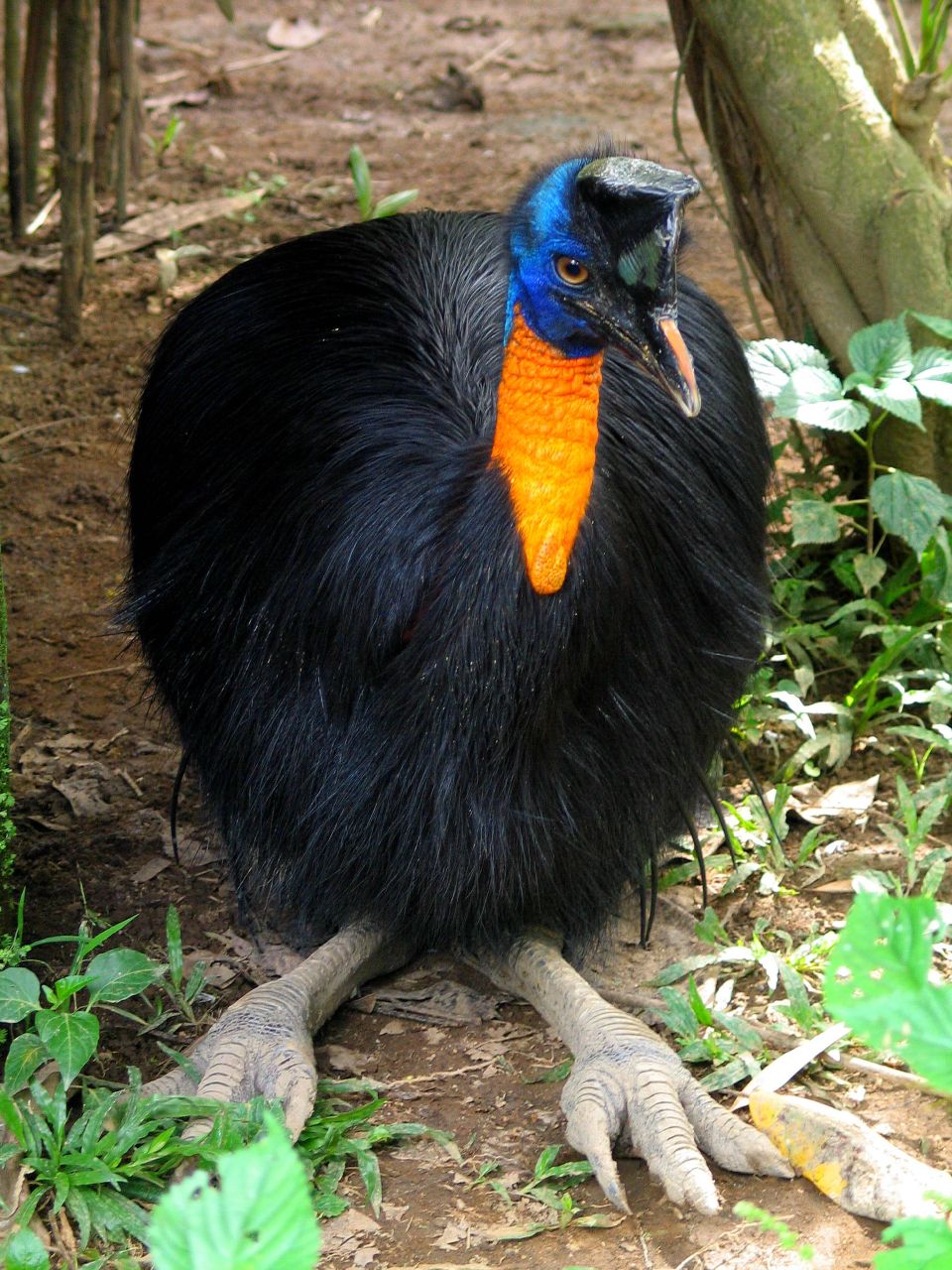
The Dwarf Cassowary is a distinctive bird with several noteworthy field marks. Adult plumage is predominantly black, with a glossy sheen that serves as camouflage in the shadowy understory of its forest habitat. Its head and neck are adorned with striking blue skin, contrasted by bright red wattles, which are less prominent than those of its larger relatives. A prominent feature is its helmet-like casque, used for both protection and communication. Juvenile Dwarf Cassowaries exhibit brownish plumage, providing effective concealment among forest debris. As they mature, their plumage darkens, and their skin coloration becomes more vivid. Sexual dimorphism is minimal, though females are generally slightly larger. Distinguishing males from females in the field can be challenging. Compared to the Southern Cassowary, the Dwarf Cassowary is smaller and lacks the Southern's elongated casque and more prominent wattles. When observed in profile, the Dwarf Cassowary's silhouette is compact, its head held low as it navigates undergrowth. Despite its flightlessness, this bird possesses strong legs adapted for running and kicking, features that are crucial for defense and navigating rugged terrain.
Having trouble telling birds apart? Upload a photo to our bird identification tool for an instant species match.
Dwarf Cassowary Habitat and Range
Preferred Habitat
The Dwarf Cassowary thrives in diverse forest habitats within New Guinea and neighboring islands. It inhabits both primary and secondary forests, demonstrating a remarkable adaptability to various forest types. Preferring elevations between 300 and 3,300 meters, the Dwarf Cassowary is commonly found in montane forests, where dense vegetation provides ample cover and food resources. Seasonal habitat shifts are largely driven by fruit availability, prompting these birds to move to areas with abundant food supplies. Despite their adaptability, Dwarf Cassowaries rarely venture into urban areas, as they are highly dependent on forested environments for survival. Their presence in rural regions is more common, particularly where forest edges meet agricultural lands. Conservation efforts emphasize the importance of maintaining contiguous forest habitats to support this species' ecological needs.
Geographic Range
The Dwarf Cassowary's range is predominantly confined to the island of New Guinea, encompassing both Papua New Guinea and the Indonesian province of Papua. Additionally, it inhabits several smaller islands, including New Britain and Yapen. The species is non-migratory, with a relatively localized distribution centered around specific forested regions. Population density varies across its range, with higher concentrations in areas of undisturbed forest. Although the Dwarf Cassowary does not engage in long-distance migrations, it exhibits seasonal movements within its range, often traversing altitudinal gradients in response to changes in fruit availability. Conservationists prioritize these regions for protection due to their significance in maintaining viable Dwarf Cassowary populations. Ensuring the preservation of these habitats is critical for the species' continued survival.
Want to know which birds visit your area? Browse our backyard birds by location guides for region-specific species lists.
What Does the Dwarf Cassowary Eat?
The Dwarf Cassowary's diet primarily consists of fallen fruits, making it a crucial seed disperser in its ecosystem. It consumes a wide variety of fruit species, ranging from palm nuts to figs, depending on seasonal availability. The bird's strong beak and robust digestive system enable it to process large, tough fruits that other species might avoid. In addition to fruits, the Dwarf Cassowary occasionally supplements its diet with fungi, insects, and small vertebrates, such as rodents, when fruits are scarce. Foraging typically occurs during the early morning and late afternoon, coinciding with cooler temperatures and reduced human activity. The Dwarf Cassowary's methodical foraging technique involves walking slowly through the forest floor, using its keen eyesight and sense of smell to locate food. This opportunistic feeding strategy ensures it meets its nutritional needs even when specific fruit sources are unavailable.
Dwarf Cassowary Behavior and Social Structure
The Dwarf Cassowary exhibits solitary behavior, with individuals often maintaining a large territory to ensure sufficient food resources. Territorial disputes, though infrequent, can result in aggressive encounters, characterized by powerful kicks and vocalizations. During the breeding season, males engage in elaborate courtship displays to attract females, showcasing their vibrant neck and casque. These displays include a combination of deep booming calls and physical posturing. Once courtship concludes, the male assumes primary responsibility for incubating the eggs and caring for the chicks, a unique trait among birds. Daily activity patterns of the Dwarf Cassowary involve foraging during early and late hours to avoid the midday heat. In response to predators, the Dwarf Cassowary relies on its speed and agility to escape, often retreating into dense underbrush. Its powerful legs serve as both a defense mechanism and a tool for navigating challenging terrain.
Dwarf Cassowary Nesting and Reproduction
Dwarf Cassowaries construct simple nests on the forest floor, using available materials such as leaves, twigs, and grass. Nests are typically located in well-concealed areas, providing protection from predators and human disturbance. The clutch size usually consists of three to five large, green eggs, which the male exclusively incubates for approximately 50 days. After hatching, the chicks are precocial and capable of walking shortly after birth. The male assumes the role of caretaker, guiding the chicks to food sources and protecting them from potential threats. Fledging occurs gradually over several months, with chicks remaining dependent on the male for up to a year. This extended parental care is vital for the survival of young Dwarf Cassowaries, ensuring they develop the skills necessary to thrive independently. The species typically produces one brood per year.
Dwarf Cassowary Sounds and Vocalizations
The Dwarf Cassowary's vocalizations include deep, resonant booming calls used primarily for communication during courtship and territorial defense. These calls, characterized by their low frequency, can carry over long distances in the dense forest. In addition to booming, the Dwarf Cassowary produces a series of grunts and hisses, often used as alarm calls or to signal distress. These sounds, while less prominent than the booming calls, play a crucial role in social interactions. The species lacks a traditional song, as seen in passerines, but its calls are integral to its communication repertoire. Observers often compare the booming calls to the sound of distant thunder, emphasizing their depth and power.
Interesting Facts About the Dwarf Cassowary
- 1The Dwarf Cassowary is one of three cassowary species, the others being the Southern and Northern Cassowaries.
- 2Despite its small size, the Dwarf Cassowary can run at speeds up to 50 km/h, aiding in predator evasion.
- 3The bird's casque, made of keratin, may help with temperature regulation and sound amplification.
- 4Dwarf Cassowaries play a crucial role in seed dispersal, affecting over 70 plant species in their habitat.
- 5Unlike many birds, the male Dwarf Cassowary solely incubates the eggs and cares for the young.
- 6The Dwarf Cassowary's legs are powerful enough to deliver a fatal kick when threatened.
- 7Despite being flightless, Dwarf Cassowaries are excellent swimmers, capable of crossing rivers with ease.
Dwarf Cassowary Conservation Status
The IUCN currently lists the Dwarf Cassowary as Near Threatened, with a population trend that is decreasing. Primary threats include habitat destruction due to logging and agricultural expansion, as well as hunting for meat and feathers. Conservation efforts focus on habitat preservation and creating protected areas to safeguard remaining populations. Community engagement programs aim to reduce hunting pressures by promoting alternative livelihoods. Historically, the Dwarf Cassowary's range has contracted due to human activities, underscoring the need for continued conservation action to prevent further declines. Initiatives such as ecotourism and habitat restoration offer hope for the species' future, provided they receive sustained support.
Other Casuariidae Species


Birds Similar to the Dwarf Cassowary
These species are often confused with the Dwarf Cassowary due to similar appearance or overlapping range.