
Pygmy Cassowary
Casuarius lydekkeri
Order: Casuariiformes / Family: Casuariidae

Wikimedia Commons
About the Pygmy Cassowary
The Pygmy Cassowary (Casuarius lydekkeri) is a fascinating member of the Casuariidae family, known for its relatively diminutive size compared to its towering relatives. This elusive bird, native to the tropical rainforests of New Guinea, plays a crucial role in its ecosystem as a seed disperser, aiding in the propagation of numerous plant species. Unlike its larger counterparts, the Pygmy Cassowary exhibits a more reclusive nature, which makes observations in the wild a rare and rewarding experience. These cassowaries thrive in the dense, humid jungles of the island's lowland and montane rainforests, where their keen senses and agility allow them to navigate the challenging terrain effectively. During the wet season, the availability of abundant fruit influences the Pygmy Cassowary's foraging behavior, leading to increased activity as it searches for food. Its diet primarily consists of fallen fruits and small invertebrates, which the bird consumes while roaming its territory. As a key ecological player, the Pygmy Cassowary's foraging habits contribute to the health of the rainforest, making it an essential component of the island's biodiversity. Despite its significance, the Pygmy Cassowary remains one of the lesser-known members of the cassowary family, overshadowed by its larger relatives like the Southern Cassowary. However, its distinct characteristics and behaviors make it a subject of interest for ornithologists and conservationists alike. With ongoing habitat loss and hunting pressures, understanding the Pygmy Cassowary's ecological role is crucial for developing effective conservation strategies to ensure its survival.
The Pygmy Cassowary belongs to the family Casuariidae, within the order Casuariiformes. These birds typically live average 30 years with a max recorded of 40 years.
How to Identify a Pygmy Cassowary
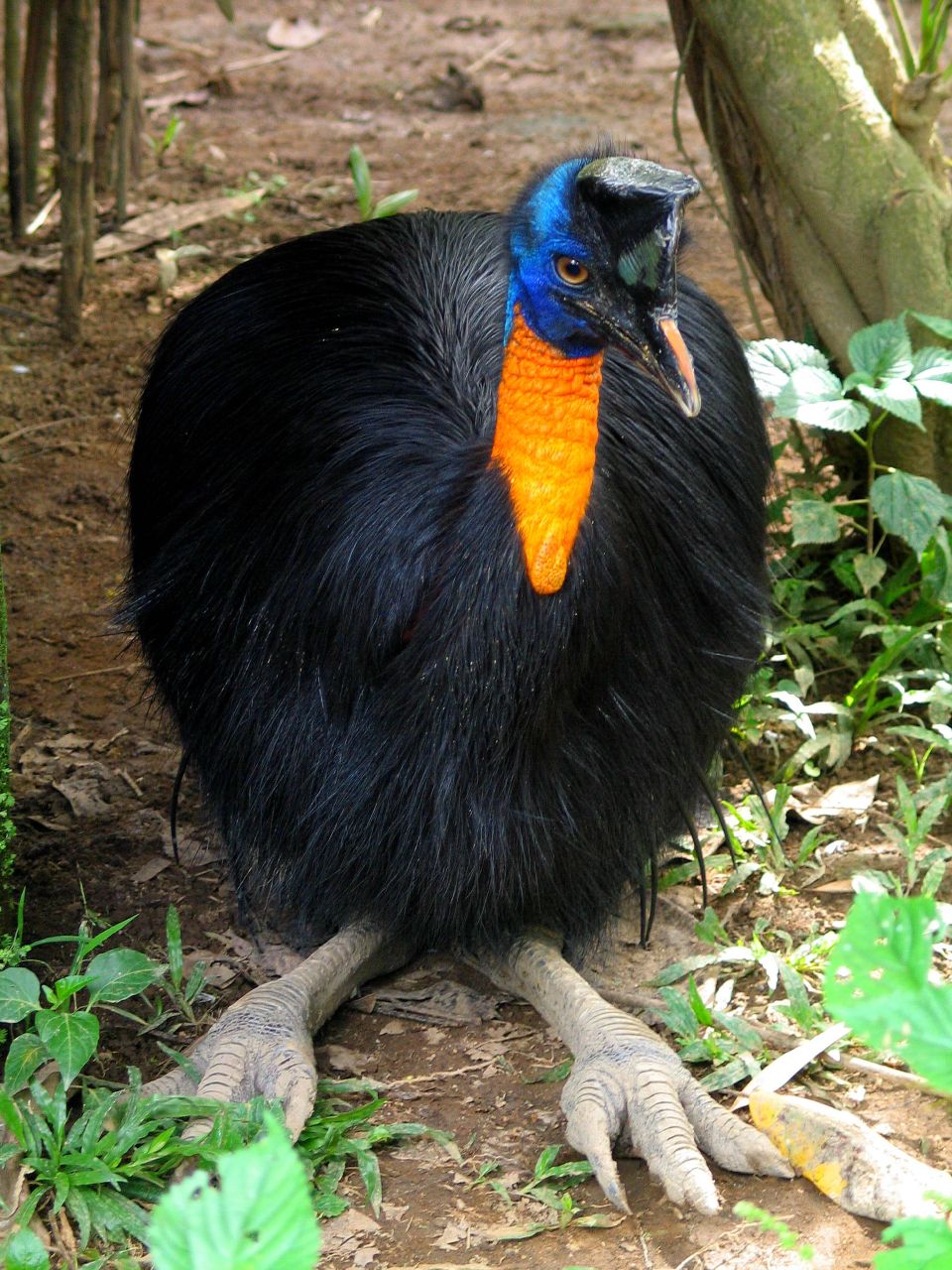
Pygmy Cassowaries are distinguished by their striking blue and black plumage, a characteristic feature of cassowaries. Adults exhibit a sleek, bare neck with vibrant blue skin, which contrasts sharply with their black body feathers. The bird's most iconic feature is its casque, a helmet-like structure on top of its head, which in the Pygmy Cassowary is notably smaller and more rounded than in other cassowary species. Juveniles possess a more muted coloration, with brownish down that gradually transitions to the adult's striking hues. Males and females look similar, though females tend to be slightly larger. Confusion with other cassowaries is possible, but the Pygmy Cassowary's smaller size and specific casque shape help in differentiation. In flight, which is rare for these mostly terrestrial birds, its short, robust posture and strong legs are evident. On perches, it adopts a vigilant stance, ready to react swiftly to disturbances.
Having trouble telling birds apart? Upload a photo to our bird identification tool for an instant species match.
Pygmy Cassowary Habitat and Range
Preferred Habitat
The Pygmy Cassowary inhabits the dense tropical rainforests of New Guinea, favoring lowland rainforest regions and occasionally venturing into montane forests up to elevations of 1,200 meters. These birds prefer areas with high humidity and abundant vegetation, which provide ample food sources and cover from predators. The Pygmy Cassowary is often found near riverbanks and swampy areas where fallen fruits are plentiful. Unlike many birds, it does not frequent urban areas, preferring the seclusion of its native forest habitat. Seasonal shifts in fruit availability may lead to minor changes in habitat preference, but the bird typically remains within forested regions throughout the year.
Geographic Range
The Pygmy Cassowary is endemic to New Guinea, with its range encompassing both Papua New Guinea and the Indonesian province of Papua. Within this range, it inhabits primarily the lowland and montane rainforests, although specific population densities can vary greatly depending on food availability and habitat quality. The bird does not engage in long-distance migration, instead exhibiting localized movements in response to seasonal fruiting patterns. The lack of significant migration corridors further underscores its reliance on the forest environments of New Guinea for survival.
Want to know which birds visit your area? Browse our backyard birds by location guides for region-specific species lists.
What Does the Pygmy Cassowary Eat?
The diet of the Pygmy Cassowary primarily consists of various fruits, which it finds on the forest floor. This frugivorous diet includes figs, berries, and nuts, supplemented by small invertebrates such as insects and snails. During the wet season, when fruit is abundant, the Pygmy Cassowary increases its foraging activity to take advantage of the surplus. It uses its powerful beak to manipulate and consume large fruits, often swallowing them whole. Foraging typically occurs during the early morning and late afternoon when temperatures are cooler. The bird's role as a seed disperser is vital, as it transports seeds away from the parent plant, facilitating forest regeneration.
Pygmy Cassowary Behavior and Social Structure
The Pygmy Cassowary exhibits solitary and territorial behavior, with individuals maintaining defined areas that they actively defend from other cassowaries. Courtship involves complex displays, where males engage in vocalizations and dramatic posturing to attract females. Once a pair bonds, mating occurs, followed by the female laying eggs in a carefully constructed nest. Unlike many birds, the male Pygmy Cassowary assumes the primary role in incubation and chick-rearing, fiercely protecting the eggs and young from predators. Daily activities include foraging, bathing in streams, and resting in shaded areas during the heat of the day. The bird remains vigilant, using its keen hearing and sight to detect potential threats, and will use its powerful legs to deliver swift kicks if threatened.
Pygmy Cassowary Nesting and Reproduction
Pygmy Cassowaries construct nests on the forest floor using leaves, twigs, and grass. These nests are strategically placed in secluded areas to minimize predation risk. The female typically lays two to four eggs per clutch, which are large and pale green. After laying, the female leaves the incubation duties to the male, who diligently attends to the eggs for about 50 days. Upon hatching, the male continues to guard the chicks, which are precocial and quickly learn to forage. Fledging occurs after several months, though juveniles often remain with the male for extended periods. Typically, the Pygmy Cassowary raises one brood per year.
Pygmy Cassowary Sounds and Vocalizations
The Pygmy Cassowary's vocalizations are low-frequency booms that resonate through the dense forest. These calls are used primarily for communication during mating and when establishing territory. The bird's alarm call is a short, sharp hiss, which serves as a warning to intruders or potential predators. Unlike many songbirds, the Pygmy Cassowary does not participate in a dawn chorus, its sounds are more sporadic and context-specific, often compared to the sound of distant drums due to their deep tonal quality.
Interesting Facts About the Pygmy Cassowary
- 1The Pygmy Cassowary's casque is made of keratin, the same material as human fingernails.
- 2Although flightless, the Pygmy Cassowary can run up to 50 km/h to evade predators.
- 3Cassowaries, including the Pygmy, are considered one of the most dangerous birds due to their powerful legs and claws.
- 4The Pygmy Cassowary's diet makes it a vital seed disperser, aiding in rainforest regeneration.
- 5Despite its name, the Pygmy Cassowary can reach heights of up to 1.5 meters, making it taller than many other bird species.
- 6The bird's booming calls can carry over long distances, helping individuals maintain territory boundaries.
- 7Pygmy Cassowaries have three-toed feet, with the inner toe sporting a sharp, dagger-like claw.
Pygmy Cassowary Conservation Status
The Pygmy Cassowary is currently listed as Near Threatened by the IUCN, with populations facing decline primarily due to habitat loss and hunting. Deforestation for agriculture and logging poses the greatest threat, reducing the bird's natural habitat. Conservation efforts focus on habitat protection and anti-poaching initiatives. Historically, the Pygmy Cassowary's range was more widespread, but human encroachment has led to fragmentation. Continued monitoring and community-based conservation programs aim to stabilize and eventually increase population numbers.
Other Casuariidae Species


Birds Similar to the Pygmy Cassowary
These species are often confused with the Pygmy Cassowary due to similar appearance or overlapping range.