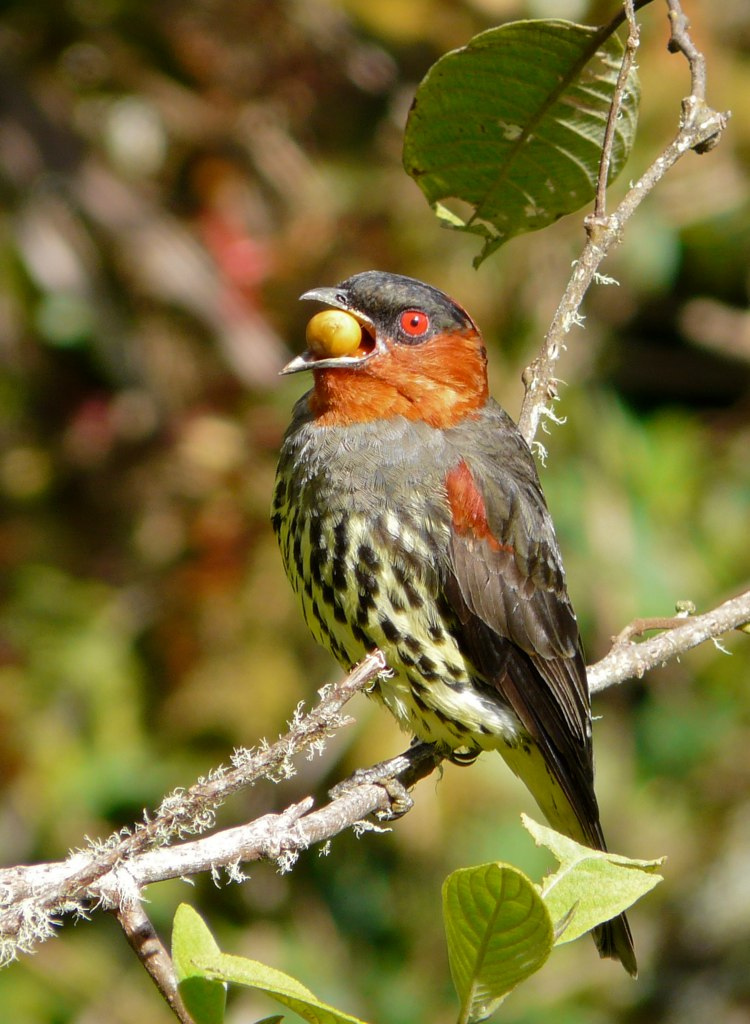
Chestnut-capped Piha
Lipaugus weberi
Order: Passeriformes / Family: Cotingidae

Wikimedia Commons
About the Chestnut-capped Piha
The Chestnut-capped Piha, known scientifically as Lipaugus weberi, is a remarkable bird species endemic to the Colombian Andes, specifically the Central Andes region. This bird is a member of the Cotingidae family and captivates birdwatchers with its distinctive combination of muted gray plumage and a rich chestnut crown. Discovered relatively recently in 2001, the Chestnut-capped Piha has drawn significant attention due to its restricted range and unique ecological niche.
Typically inhabiting montane cloud forests, the Chestnut-capped Piha plays a vital role in its ecosystem. Its feeding habits contribute to seed dispersal, particularly of fruiting plants that thrive in its high-altitude habitat. The piha is often observed at elevations ranging from 1,600 to 2,500 meters, where it finds the dense, humid conditions preferable for both foraging and nesting. The cloud forests of the Central Andes provide a specialized environment that supports this species' survival, offering ample food resources and nesting sites.
Seasonally, the Chestnut-capped Piha engages in breeding activities which are aligned with the rainy seasons, ensuring that food availability is at its peak. Despite its recent discovery, the Chestnut-capped Piha's ecological significance is clear, as it plays a role in maintaining the health and regeneration of its forest habitat. Conservationists have taken particular interest in the piha not only for its beauty and rarity but also for its role in the biodiversity of the Andean cloud forests.
The significance of the Chestnut-capped Piha extends beyond its ecological role, as it also serves as an indicator species. Its presence, or lack thereof, can signify changes in forest health. As cloud forests face mounting threats from deforestation and climate change, protecting such species becomes increasingly crucial. The piha's restricted geographic distribution and specialized habitat requirements highlight the importance of targeted conservation efforts in the Colombian Andes to preserve both the species and its environment.
The Chestnut-capped Piha belongs to the family Cotingidae, within the order Passeriformes. These birds typically live average 5-8 years with a maximum recorded of 10 years..
How to Identify a Chestnut-capped Piha
Adult Chestnut-capped Pihas boast a distinctive plumage that aids in identification. Males and females are similar in appearance, featuring a striking chestnut crown that sharply contrasts with their otherwise gray body. This coloration makes the bird easily recognizable when perched or in flight. The chestnut crown extends from the forehead to the nape, giving the piha its name and offering a unique field mark for birders.
Juvenile Chestnut-capped Pihas resemble adults but may have a slightly duller crown until they reach maturity. While the overall size of the bird classifies it as medium, it has a robust build typical of many cotingas. The piha's silhouette in flight is characterized by broad rounded wings and a short tail, aiding in maneuverability through dense forest canopies.
The Chestnut-capped Piha can be mistaken for other gray cotingas in its range, such as the Andean-cock-of-the-rock. However, its distinct chestnut crown and quieter demeanor help differentiate it from more conspicuous relatives. Observers note that the piha often perches motionless, blending seamlessly with the forest undergrowth until its unique call gives away its position.
Having trouble telling birds apart? Upload a photo to our bird identification tool for an instant species match.
Chestnut-capped Piha Habitat and Range
Preferred Habitat
The Chestnut-capped Piha predominantly inhabits the cloud forests of the Central Andes in Colombia. These montane forests are characterized by high humidity, frequent mist, and dense vegetation, providing an ideal environment for the piha. The elevation range for this species typically spans from 1,600 to 2,500 meters, where it finds both food and shelter.
Within these forests, the piha favors areas with abundant fruiting trees, which support its frugivorous diet. It tends to avoid open areas or disturbed habitats, highlighting its preference for intact forest ecosystems. While it is primarily a forest dweller, some seasonal movements may occur in search of food resources, although these shifts typically stay within montane forest confines.
Unlike some avian species that adapt to urban or suburban environments, the Chestnut-capped Piha remains strictly tied to its natural forest habitat. This specialization makes it particularly vulnerable to habitat loss, emphasizing the need for conservation of these cloud forest areas.
Geographic Range
The Chestnut-capped Piha has a highly restricted range, confined to the Central Andes of Colombia. Specifically, it inhabits the department of Antioquia, where it is found only in a few isolated localities. This limited geographic range makes the species particularly susceptible to habitat destruction and fragmentation.
While the piha does not undergo long migratory movements, it may exhibit some altitudinal movements in response to seasonal changes in food availability. These movements, however, remain within the confines of its montane forest habitat. Due to its restricted range, population density hotspots for the Chestnut-capped Piha align closely with areas of undisturbed montane forest.
The piha's range does not extend beyond Colombia, marking it as a species of significant conservation concern due to its endemic status. Efforts to map its distribution focus on identifying and preserving these critical forest areas where the bird is most frequently observed.
Want to know which birds visit your area? Browse our backyard birds by location guides for region-specific species lists.
What Does the Chestnut-capped Piha Eat?
The Chestnut-capped Piha's diet primarily consists of fruits, making it an essential frugivore within its ecosystem. This dietary preference emphasizes the bird's role in seed dispersal, aiding in forest regeneration. Common fruit sources include various berries and small fruits found within the cloud forests.
Seasonally, the piha may alter its diet slightly to include insects, particularly during the breeding season when protein demands increase. This opportunistic feeding strategy allows it to adapt to varying food availability within its habitat. Typical prey size for insects ranges from small beetles to caterpillars, which it gleans from foliage and branches.
Foraging behavior of the Chestnut-capped Piha involves both solitary and small group activities. It often feeds at mid-canopy levels, using its agile flight and strong legs to navigate the dense forest. Feeding takes place primarily during the day, with peak activity observed in the early morning and late afternoon when fruiting trees are most abundant.
Chestnut-capped Piha Behavior and Social Structure
The Chestnut-capped Piha exhibits intriguing social and territorial behaviors. It is generally a solitary bird but may form loose associations with others during feeding or when fruiting trees are plentiful. Territories are established and defended primarily through vocalizations, with males emitting distinctive calls to ward off rivals and attract potential mates.
Courtship displays for the piha are subtle, relying more on vocal prowess than visual displays. Males sing from prominent perches to advertise their presence. These vocal performances can be crucial during the breeding season, acting as an indicator of fitness to females.
In terms of daily activity, the Chestnut-capped Piha maintains a predictable schedule. It is most active at dawn and dusk, times that align with peak feeding periods. While generally calm, it can become vocal and animated in response to intruders or predators, using a series of alarm calls to alert others.
Flocking behavior is uncommon, as the piha prefers solitary or paired life. However, during times of abundant food resources, it may tolerate the presence of conspecifics or other frugivorous birds. Its response to predators involves both vocal alarms and discreet retreat into denser forest cover.
Chestnut-capped Piha Nesting and Reproduction
The Chestnut-capped Piha's nesting habits align closely with its habitat preferences, favoring secluded, well-covered locations in montane cloud forests. Nests are typically constructed with a combination of twigs, moss, and leaves, forming a sturdy, cup-shaped structure. They are often situated on horizontal branches away from tree trunks to avoid predators.
Clutch size for the piha ranges from one to three eggs, with two being most common. Eggs are incubated for approximately 17 to 20 days, predominantly by the female, although males may assist in some cases. The fledging period lasts about 20 days, during which both parents participate in feeding and protecting the young.
The piha usually raises one brood per year, though this can vary based on environmental conditions and food availability. Parental roles are well defined, with both sexes contributing to feeding and care post-hatching. Successful nesting requires a territory with sufficient food resources and protection from environmental disturbances.
Chestnut-capped Piha Sounds and Vocalizations
The Chestnut-capped Piha's song is a simple yet distinctive series of notes, characterized by a rhythmic, repetitive call that resonates through its montane habitat. Often described as a series of soft whistles, the song serves as both a territorial marker and a mating call.
In addition to its primary song, the piha produces a variety of calls including chirps and low-pitched notes used in communication with mates or signaling alarm. These calls, while not as melodic as the song, are integral to its social interactions.
During the dawn chorus, the Chestnut-capped Piha's voice blends with the ambient sounds of the forest, creating a symphonic backdrop to the early morning hours. Its vocalizations, while not as complex as some other species, are distinct enough to serve as a reliable identification feature for birders.
Interesting Facts About the Chestnut-capped Piha
- 1The Chestnut-capped Piha was only discovered in 2001, making it a relatively new species to science.
- 2This piha's chestnut crown is a unique feature among its close relatives in the cotinga family.
- 3The species is so specialized that it only inhabits a few specific locations in the Colombian Andes.
- 4Despite its loud calls, the piha remains elusive due to its preference for dense, high-altitude forests.
- 5The piha's role as a seed disperser is critical for maintaining the health of montane cloud forests.
- 6Efforts to study the piha have led to increased awareness of the biodiversity within the Colombian Andes.
- 7The Chestnut-capped Piha's discovery has highlighted the importance of preserving lesser-known habitats.
Chestnut-capped Piha Conservation Status
Currently, the Chestnut-capped Piha holds an IUCN status of Endangered, reflecting its limited range and ongoing threats to its habitat. Primary threats include deforestation for agriculture, logging, and human settlement expansion, all of which have resulted in significant habitat fragmentation. Population trends for the piha indicate a decline, largely due to these anthropogenic pressures. Conservation efforts focus on habitat preservation and restoration, with particular emphasis on protecting the montane cloud forests of Colombia. Establishing protected areas and promoting sustainable land-use practices are crucial steps in ensuring the survival of this species. Historically, the piha's population faced fewer threats, but as human activities have encroached upon its habitat, the need for effective conservation measures has become increasingly urgent. Organizations working in the region prioritize both the protection of natural habitats and the study of the piha's ecology to inform conservation strategies.