Chestnut-crowned Laughingthrush
Trochalopteron erythrocephalum
Order: Passeriformes / Family: Leiothrichidae

Wikimedia Commons
About the Chestnut-crowned Laughingthrush
The Chestnut-crowned Laughingthrush, Trochalopteron erythrocephalum, is a captivating songbird native to the lush, mountainous regions of South and Southeast Asia. This species thrives primarily in the subtropical and tropical montane forests that stretch across countries like India, Bhutan, Nepal, and Myanmar. Its presence is particularly notable in the eastern Himalayas, where it inhabits dense undergrowth and bamboo thickets. The bird's role in its ecosystem is significant, as it aids in seed dispersal and insect population control, contributing to the ecological balance in these biodiverse regions. Throughout the year, the Chestnut-crowned Laughingthrush exhibits various seasonal behaviors, such as forming large flocks during the non-breeding season to forage more efficiently. These flocks often consist of mixed species, showcasing the bird's adaptability and social nature. In the breeding season, typically from March to July, the laughingthrush becomes more territorial and reclusive, as pairs establish breeding territories and engage in elaborate courtship displays. The call of the Chestnut-crowned Laughingthrush is unmistakable, with a series of melodious notes that resemble human laughter, earning its name. This vocalization not only plays a crucial role in mate attraction and territory defense but also enhances social bonds within flocks. The bird's ecological role extends beyond its immediate environment as it serves as an indicator species for the health of its habitat. Conservationists monitor populations of the Chestnut-crowned Laughingthrush to assess the impact of habitat degradation and climate change on these montane ecosystems. The bird's preference for dense foliage and bamboo undergrowth makes forest preservation essential for its continued survival. In recent years, deforestation and habitat fragmentation have posed significant threats to its population, prompting increased conservation efforts to protect these regions. The Chestnut-crowned Laughingthrush exemplifies the intricate connections between avian life and habitat health, highlighting the importance of maintaining the integrity of montane forests.
The Chestnut-crowned Laughingthrush belongs to the family Leiothrichidae, within the order Passeriformes. These birds typically live averages 6-8 years, with some individuals living up to 12 years..
How to Identify a Chestnut-crowned Laughingthrush
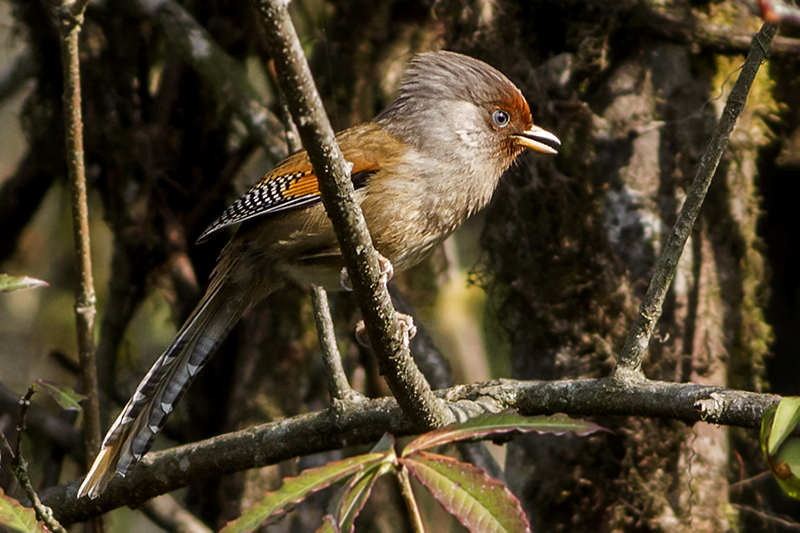
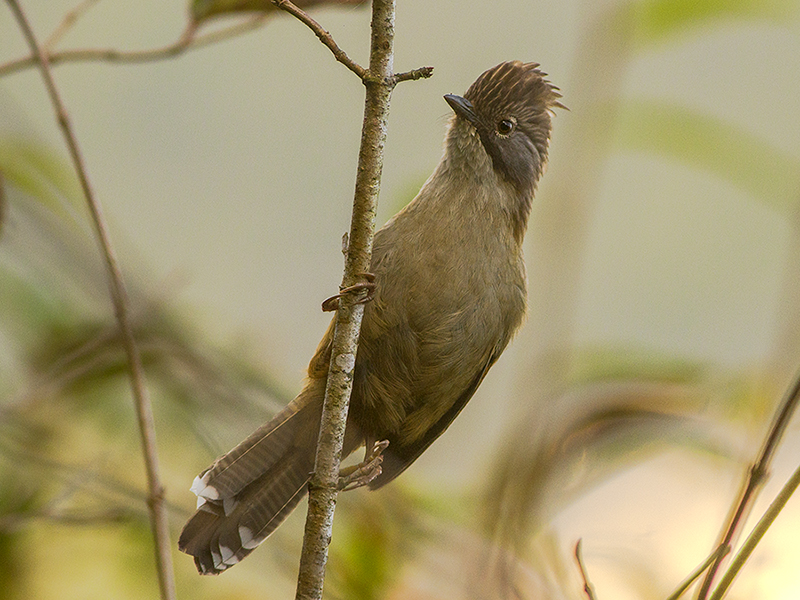
The Chestnut-crowned Laughingthrush is easily identifiable due to its distinctive chestnut-colored crown, which is its most prominent feature. The rest of its plumage consists of olive-brown upperparts and paler underparts, with a subtle mottling that enhances its camouflage in forested habitats. Adult birds have a conspicuous white eye-ring, which contrasts sharply with their dark eyes and enhances their alert expression. Males and females are similar in appearance, making sex determination in the field challenging without behavioral cues. Juveniles, however, display duller plumage, with a less pronounced chestnut crown and a more muted overall coloration. These differences become less noticeable as they mature. In flight, the Chestnut-crowned Laughingthrush shows a rounded silhouette, with short wings and a long, broad tail that fans out during flight. Its flight is typically short and low, as the bird prefers to stay within the protection of dense foliage. When perched, it assumes a characteristic upright posture, often flicking its tail and wings to maintain balance. While the Chestnut-crowned Laughingthrush's plumage is distinctive, it can be confused with other laughingthrush species in its range, such as the Streaked Laughingthrush. However, the latter lacks the bright chestnut crown and has a more streaked appearance overall.
Having trouble telling birds apart? Upload a photo to our bird identification tool for an instant species match.
Chestnut-crowned Laughingthrush Habitat and Range
Preferred Habitat
The Chestnut-crowned Laughingthrush is predominantly found in subtropical and tropical montane forests. It thrives at elevations ranging from 1,200 to 3,500 meters, where the climate is cooler and the vegetation dense. These habitats are typically characterized by a mix of broadleaf evergreen trees and bamboo thickets, providing ample cover and foraging opportunities. The bird is less common in lowland areas, preferring the complexity of montane ecosystems. During winter, some populations may descend to slightly lower elevations in search of food, but the species generally maintains a consistent elevation range throughout the year. While primarily a forest dweller, the Chestnut-crowned Laughingthrush can occasionally be found in forest edges and clearings, especially when searching for insects and other food resources. It is not typically found in urban environments, as it relies heavily on the undisturbed forest floor and dense undergrowth. The loss of its preferred habitat due to deforestation poses a significant threat, making the conservation of montane forests crucial for its survival.
Geographic Range
The Chestnut-crowned Laughingthrush occupies a broad geographic range across parts of South and Southeast Asia. It breeds primarily in the eastern Himalayas, covering regions in India, Nepal, Bhutan, and extending into northern Myanmar. Within India, it is particularly prevalent in the states of Arunachal Pradesh, Sikkim, and parts of West Bengal. The species does not typically undertake long-distance migrations, but some altitudinal movements occur, especially in response to seasonal food availability. During the winter months, certain populations may move to lower elevations, though they generally remain within the montane regions. The density of the Chestnut-crowned Laughingthrush is higher in undisturbed habitats where dense vegetation supports its foraging and nesting requirements. These areas, often remote and less accessible, allow for more stable populations. While the bird's range is extensive, it remains localized to suitable high-elevation forested habitats, and its presence serves as an indicator of ecosystem health in these regions.
Want to know which birds visit your area? Browse our backyard birds by location guides for region-specific species lists.
What Does the Chestnut-crowned Laughingthrush Eat?
The Chestnut-crowned Laughingthrush primarily feeds on insects and other small invertebrates, playing a vital role in controlling insect populations within its habitat. Its diet includes beetles, caterpillars, spiders, and other arthropods, which it forages from the forest floor and low vegetation. During the breeding season, the bird's diet may shift to include more protein-rich food sources to support the nutritional needs of chicks. The laughingthrush employs a variety of foraging techniques, often seen flipping over leaves and probing into crevices to uncover hidden prey. Its strong, slightly curved bill aids in these activities, allowing it to capture and manipulate food effectively. In addition to insects, the Chestnut-crowned Laughingthrush consumes fruit, seeds, and berries, particularly during periods when insect abundance is lower. This dietary flexibility enables the bird to adapt to seasonal changes in food availability. It forages in small groups, which can include mixed-species flocks, enhancing its ability to find food while reducing individual predation risk. Feeding occurs primarily during the morning and late afternoon, with periods of rest and preening in between.
Chestnut-crowned Laughingthrush Behavior and Social Structure
The Chestnut-crowned Laughingthrush is a highly social bird, often observed in pairs or small groups, especially outside the breeding season. These groups can form mixed-species flocks, which provide safety in numbers and improve foraging success. Within these flocks, individuals communicate through a range of vocalizations, including their characteristic laughing calls. The bird exhibits strong territorial behavior during the breeding season, with pairs defending their chosen nesting sites against intruders. Territorial disputes are often resolved through vocal displays and, occasionally, physical confrontations. Courtship involves elaborate displays from both sexes, including synchronized movements and vocal duets that strengthen pair bonds. The Chestnut-crowned Laughingthrush is diurnal, with peak activity occurring during the early morning and late afternoon. It spends considerable time foraging on or near the ground, using its strong legs and bill to search for food. In response to predators, the bird relies on its cryptic plumage and agile movements to avoid detection, often retreating into dense vegetation. Alarm calls are used to alert other flock members of potential threats, demonstrating their cooperative social structure.
Chestnut-crowned Laughingthrush Nesting and Reproduction
The Chestnut-crowned Laughingthrush constructs its nest in dense shrubs or low trees, typically at heights ranging from 1 to 3 meters above the ground. The nest is a cup-shaped structure, intricately woven from twigs, roots, and leaves, and lined with softer materials such as moss and feathers to provide insulation for the eggs. The breeding season spans from March to July, depending on the region and local climate conditions. Clutch size usually consists of 2 to 4 eggs, which are pale blue with reddish-brown speckles. Both parents share the responsibilities of incubating the eggs and feeding the chicks, exhibiting strong parental cooperation. The incubation period lasts approximately 14 to 16 days, after which the chicks hatch and remain in the nest for about two weeks before fledging. During this time, the parents tirelessly forage to meet the nutritional needs of their growing offspring. The Chestnut-crowned Laughingthrush typically raises one brood per year, although in favorable conditions, a second brood may be attempted.
Chestnut-crowned Laughingthrush Sounds and Vocalizations
The vocalizations of the Chestnut-crowned Laughingthrush are both distinctive and varied, playing an integral role in its social interactions. Its primary song consists of a series of melodious, flute-like notes that cascade in a rhythmic pattern, often compared to human laughter. This song is used for mate attraction and territory defense, resonating through the dense forest undergrowth. In addition to its song, the bird produces a range of call notes, including soft whistles and harsh chattering, which facilitate communication within flocks. Alarm calls are sharp and abrupt, designed to alert group members of nearby predators or threats. During the early morning, the Chestnut-crowned Laughingthrush participates in the dawn chorus, a communal vocal display that reinforces social bonds and establishes group presence within their habitat. Its vocal repertoire, though complex, is consistent with the species' social and territorial nature, making it an audible presence in its montane home.
Interesting Facts About the Chestnut-crowned Laughingthrush
- 1The Chestnut-crowned Laughingthrush's call has been likened to that of a human's laughter, a trait that inspired its common name.
- 2This bird's habitat in the eastern Himalayas includes some of the world's tallest and most biodiverse mountain ranges.
- 3While predominantly insectivorous, the Chestnut-crowned Laughingthrush adapts its diet to include fruits and seeds during lean periods.
- 4The species can form flocks with other laughingthrushes, showcasing its social flexibility and cooperative foraging strategies.
- 5Nests are often located in dense bamboo thickets, providing concealment from predators and harsh weather conditions.
- 6The Chestnut-crowned Laughingthrush plays a crucial role in seed dispersal, contributing to the regeneration of its forest habitat.
- 7Despite its vocal prowess, the bird relies heavily on its cryptic plumage for camouflage against predators in dense undergrowth.
Chestnut-crowned Laughingthrush Conservation Status
The Chestnut-crowned Laughingthrush is currently classified as Least Concern by the IUCN, reflecting a stable population trend across its range. However, the bird faces several threats, primarily due to habitat loss from deforestation and land conversion for agriculture. These activities reduce the availability of suitable nesting and foraging habitats, posing a long-term risk to population stability. Conservation efforts focus on protecting montane forest habitats and implementing sustainable land-use practices to mitigate these impacts. In some regions, community-based conservation initiatives have successfully raised awareness about the importance of preserving forest ecosystems for species like the Chestnut-crowned Laughingthrush. Despite its current status, ongoing monitoring is essential to detect early signs of population decline and implement timely conservation measures. Historically, the species has shown resilience to environmental changes, but continued vigilance is necessary to ensure its survival in an increasingly altered landscape.