Crested Becard
Pachyramphus validus
Order: Passeriformes / Family: Cotingidae

Wikimedia Commons
About the Crested Becard
The Crested Becard, Pachyramphus validus, is a captivating member of the Cotingidae family, recognized for its robust presence across various forested regions of South America. Primarily found from southeastern Brazil to northern Argentina and eastern Paraguay, this bird thrives in subtropical and tropical forests. The Crested Becard holds ecological significance as both a predator of insects and a disperser of seeds, contributing to the health and diversity of its ecosystem. Observers often find it in the canopy and mid-story layers, indicating its adaptability and resourcefulness in exploiting available niches. Seasonal behaviors of the Crested Becard include a heightened vocal activity during the breeding season, usually from September to December, coinciding with the austral spring and summer. This time marks an increase in available food sources, facilitating the provisioning for offspring. Throughout the year, the Crested Becard's presence in mixed-species flocks highlights its social nature and offers protection from predators through collective vigilance. As a species adapting to different environments, the Crested Becard's role extends beyond the confines of dense woodlands into more fragmented landscapes, often seen in secondary growth and even plantations, reflecting its resilience and versatility. Such adaptability is crucial as it faces habitat alterations and climatic changes. The Crested Becard's ecological role is underscored by its feeding habits, which involve capturing a variety of insects and occasionally consuming fruit, thus participating in seed dispersal. This dual role enhances plant propagation and helps maintain insect population balance. The species' presence in areas like the Atlantic Forest, one of the world's biodiversity hotspots, further emphasizes its contribution to regional ecological stability. Conservation efforts in these regions often consider the Crested Becard's habitat preferences, aiming to preserve its natural environment while ensuring ecological integrity and diversity.
The Crested Becard belongs to the family Cotingidae, within the order Passeriformes. These birds typically live typically 5-8 years, with individuals occasionally living up to 10 years..
How to Identify a Crested Becard
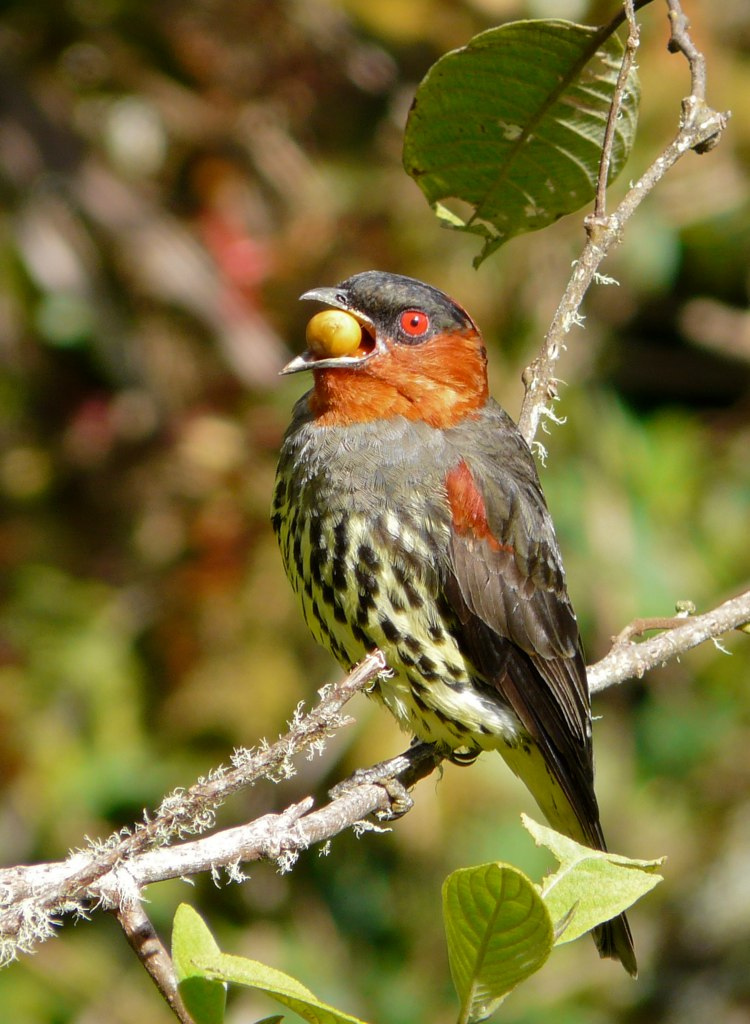
The Crested Becard is a medium-sized songbird, easily identified by its prominent crest. Adults display a unique combination of plumage colors: males typically have a blackish crown and upperparts with a contrasting white throat and underparts. Females, on the other hand, exhibit a more subdued appearance, with browner tones replacing the black of the males and a less defined crest. Juveniles resemble females but are even duller, lacking the full development of the crest feature. This sexual dimorphism aids in distinguishing between the sexes, especially during field observations. The Crested Becard can be confused with the similar-looking White-winged Becard, but the latter's distinguishing white wing patches and paler underparts provide reliable points of differentiation. In flight, the Crested Becard presents a compact silhouette with a relatively short tail and rounded wings, typical of its family. When perched, it often assumes an upright posture, showcasing its crest prominently. This posture, combined with its coloration, serves as key identification features in dense foliage.
Having trouble telling birds apart? Upload a photo to our bird identification tool for an instant species match.
Crested Becard Habitat and Range
Preferred Habitat
The Crested Becard inhabits a range of forest types, including subtropical evergreen forests, gallery forests, and wooded savannas. It is commonly found in the Atlantic Forest region, extending into secondary growth and edges where human activity has led to vegetation fragmentation. This adaptability enables it to thrive in elevations from sea level up to around 1,500 meters. While primarily a forest dweller, the Crested Becard shows tolerance for human-altered environments, occasionally venturing into plantations and urban parks with adequate tree cover. Seasonal habitat shifts are minimal, as the Crested Becard remains relatively sedentary, though it may move locally in response to food availability and breeding needs.
Geographic Range
The Crested Becard's range spans southeastern Brazil, eastern Paraguay, and northern Argentina, particularly thriving in regions like the Atlantic Forest. It is a non-migratory resident, with its distribution closely tied to the availability of suitable forest habitats. These areas, rich in biodiversity, provide the necessary resources for the Crested Becard's survival and reproduction. Population density hotspots include the well-preserved forest patches within São Paulo and Paraná states in Brazil. While the species does not undertake long migrations, it may exhibit short-range movements within its range to exploit seasonal abundance of food. The stability of its range highlights the importance of conserving its natural habitats, particularly in light of ongoing deforestation pressures.
Want to know which birds visit your area? Browse our backyard birds by location guides for region-specific species lists.
What Does the Crested Becard Eat?
The Crested Becard primarily feeds on insects, including beetles, caterpillars, and orthopterans, capturing them through an agile foraging strategy that involves sallying forth from perches. This method allows it to exploit the mid-canopy where insect abundance is high. Additionally, the Crested Becard supplements its diet with fruit, particularly during the breeding season when energy demands increase. It shows a preference for small berries and figs, which it plucks directly from trees. Seasonal variations in diet are notable, with insects forming the core diet during warmer months, while fruits become more prominent as they mature. The Crested Becard's feeding schedule aligns with peak insect activity, often early in the morning and late afternoon, ensuring optimal foraging efficiency.
Crested Becard Behavior and Social Structure
The Crested Becard exhibits a variety of intriguing behaviors, characterized by its social structure and territorial dynamics. Typically found alone or in pairs during the breeding season, it becomes more social in the non-breeding months, often joining mixed-species flocks. This behavior not only provides safety in numbers but also enhances foraging success. Territoriality is pronounced during the breeding season, with pairs actively defending their nesting sites through vocalizations and displays. Courtship involves males performing an elaborate series of calls and postures to attract females. In response to predators, the Crested Becard employs a combination of mobbing and alarm calls to deter threats. Its daily activity pattern includes periods of intense foraging interspersed with rest and preening, maintaining its plumage in optimal condition for both insulation and flight. The Crested Becard's adaptability in social and territorial interactions underscores its resilience in a changing environment.
Crested Becard Nesting and Reproduction
The Crested Becard constructs an elaborate, globe-shaped nest made of woven plant fibers, lichen, and moss, often suspended from the fork of a tree branch. This strategic placement minimizes predation risk while providing adequate shelter from the elements. Preferred nesting sites are typically located 5 to 20 meters above ground, within the mid-canopy. The female lays a clutch of two to three eggs, which she incubates for approximately 16 to 18 days. Males assist in feeding the fledglings, which leave the nest about two weeks after hatching. Parental roles are well-defined, with both sexes contributing to nest building, brooding, and feeding. The Crested Becard usually raises one brood per year, although favorable conditions may occasionally allow for a second.
Crested Becard Sounds and Vocalizations
The Crested Becard's primary song is a series of melodious whistles and trills, often repeated in quick succession. This song, with its rhythmic cadence and moderate pitch, serves both in mate attraction and territorial defense. Call notes are short, sharp, and less musical, used primarily for communication between mates and within flocks. Alarm calls are more strident and harsh, signaling the presence of predators. During the dawn chorus, the Crested Becard's song can be heard prominently, adding to the symphony of forest sounds. Its vocalizations, though less varied than some songbirds, are distinctive enough to aid in identification during field observations.
Interesting Facts About the Crested Becard
- 1The Crested Becard's nest resembles a hanging ball, ingeniously constructed to deter predators and withstand weather.
- 2Unlike many birds, the Crested Becard shows a remarkable ability to adapt to both primary and secondary forests.
- 3During courtship, the male Crested Becard often performs a series of acrobatic flights to impress a potential mate.
- 4In mixed-species flocks, the Crested Becard plays a role as both a sentinel and a forager, enhancing group dynamics.
- 5The Crested Becard's diet consists of about 70% insects and 30% fruits, illustrating its opportunistic feeding habits.
- 6Despite its striking appearance, the Crested Becard often goes unnoticed due to its habit of remaining still in dense foliage.
- 7This species' presence in the Atlantic Forest highlights the importance of this region as a biodiversity hotspot.
Crested Becard Conservation Status
The Crested Becard is currently listed as Least Concern by the IUCN, with its population considered stable across its range. However, habitat loss due to deforestation and urbanization poses a significant threat, particularly in the Atlantic Forest where much of its original habitat has been altered. Conservation efforts focus on protecting and restoring these vital forest habitats, with initiatives in Brazil and Argentina aiming to preserve biodiversity hotspots. Historically, the Crested Becard has shown a capacity to adapt to some degree of habitat disturbance, although continued habitat degradation could impact its long-term survival. Conservationists emphasize the importance of sustainable land use practices to mitigate these threats.