
Dwarf Tyrant-Manakin
Tyranneutes stolzmanni
Order: Passeriformes / Family: Pipridae

Wikimedia Commons
About the Dwarf Tyrant-Manakin
The Dwarf Tyrant-Manakin, scientifically known as Tyranneutes stolzmanni, is a fascinating member of the Pipridae family, notable for its small size and vibrant presence in the understory of tropical forests. Found predominantly in the Amazon Basin, this bird thrives in regions such as eastern Ecuador, northern Peru, and parts of Colombia. The species plays a crucial role in the ecosystem as both a seed disperser and an insect predator, contributing to the balance of its habitat. Despite their small stature, Dwarf Tyrant-Manakins exhibit remarkable adaptability, navigating the dense foliage with agility as they forage for food.
In terms of ecological significance, the Dwarf Tyrant-Manakin is an integral part of its environment. By consuming a variety of fruits and small insects, it aids in controlling insect populations and supports the propagation of fruit-bearing plants through seed dispersal. This mutualistic relationship underscores the bird's importance within its ecosystem. The Dwarf Tyrant-Manakin is often observed engaging in mixed-species flocks, collaborating with other small birds to enhance foraging efficiency and predator awareness. The seasonal behaviors of this species remain relatively stable, with little evidence of long-distance migration, although slight altitudinal movements may occur in response to food availability.
The Dwarf Tyrant-Manakin's significance extends to its role as an indicator species for the health of tropical forests. Due to its reliance on pristine forest environments, changes in its population can reflect broader environmental shifts, particularly those related to deforestation and habitat fragmentation. The bird's presence or absence in a given area can offer insights into the ecological integrity of the region, making it a valuable subject for conservation studies. During the breeding season, from November to February, males perform unique courtship displays to attract females, showcasing their agility and vocal prowess. This period also sees heightened activity as the birds establish territories and engage in nesting behaviors.
The Dwarf Tyrant-Manakin belongs to the family Pipridae, within the order Passeriformes. These birds typically live approximately 5 years on average, with some individuals living up to 8 years..
How to Identify a Dwarf Tyrant-Manakin
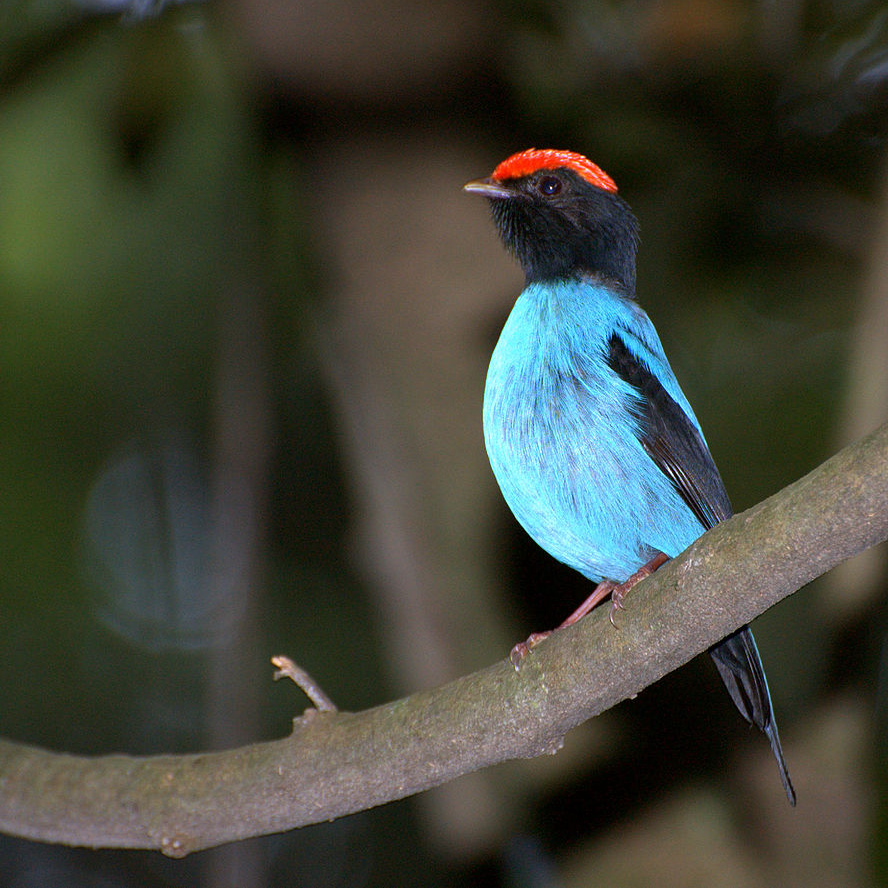
Identifying the Dwarf Tyrant-Manakin requires attention to its subtle but distinctive features. Adult males and females are similar in size, measuring approximately 9-10 cm in length, but exhibit slight differences in plumage. Males possess a more vibrant olive-green coloration on their upperparts with a duller yellowish underbelly, while females are generally more uniform in their greenish hues. Both sexes have short tails and relatively large heads, which are typical characteristics of manakins.
Juvenile Dwarf Tyrant-Manakins can be tricky to distinguish from adults due to their similar plumage, though they often appear slightly duller and may have some flecking on their underparts. The species' small size can lead to confusion with other small forest birds, but careful observation of their behavior and habitat preferences can aid in accurate identification. In comparison to other manakins, the Dwarf Tyrant-Manakin lacks the vivid coloration that some of its relatives display, making its subtle hues and size key identifiers.
In flight, the Dwarf Tyrant-Manakin presents a compact silhouette, with rapid, fluttering wingbeats that allow it to maneuver through dense foliage effectively. When perching, this bird typically holds a slight crouch, remaining alert and poised for quick movements. Its understated plumage and distinctive calls provide reliable cues for identification amidst the cacophony of tropical forest sounds.
Having trouble telling birds apart? Upload a photo to our bird identification tool for an instant species match.
Dwarf Tyrant-Manakin Habitat and Range
Preferred Habitat
The Dwarf Tyrant-Manakin inhabits the humid, lowland tropical forests of the Amazon Basin. Preferring the dense understory, it thrives in regions with abundant foliage and ample food resources. This bird is commonly found at elevations ranging from sea level up to about 1,000 meters, although it tends to avoid higher altitudes where conditions become less favorable.
Throughout the year, the Dwarf Tyrant-Manakin remains closely tied to its preferred habitat, exhibiting minimal seasonal shifts. It is rarely found in urban or heavily disturbed areas, as it requires the complex structure of undisturbed forest environments to support its foraging and nesting needs. While the bird is not typically found in open areas or savannas, it can occasionally be spotted in secondary forests as long as sufficient understory vegetation is present.
The presence of the Dwarf Tyrant-Manakin in a particular area often indicates a healthy, thriving ecosystem, as this species relies on the intricate web of forest life to sustain its population. Conservation efforts to protect these habitats are vital, as any loss or degradation directly threatens the species' survival.
Geographic Range
The range of the Dwarf Tyrant-Manakin spans several countries within the Amazon Basin. It is commonly found in eastern Ecuador, northern Peru, southern Colombia, and western Brazil. Throughout this distribution, the bird maintains a year-round presence, as it is not known to undertake long-distance migrations like some other tropical bird species.
In terms of population density, the species tends to be more abundant in areas with dense forest cover and high biodiversity. Regions such as the Yasuni National Park in Ecuador and the Loreto region of Peru are notable for supporting healthy populations of the Dwarf Tyrant-Manakin.
While the bird's range is relatively stable, its dependence on pristine forest environments makes it vulnerable to habitat loss and fragmentation. Deforestation in the Amazon Basin poses a significant threat to the species, potentially leading to localized population declines. Conservation initiatives aimed at preserving forest habitats are critical for maintaining the Dwarf Tyrant-Manakin's range and ensuring its continued presence across its native regions.
Want to know which birds visit your area? Browse our backyard birds by location guides for region-specific species lists.
What Does the Dwarf Tyrant-Manakin Eat?
The Dwarf Tyrant-Manakin's diet consists primarily of small fruits and insects, reflecting its role as both a frugivore and insectivore. The bird's foraging habits are adapted to the dense understory of tropical forests, where it skillfully picks off ripe fruits and captures insects in midair with remarkable agility.
Seasonal variations in the availability of food sources influence the Dwarf Tyrant-Manakin's diet. During periods of fruit abundance, it focuses on consuming a variety of berries and small fruits, aiding in seed dispersal for many plant species. In contrast, when insect populations flourish, the bird shifts its diet to include a higher proportion of arthropods, such as flies, beetles, and spiders.
Foraging typically occurs during the early morning and late afternoon, when temperatures are more moderate and insect activity is heightened. The Dwarf Tyrant-Manakin often participates in mixed-species flocks while foraging, which not only increases foraging efficiency but also provides safety in numbers against potential predators. This cooperative behavior is a testament to the bird's adaptability and social nature within its habitat.
Dwarf Tyrant-Manakin Behavior and Social Structure
The Dwarf Tyrant-Manakin exhibits a range of behaviors that highlight its adaptability and social nature. It often forms small, loose flocks with other bird species, enhancing its ability to detect predators and locate food resources. This bird is typically more active during the cooler parts of the day, engaging in foraging and social interactions primarily in the early morning and late afternoon.
Territorial behavior is particularly evident during the breeding season, when males establish and defend small territories to attract females. The courtship displays of the Dwarf Tyrant-Manakin are a spectacle to observe, with males performing acrobatic flights and vocalizations to woo potential mates. These displays are crucial for pair formation and mating success, as females select mates based on the vigor and skill of their performances.
In response to predators, the Dwarf Tyrant-Manakin relies on its agility and alertness. When threatened, it seeks cover in the dense foliage, using its small size and cryptic coloration to remain undetected. The bird's vocalizations also play a role in predator deterrence, with alarm calls alerting other members of the flock to potential danger. Overall, the Dwarf Tyrant-Manakin's behaviors reflect its ability to thrive in the dynamic and often challenging environment of the tropical forest.
Dwarf Tyrant-Manakin Nesting and Reproduction
The nesting habits of the Dwarf Tyrant-Manakin involve constructing small, cup-shaped nests in the understory of dense forests. These nests are typically woven with fine plant fibers, leaves, and spider silk, providing a secure and camouflaged structure for raising young. Nests are usually placed on horizontal branches or within forked twigs, allowing easy access while maintaining concealment.
The breeding season spans from November to February, during which time females lay a clutch of two eggs. The incubation period lasts approximately 16 to 18 days, with the female primarily responsible for incubating the eggs while the male defends the territory and provides food.
Once hatched, the chicks remain in the nest for about two weeks, during which both parents participate in feeding and caring for them. Parental roles are well-defined, with each parent taking turns foraging and guarding the nest. The Dwarf Tyrant-Manakin typically raises one brood per year, although successful breeding conditions can occasionally result in a second clutch. Nest predation remains a significant threat, necessitating vigilance and protective behaviors from both parents throughout the nesting period.
Dwarf Tyrant-Manakin Sounds and Vocalizations
The vocalizations of the Dwarf Tyrant-Manakin are a key aspect of its behavior, characterized by clear, whistling notes that carry through the dense forest understory. The primary song consists of a series of high-pitched whistles, repeated at regular intervals, creating a rhythmic and melodic sequence that serves both territorial and mate attraction purposes.
In addition to its primary song, the Dwarf Tyrant-Manakin emits various call notes, including brief chirps and trills, which facilitate communication among flock members and signal alarm when predators are nearby. The bird's vocal repertoire also includes a distinctive dawn chorus, where multiple individuals engage in synchronized singing to establish presence and dominance within the territory.
The quality of the Dwarf Tyrant-Manakin's calls is often compared to the sound of a fine whistle or a small flute, with a clear, resonant tone that stands out amidst the background noise of the forest. These vocalizations are not only a defining characteristic of the species but also a critical tool for survival in its complex habitat.
Interesting Facts About the Dwarf Tyrant-Manakin
- 1The Dwarf Tyrant-Manakin, despite its small size, can produce vocalizations that travel up to 150 meters through dense forest.
- 2Unlike many manakin species, the Dwarf Tyrant-Manakin does not display elaborate plumage, relying instead on its vocal and acrobatic displays.
- 3The species' scientific name, Tyranneutes stolzmanni, honors Polish ornithologist Jan Sztolcman, who contributed significantly to tropical bird studies.
- 4Dwarf Tyrant-Manakins often partake in mixed-species foraging flocks, enhancing their ability to find food and avoid predators.
- 5This bird's courtship display involves rapid wing beats and unique whistling calls, captivating potential mates with its energetic performance.
- 6The Dwarf Tyrant-Manakin serves as a seed disperser, playing a crucial role in the regeneration of tropical forest ecosystems.
- 7Though primarily a forest dweller, the Dwarf Tyrant-Manakin occasionally adapts to secondary forests, demonstrating its ecological flexibility.
Dwarf Tyrant-Manakin Conservation Status
The Dwarf Tyrant-Manakin is currently listed as Least Concern by the IUCN, indicating a relatively stable population across its range. However, ongoing deforestation and habitat fragmentation in the Amazon Basin pose significant threats to its long-term survival. The primary conservation concern for this species is the loss of pristine forest environments, which directly impacts its ability to thrive. Efforts to protect the Dwarf Tyrant-Manakin focus on habitat preservation and sustainable land-use practices. Conservation organizations advocate for the establishment of protected areas and the enforcement of regulations to curb illegal logging and land conversion. Monitoring population trends and habitat quality in key regions is also essential for assessing the effectiveness of these conservation measures. Historical population data suggest that while the Dwarf Tyrant-Manakin has maintained a stable presence in many areas, localized declines have occurred in regions experiencing significant environmental pressures. Continued conservation efforts are necessary to ensure that this species remains a vibrant and integral part of the Amazonian ecosystem.
Other Pipridae Species


Birds Similar to the Dwarf Tyrant-Manakin
These species are often confused with the Dwarf Tyrant-Manakin due to similar appearance or overlapping range.
